

Quick Answer
Industrial IoT security protects connected manufacturing devices like smart sensors, programmable logic controllers, and automated systems from cyber threats. Unlike traditional IT security, industrial IoT security must balance operational continuity with protection, ensuring that security measures don’t disrupt critical production processes while defending against attacks that could shut down entire manufacturing lines.
Key Takeaways
- Industrial IoT devices create new attack surfaces that traditional IT security tools can’t adequately protect
- Manufacturing cyberattacks can cause production shutdowns costing thousands of dollars per minute
- Network segmentation separates critical operational technology from corporate IT systems
- Regular firmware updates and device authentication prevent most common IoT vulnerabilities
- Asset inventory and continuous monitoring provide visibility into all connected manufacturing equipment
- Compliance requirements like NIST and IEC 62443 mandate specific industrial IoT security controls
- Small manufacturers face the same threats as large enterprises but often lack dedicated cybersecurity resources
- Legacy equipment requires special security considerations when connecting to modern IoT networks
What Is Industrial IoT Security and Why Does It Matter
Industrial IoT security protects the connected devices, sensors, and control systems that run modern manufacturing operations. This includes everything from temperature sensors and pressure gauges to programmable logic controllers (PLCs) and robotic assembly systems that communicate over networks.
The stakes are much higher than typical IT security breaches. When hackers compromise industrial IoT devices, they can shut down entire production lines, damage expensive equipment, or even create safety hazards for workers. A single successful attack on a manufacturing facility can cost hundreds of thousands of dollars in lost production time alone.
Manufacturing companies are rapidly connecting previously isolated equipment to gain real-time visibility, improve efficiency, and enable predictive maintenance. However, each new connected device potentially opens a door for cybercriminals. Many of these devices were designed for reliability and performance, not security, making them attractive targets for attackers looking for easy entry points into industrial networks.
The challenge is protecting these critical systems without interfering with production. Manufacturing operations can’t tolerate the security updates, reboots, and network changes that are routine in traditional IT environments. This requires a specialized approach that understands both cybersecurity principles and operational technology requirements.
How Industrial IoT Differs from Regular IoT Security

Industrial IoT security operates under fundamentally different constraints than consumer or commercial IoT security. The primary difference is that industrial systems prioritize availability and safety over all other concerns, including security convenience.
Uptime Requirements
Manufacturing equipment often runs 24/7 with scheduled maintenance windows only a few times per year. You can’t simply reboot a production line to install security patches like you would with office computers. Any security solution must work around these operational realities without causing unexpected downtime.
Safety Considerations
Industrial IoT devices often control physical processes that could harm workers or damage equipment if compromised. A hacked temperature controller in a chemical plant poses risks far beyond data theft. Security measures must account for these safety implications and include fail-safe mechanisms.
Legacy System Integration
Many manufacturing facilities use equipment that’s decades old, running on protocols and operating systems that predate modern security standards. These legacy systems weren’t designed with network connectivity in mind, yet manufacturers need to connect them to gain operational insights. This creates unique security challenges that don’t exist in typical IT environments.
Real-Time Performance
Industrial processes often require millisecond response times. Security measures like encryption and authentication must be implemented in ways that don’t introduce latency that could disrupt time-sensitive operations. This rules out many standard cybersecurity tools that work fine in office environments.
Main Threats to Industrial IoT Devices
Industrial IoT devices face a wide range of cyber threats, many of which exploit the same vulnerabilities that make these devices useful for manufacturing operations.
Unsecured Network Communications
Many industrial devices communicate using protocols that were designed for isolated networks and lack built-in encryption. When these protocols are used over IP networks or wireless connections, attackers can intercept and modify communications between devices and control systems.
Weak or Default Authentication
Industrial devices often ship with default usernames and passwords that are never changed, or use weak authentication mechanisms that are easy to bypass. Attackers scan for these devices and use credential databases to gain unauthorized access.
Firmware Vulnerabilities
Industrial IoT devices frequently run outdated firmware with known security flaws. Unlike consumer devices, industrial equipment may go years between updates due to uptime requirements and change control processes. This creates windows of vulnerability that attackers actively exploit.
Network Lateral Movement
Once attackers gain access to one industrial IoT device, they often use it as a stepping stone to access other systems on the same network. Many industrial networks lack proper segmentation, allowing attackers to move freely between operational technology and corporate IT systems.
Supply Chain Compromises
Attackers sometimes target the manufacturers of industrial IoT devices, inserting malicious code into firmware or hardware before devices reach end users. These supply chain attacks are particularly dangerous because they can affect thousands of devices across multiple organizations.
Industrial IoT Security Best Practices for Manufacturers
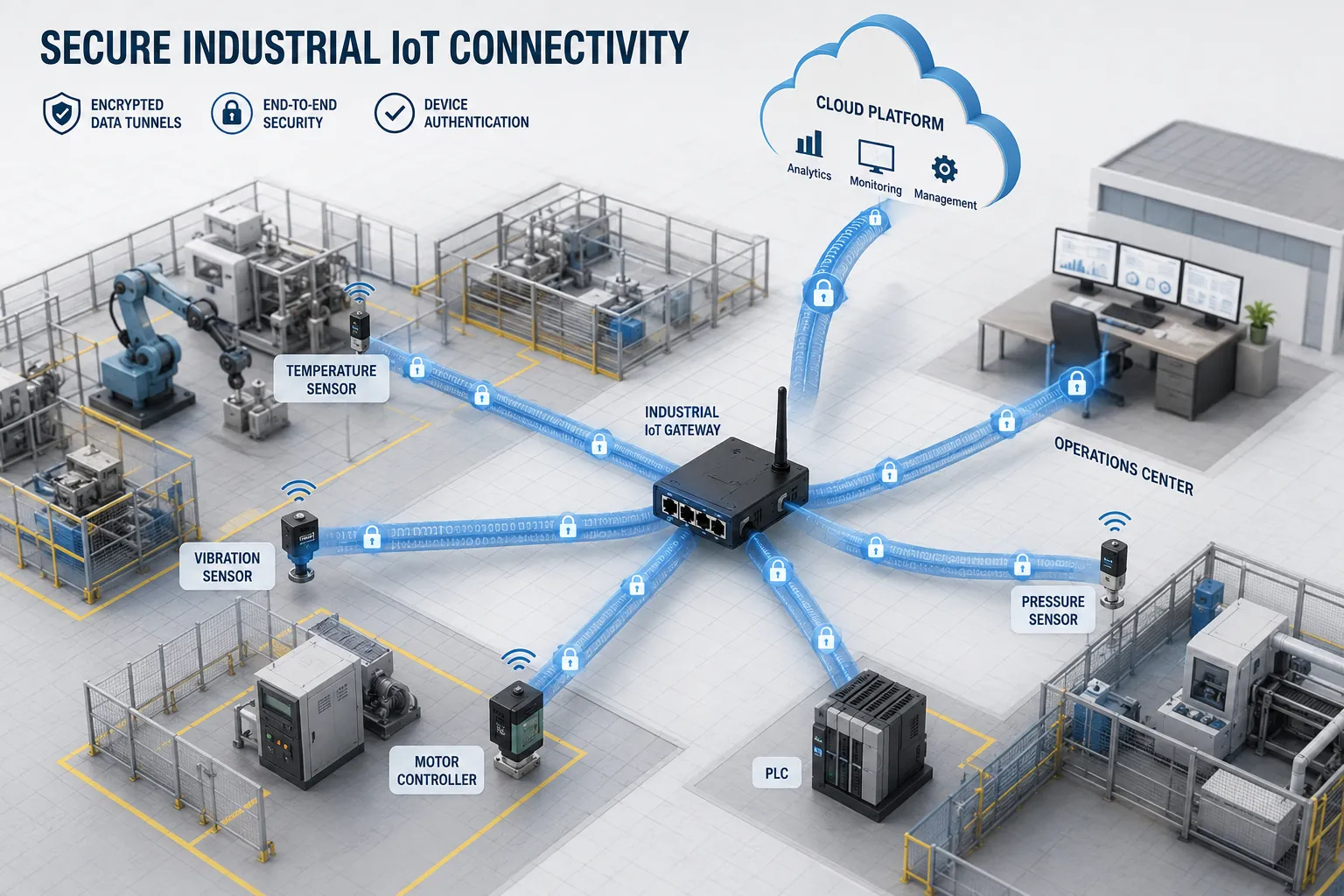
Implementing effective industrial IoT security requires a systematic approach that addresses both technical controls and operational procedures.
Complete Asset Inventory
Start by cataloging every connected device in your manufacturing environment. This includes obvious IoT devices like sensors and controllers, but also less obvious connected equipment like HVAC systems, security cameras, and network printers. You can’t protect what you don’t know exists.
Document each device’s manufacturer, model, firmware version, network connections, and criticality to operations. This inventory becomes the foundation for all other security activities and should be updated whenever new devices are added or existing ones are modified.
Network Segmentation Strategy
Separate your operational technology (OT) networks from corporate IT networks using firewalls and VLANs. This prevents attackers who compromise office systems from easily accessing manufacturing equipment. Within OT networks, create additional segments based on criticality and function.
For example, safety-critical control systems should be on a separate network segment from less critical monitoring devices. This layered approach limits the potential impact of any single compromise and makes it easier to implement appropriate security controls for each type of system.
Firmware Management Program
Establish procedures for tracking and updating firmware on all industrial IoT devices. This includes maintaining an inventory of current firmware versions, monitoring vendor security advisories, and testing updates in non-production environments before deployment.
Create a risk-based approach to firmware updates that prioritizes critical security patches while considering operational impact. Some updates can be scheduled during planned maintenance windows, while others may require emergency change procedures for severe vulnerabilities.
Strong Device Authentication
Replace default passwords on all devices and implement strong authentication mechanisms where possible. For devices that support it, use certificate-based authentication or multi-factor authentication. For legacy devices with limited authentication options, consider using network-based access controls.
Document authentication credentials securely and ensure they’re changed regularly according to your organization’s password policy. Avoid sharing credentials between multiple devices, as this increases the impact of any single compromise.
Encryption and Secure Communications
Implement encryption for all network communications between industrial IoT devices and control systems. This may require upgrading older devices or adding security gateways that can encrypt communications on behalf of legacy equipment.
Pay special attention to wireless communications, which are particularly vulnerable to interception. Use WPA3 or equivalent encryption for Wi-Fi networks, and consider VPN connections for devices that communicate over public networks.
Continuous Monitoring and Detection
Deploy monitoring tools that can detect unusual network activity, unauthorized device connections, and potential security incidents in your industrial environment. This includes both network-based monitoring and endpoint detection on supported devices.
Configure alerting for critical security events, but be careful to tune alerts appropriately for industrial environments. False alarms that trigger during normal operations can lead to alert fatigue and missed real threats.
How Much Does Industrial IoT Security Cost
Industrial IoT security costs vary significantly based on the size of your manufacturing operation, the complexity of your equipment, and your current security maturity level. Small manufacturers might spend $50,000 to $150,000 annually on industrial cybersecurity, while large facilities can invest millions.
Initial Assessment and Planning
Most organizations start with a security assessment that costs $25,000 to $100,000 depending on facility size and complexity. This includes asset inventory, vulnerability scanning, and development of a security roadmap. While this represents a significant upfront investment, it prevents much more expensive reactive security measures later.
Technology Infrastructure
Network segmentation equipment, security monitoring tools, and encryption gateways typically cost $100,000 to $500,000 for a mid-sized manufacturing facility. However, many of these investments pay for themselves through reduced downtime and improved operational efficiency.
Ongoing Operations
Annual costs for managed security services, software licenses, and staff training range from $75,000 to $300,000 for most manufacturers. Organizations with internal cybersecurity expertise can reduce these costs, but many find that outsourcing to specialized providers offers better coverage and peace of mind.
The cost of not implementing proper industrial IoT security can be much higher. Manufacturing downtime costs an average of $50,000 per hour according to industry studies, and a single successful cyberattack can result in days or weeks of production disruption.
Industrial IoT Security Tools and Software Options
Several categories of security tools are specifically designed for industrial environments and can help protect connected manufacturing devices.
Industrial Firewalls and Network Security
Purpose-built industrial firewalls understand operational technology protocols and can inspect traffic between industrial IoT devices without introducing unacceptable latency. These differ from traditional IT firewalls by supporting industrial communication protocols and providing deterministic performance.
Popular options include solutions from Fortinet, Palo Alto Networks, and specialized industrial security vendors. These tools typically cost $10,000 to $50,000 per installation depending on throughput requirements and feature sets.
Asset Discovery and Inventory Tools
Specialized tools can automatically discover and catalog industrial IoT devices on your network, identifying device types, firmware versions, and potential vulnerabilities. This is particularly valuable in complex manufacturing environments where manual inventory is impractical.
Leading solutions include Claroty, Dragos, and Nozomi Networks, with annual licensing costs ranging from $25,000 to $100,000 based on the number of monitored devices.
Industrial Endpoint Protection
Some industrial IoT devices can run lightweight security agents that provide real-time protection and monitoring. However, many operational technology systems cannot support traditional endpoint protection due to performance or compatibility constraints.
For devices that can support endpoint protection, industrial-specific solutions are available from vendors like CrowdStrike and Microsoft, typically costing $50 to $200 per protected endpoint annually.
Security Information and Event Management (SIEM)
Industrial SIEM solutions aggregate security events from across your manufacturing environment and use specialized analytics to detect threats relevant to operational technology. These systems understand industrial protocols and normal operational patterns.
Enterprise SIEM solutions suitable for industrial environments start around $100,000 annually for mid-sized deployments, with costs scaling based on data volume and advanced analytics features.
Industrial IoT vs Operational Technology Security
While industrial IoT security and operational technology (OT) security are closely related, they address different aspects of manufacturing cybersecurity and require complementary approaches.
Scope Differences
Operational technology security focuses on protecting the control systems, SCADA networks, and industrial protocols that directly manage manufacturing processes. Industrial IoT security specifically addresses the newer generation of connected sensors, smart devices, and cloud-connected equipment that provide data and insights but may not directly control operations.
Risk Profiles
OT security typically deals with systems that have direct safety and production impact, while industrial IoT devices often provide monitoring and optimization functions. However, compromised IoT devices can be used as entry points to access more critical OT systems, making both equally important from a security perspective.
Implementation Approaches
OT security often relies heavily on network segmentation and air-gapped systems to protect critical control functions. Industrial IoT security must balance connectivity requirements with protection, as these devices are specifically designed to communicate with cloud services and enterprise systems.
Compliance Requirements
Both areas are subject to industrial cybersecurity standards like IEC 62443 and NIST frameworks, but the specific controls and implementation guidance may differ based on the criticality and function of the systems involved.
What Happens If Industrial IoT Devices Get Hacked

The consequences of compromised industrial IoT devices can range from minor operational disruptions to catastrophic safety incidents, depending on the affected systems and the attacker’s objectives.
Production Disruptions
Attackers who gain control of manufacturing IoT devices can disrupt production by providing false sensor readings, triggering unnecessary shutdowns, or preventing normal operations. Even temporary disruptions can cost manufacturers thousands of dollars per minute in lost production.
Data Theft and Espionage
Industrial IoT devices often have access to sensitive operational data, including production schedules, quality metrics, and process parameters. Competitors or nation-state actors may target this information for economic or strategic advantage.
Safety Hazards
Compromised safety sensors or control devices can create dangerous conditions for workers or equipment. Attackers could disable safety interlocks, provide false readings from gas detectors, or interfere with emergency shutdown systems.
Ransomware and Extortion
Cybercriminals increasingly target manufacturing facilities with ransomware attacks that encrypt critical data or lock operators out of control systems. These attacks can shut down entire facilities until ransom payments are made or systems are restored from backups.
Long-term Operational Impact
Beyond immediate disruptions, successful attacks can damage customer confidence, trigger regulatory investigations, and require expensive remediation efforts. Some manufacturers have spent millions of dollars recovering from major cybersecurity incidents.
Industrial IoT Security Compliance Requirements
Manufacturing organizations must comply with various cybersecurity standards and regulations that specifically address industrial IoT and operational technology security.
IEC 62443 Standards
The IEC 62443 series provides comprehensive cybersecurity standards for industrial automation and control systems. These standards define security levels, risk assessment procedures, and specific technical controls for industrial environments including IoT devices.
Compliance with IEC 62443 is increasingly required by insurance providers and is considered the gold standard for industrial cybersecurity. The standards address the entire lifecycle of industrial systems from design through decommissioning.
NIST Cybersecurity Framework
The NIST framework provides a risk-based approach to cybersecurity that many manufacturers use to structure their industrial IoT security programs. The framework’s five functions (Identify, Protect, Detect, Respond, Recover) map well to industrial environments.
Industry-Specific Requirements
Certain manufacturing sectors have additional compliance requirements. For example, chemical facilities may need to comply with CFATS regulations, while defense contractors must meet NIST 800-171 or CMMC requirements that extend to their industrial systems.
International Standards
Manufacturers with global operations may need to comply with additional standards like ISO 27001 for information security management or regional regulations like the EU’s NIS Directive for critical infrastructure protection.
Securing Legacy Manufacturing Equipment
Many manufacturing facilities operate equipment that’s decades old but still critical to production. Connecting this legacy equipment to modern networks requires special security considerations.
Risk Assessment Approach
Start by evaluating which legacy systems truly need network connectivity and what business value that connectivity provides. Some equipment may be better left isolated if the security risks outweigh the operational benefits.
For equipment that must be connected, document all known vulnerabilities and limitations. Legacy systems often can’t be patched or updated, so you’ll need compensating controls to manage risks.
Network Isolation Strategies
Use security gateways or industrial DMZ networks to provide controlled connectivity for legacy equipment. These solutions can translate between legacy protocols and modern secure communications without requiring changes to the original equipment.
Consider one-way data flows where possible, allowing legacy equipment to send monitoring data to modern systems without accepting inbound connections that could be exploited by attackers.
Compensating Controls
When legacy equipment can’t support modern security features, implement additional monitoring and access controls at the network level. This might include dedicated firewalls, intrusion detection systems, or physical security measures for critical legacy systems.
Upgrade Planning
Develop a long-term strategy for replacing or upgrading legacy equipment with more secure alternatives. While this requires significant capital investment, the security and operational benefits often justify the costs over time.
Common Industrial IoT Security Mistakes
Many manufacturers make predictable mistakes when implementing industrial IoT security, often due to applying traditional IT security approaches to operational technology environments.
Treating IoT Devices Like IT Equipment
Industrial IoT devices have different performance, availability, and safety requirements than typical IT equipment. Applying standard IT security policies without considering operational impact can cause production disruptions or create safety hazards.
Inadequate Change Management
Manufacturing environments require strict change control procedures, but many organizations fail to extend these procedures to cybersecurity updates. Uncoordinated security changes can disrupt operations or create new vulnerabilities.
Over-reliance on Perimeter Security
Many manufacturers assume that firewalls and network segmentation alone will protect their industrial IoT devices. However, attackers who gain initial access through other means can often move laterally through poorly secured internal networks.
Ignoring Vendor Security Practices
Organizations often focus on their own security measures while overlooking the security practices of their industrial IoT device vendors. Compromised vendors can introduce vulnerabilities through supply chain attacks or poor product security design.
Insufficient Staff Training
Industrial IoT security requires specialized knowledge that combines cybersecurity expertise with operational technology understanding. Many organizations underestimate the training required for their staff to effectively manage these hybrid environments.
Industrial IoT Security for Small vs Large Manufacturers
The fundamental security principles are the same regardless of organization size, but the implementation approaches and available resources differ significantly between small and large manufacturers.
Resource Constraints
Small manufacturers typically lack dedicated cybersecurity staff and must rely on external expertise or multi-skilled personnel who handle both IT and OT responsibilities. This requires security solutions that are easier to manage and don’t require specialized cybersecurity expertise for day-to-day operations.
Large manufacturers can invest in dedicated industrial cybersecurity teams and more sophisticated security tools, but they also face greater complexity with multiple facilities, diverse equipment types, and more extensive regulatory requirements.
Risk Tolerance
Small manufacturers often have less redundancy in their operations, making them more vulnerable to disruptions from both cyberattacks and overly aggressive security measures. They need security approaches that prioritize operational continuity while still providing adequate protection.
Compliance Requirements
Both small and large manufacturers may face the same regulatory requirements, but smaller organizations often struggle more with compliance due to limited resources and expertise. They benefit from standardized security frameworks and managed security services.
Technology Approaches
Small manufacturers typically prefer cloud-based security services and simple-to-deploy solutions that don’t require extensive on-site infrastructure. Large manufacturers may implement more complex on-premises security architectures with greater customization and control.