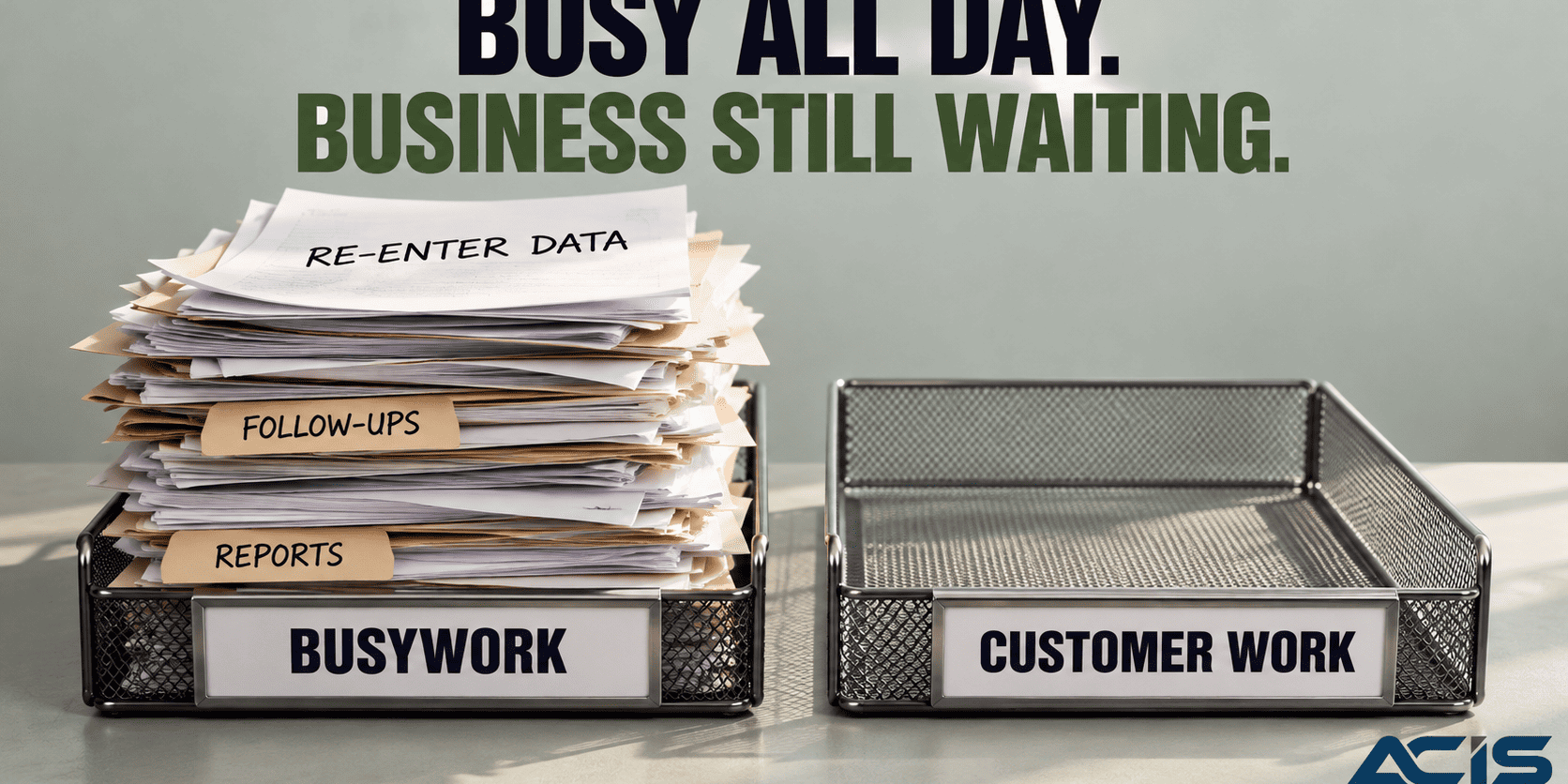

Every Production Order Creates Work Beyond the Shop Floor
A production order does not start or end on the shop floor. It starts with an email, a phone call, or a portal submission, and it does not close until someone has entered, checked, approved, and filed information about it in at least three or four different places.

Think about one mid-size job: a repeat customer orders 500 custom brackets. Before a single machine runs, someone reviews the request, checks the drawing against prior specs, pulls pricing history, and drafts a quote. After the customer approves it, someone else re-enters that same order into the ERP system, schedules it against existing jobs, and notifies purchasing, production, and quality. None of that work shows up on a job cost report labeled “materials” or “machine hours,” but it still costs real money.
That is the core problem with how most shops calculate the cost of an order. Direct costs get tracked closely because they are easy to see on a traveler or a time card. Administrative costs get absorbed into “overhead” and never get measured order by order, which means nobody notices how much they have grown until headcount, overtime, or customer complaints force the issue.
What Are Manufacturing Administrative Costs?
Manufacturing administrative costs are the labor hours and related expenses spent handling information about an order rather than physically producing it. This includes quoting, data entry, scheduling communication, purchasing coordination, status reporting, quality paperwork, and invoicing.
These costs are different from manufacturing overhead, even though people often use the terms loosely. Here is how they compare:
| Category | What it covers | Example |
|---|---|---|
| Manufacturing overhead | Facility, equipment, utilities, indirect materials, indirect labor tied to production | Machine depreciation, factory electricity, maintenance staff |
| Manufacturing administrative costs | Labor spent managing order information and coordination | Quote prep, order entry, status reports, shipping paperwork |
Overhead is mostly about keeping the plant physically running. Administrative cost is about keeping information flowing correctly between people and systems. A shop can have excellent overhead control (efficient equipment, low energy waste) and still bleed money through administrative cost, because the two live in different parts of the business.
Administrative cost tends to run highest in industries built on custom or configure-to-order work: job shops, contract manufacturers, metal fabricators, and makers of engineered-to-order equipment. These businesses rarely run the same order twice, so every job restarts the quoting, documentation, and coordination cycle from scratch. High-volume, standardized manufacturers (think bottling or basic injection molding) usually carry lower administrative cost per unit because the same paperwork template covers thousands of units at once.
Step One: RFQ Intake and Quote Preparation
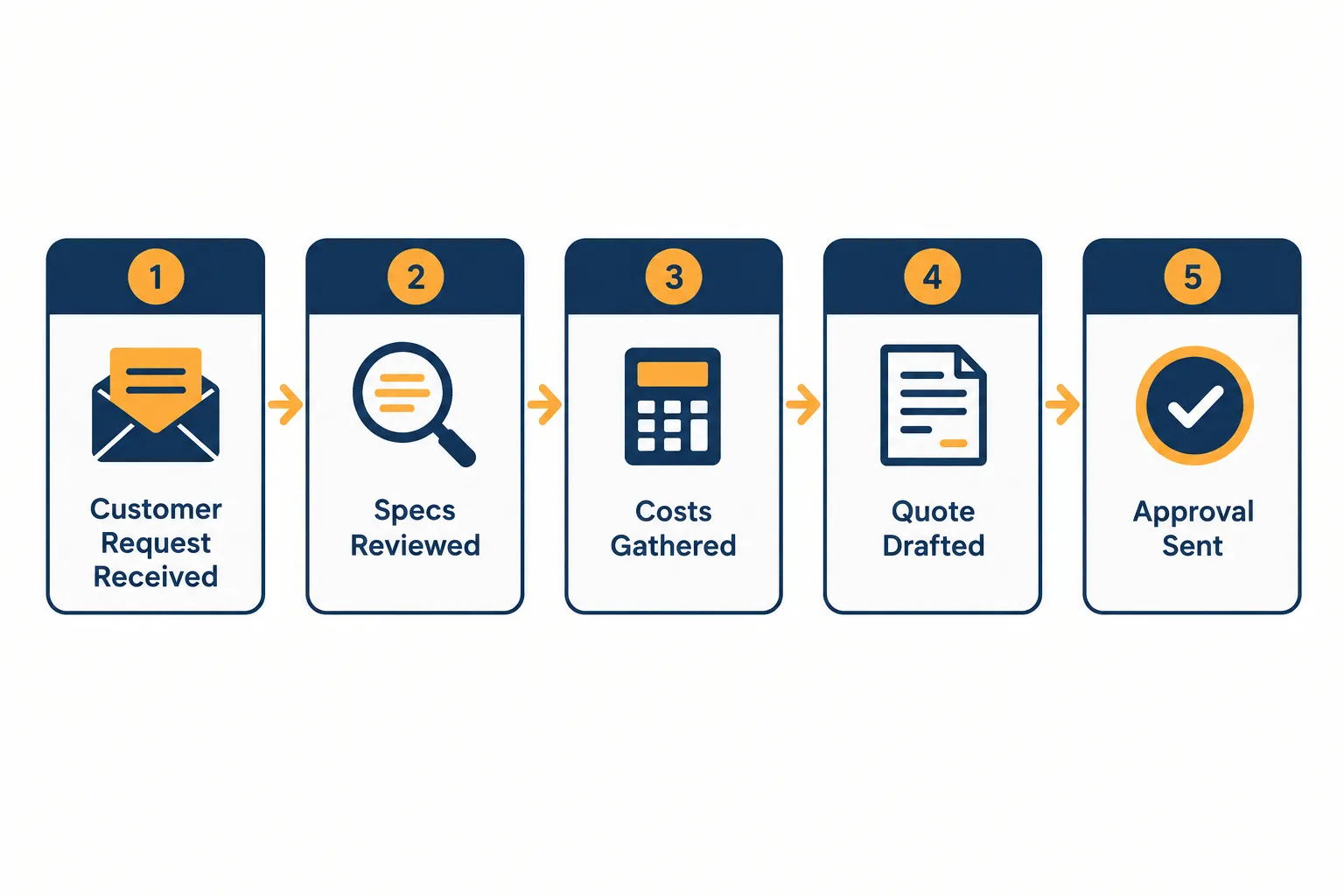
Quoting is almost always the first place manufacturing administrative costs show up, because every request for quote requires someone to interpret, verify, and price a job before any revenue exists. This step happens before you know if the order will even close.
A typical RFQ cycle includes:
- Reviewing the customer’s request and attached drawings or specs
- Checking specifications against prior jobs, tolerances, or material requirements
- Gathering pricing for materials, outside processing, and labor
- Drafting a formal quote document
- Routing the quote for internal approval before it goes to the customer
- Following up with the customer and revising the quote if needed
If an estimator spends 30 minutes on a routine RFQ and your shop handles 40 of them a month, that is 20 hours of labor before a single order is won. Shops quoting complex or engineered products often see this number double or triple, because specification review alone can take an hour or more per request.
Step Two: Order Entry and Production Planning
Order entry is the step where an approved quote becomes a live production order, and it is also where duplicate data entry most often starts. Someone has to take the agreed terms and manually build a corresponding record in the ERP, the production schedule, and sometimes a separate spreadsheet.
Common tasks at this stage:
- Entering the approved order details into the ERP or job tracking system
- Creating a job traveler or work order packet
- Coordinating the production schedule around existing jobs and capacity
- Communicating special requirements to supervisors (tolerances, finish, packaging)
- Confirming due dates with the customer or sales team
Here is the catch most shops miss: if the quote lived in one system and the order lives in another, someone retypes the same specifications, quantities, and pricing a second time. That retyping is where transcription errors creep in, and those errors often surface much later, during production or shipping, when they are far more expensive to fix.
Step Three: Purchasing and Inventory Coordination
Purchasing coordination is a recurring administrative load because material availability has to be checked and rechecked every time a new order enters the schedule. Even with an ERP in place, many shops still verify stock manually before committing to a production date.
This step usually involves:
- Checking current inventory against the bill of materials for the new order
- Updating inventory records when counts do not match the system
- Creating and sending purchase requests for shortages
- Following up with suppliers on lead times and confirmations
- Re-checking availability if the order quantity or date changes
A purchasing coordinator who manually checks stock for 15 orders a week, at 10 minutes each, spends over 2 hours a week on availability checks alone, before a single purchase order gets issued. Multiply that across a full purchasing team and the hours add up fast.
Step Four: Production Updates and Reporting
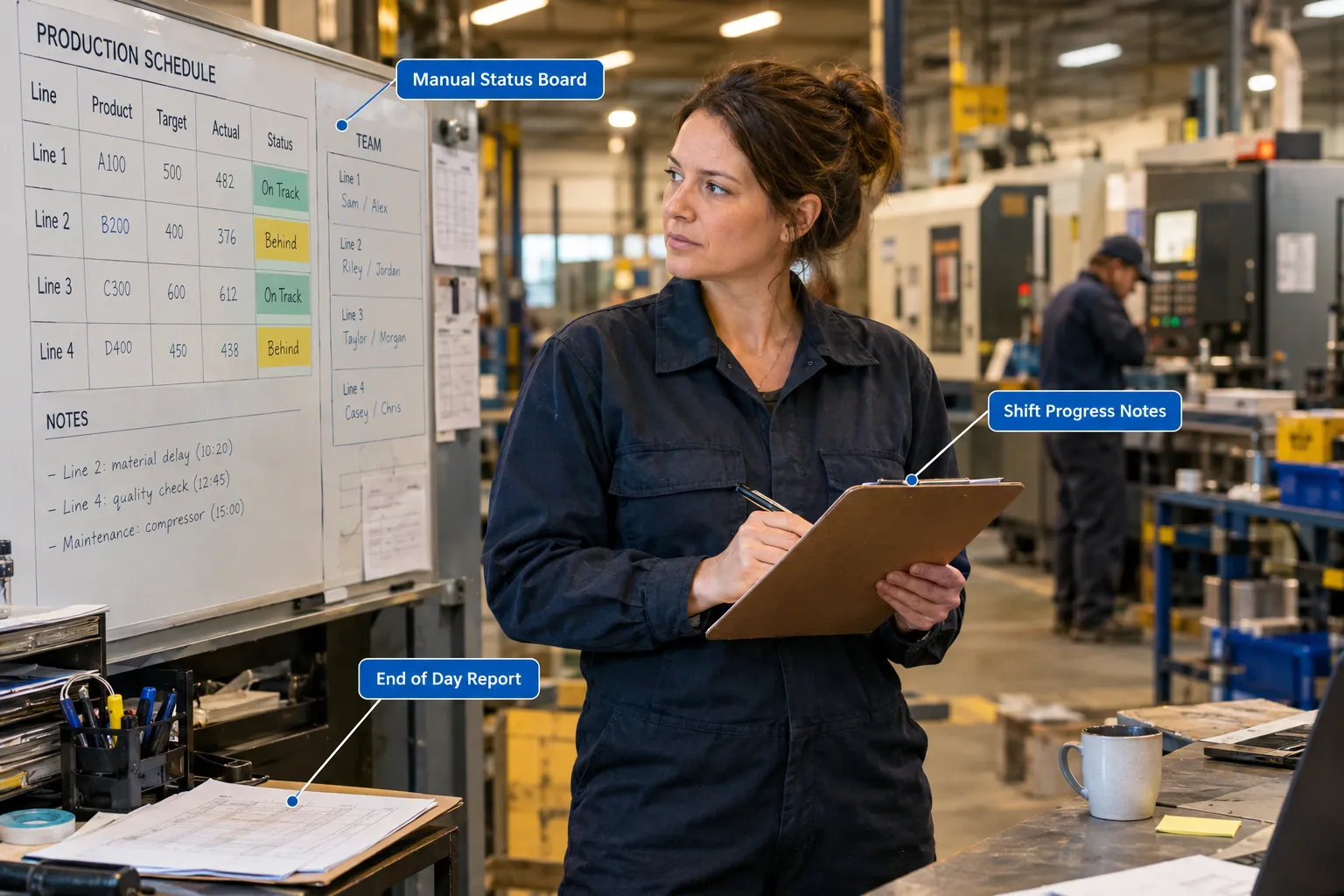
Production reporting consumes administrative hours because status information rarely lives in one place, so someone has to collect it from the floor and reassemble it for management or customers. This is one of the most repetitive tasks in the entire order cycle.
Typical reporting tasks include:
- Collecting progress updates from supervisors or operators
- Consolidating status across multiple jobs into a single report
- Updating customers on order progress by phone or email
- Preparing daily, weekly, or shift-based production summaries
- Reconciling the paper or whiteboard schedule with the ERP system
If a supervisor spends 20 minutes compiling an end-of-shift report, and that happens three shifts a day, five days a week, that is roughly 5 hours a week spent on reporting alone, across one supervisor role. In plants running multiple lines, this multiplies quickly.
Step Five: Quality Documentation and Approvals
Quality documentation adds administrative load because inspection results, nonconformance reports, and supporting files all have to be captured, organized, and routed for approval, often across paper forms and digital systems at the same time. This work is necessary for compliance and customer requirements, but it is rarely efficient by default.
Recurring quality tasks include:
- Recording inspection results for incoming materials and finished goods
- Documenting nonconformances and corrective actions
- Attaching certificates, test reports, or supporting files to the job record
- Routing documentation for supervisor or customer approval
- Filing completed records for audit or traceability purposes
A shop running ISO-style quality requirements can easily spend 30 to 60 minutes per order just assembling and filing the documentation package, especially for regulated industries like aerospace, medical, or automotive supply.
Step Six: Shipping, Invoicing, and Order Closure
Order closure is where administrative cost often peaks, because shipping and accounting both need information that already exists somewhere else in the system, yet it frequently has to be re-entered or re-confirmed. This is also the last chance for small errors from earlier steps to surface.
Closing an order usually requires:
- Confirming final quantities and packaging details for shipment
- Preparing shipping documents and customer notifications
- Updating the order record to “complete” across systems
- Pulling order details into an invoice
- Reconciling the invoice against the original quote and any change orders
If pricing, quantities, or specs changed mid-job and that change was not clearly communicated earlier, accounting may spend extra time tracking down the correct numbers before billing. That delay pushes out your cash collection, not just your paperwork.
How Much Do Administrative Costs Add to Manufacturing? Use This Calculator
Administrative costs add up through labor hours spent on repetitive information handling, and you can estimate the monthly cost with a simple formula rather than guessing. This gives you a defensible number to bring into a budget or efficiency conversation.
Use this two-step formula:
- Minutes per task × monthly frequency × employees involved ÷ 60 = monthly labor hours
- Monthly labor hours × loaded hourly labor cost = estimated monthly labor cost
The loaded hourly rate matters here. It should reflect wages plus payroll taxes, benefits, and other employment costs, not just take-home pay. Using take-home pay alone will understate the real cost of the work.
Example: Order entry takes 15 minutes, happens 60 times a month, and involves 2 employees.
15 x 60 x 2 ÷ 60 = 30 monthly labor hours.
At a loaded rate of $38 per hour, that is roughly $1,140 a month, for one workflow, in one department.
Is this cost included in your product price? It should be, even if it is buried inside a general overhead rate rather than broken out by order. Custom and small batch orders carry more administrative cost per unit than bulk orders, because quoting, documentation, and setup communication happen at nearly the same intensity whether you are making 10 units or 10,000. If your pricing does not account for that difference, small custom jobs are likely underpriced relative to the real labor behind them.
The Hidden Costs Beyond Labor
Labor hours are only the visible part of manufacturing administrative costs. The less visible part shows up as delay, rework, and lost trust, and it is harder to put a clean dollar figure on it, but it is real.
Watch for these patterns:
- Correction time: fixing a transcription error after it has already affected a purchase order or shipment
- Duplicate records: the same order existing slightly differently in two systems, with no clear source of truth
- Delayed decisions: a manager waiting on a report that should have taken minutes to compile
- Late customer updates: a customer calling in because your team has not updated them first
- Rework: production starting on outdated specs because a change did not reach the floor in time
- Bottlenecks: one person becoming the single point of failure for a whole workflow because only they know the manual process
These costs are harder to measure precisely, so avoid assigning them a specific dollar figure unless you can track it directly through your own records. What you can say with confidence is that every one of these patterns adds time and risk to an order that should have closed cleanly.
Why Are Manufacturing Admin Costs So High?
Manufacturing admin costs run high mainly because the same order information gets handled more than once, by more than one person, in more than one system, with no single source of truth. Each handoff is a chance for delay or error, and most shops have several handoffs per order.
Common mistakes that inflate this cost:
- Treating administrative labor as a fixed overhead percentage instead of measuring it per workflow
- Letting quotes, orders, and schedules live in separate systems with no connection between them
- Assuming paper forms and spreadsheets are “free” because they do not carry a software cost
- Only counting direct labor and materials when calculating true order cost
- Adding headcount to handle growing paperwork instead of fixing the workflow causing it
If you recognize two or more of these in your own operation, that is a strong signal your administrative cost is higher than your financial reports currently show.
How to Track and Measure Manufacturing Administrative Costs
You track manufacturing administrative costs by timing the actual tasks involved in a production order, not by estimating from memory. Start with one workflow and measure it directly for two to four weeks before drawing conclusions.
For each task, record:
- Frequency: how often the task happens per week or month
- Time per task: how long it actually takes, timed if possible
- Employees involved: how many people touch this task
- Error rate: how often the task has to be redone or corrected
- Business impact: what happens downstream if this task is late or wrong
Smaller manufacturers and startups often skip this step because formal time tracking feels like overkill at a small scale. In practice, a smaller team usually means fewer people covering more administrative steps each, which makes the per-person cost of inefficient processes even more noticeable, not less.
How to Reduce Manufacturing Administrative Expenses With Workflow Automation
You reduce manufacturing administrative expenses by automating the repetitive, rule-based parts of order handling while leaving judgment calls and exceptions to your team. This is not about removing people from the process. It is about removing retyping, re-checking, and re-formatting from their day.

Realistic opportunities include:
- Extracting key details from RFQs and customer documents instead of reading and retyping them
- Transferring approved order data between your quoting tool, ERP, and scheduling system
- Triggering automatic notifications when material falls below a threshold or an approval is waiting
- Generating routine production summaries from data that already exists in your systems
- Organizing quality documentation into a searchable, linked record instead of scattered files
- Updating order status automatically as a job moves through production stages
- Preparing shipping and invoicing data from the original order record instead of re-entering it
AI tools are a good fit for interpreting unstructured information, like reading a PDF drawing and pulling out dimensions or quantities. Traditional workflow automation is usually the better fit for predictable, rule-based system updates, like moving an approved order from your CRM into your ERP every time a specific trigger occurs. Most manufacturers get the best results from a combination of both, not one tool trying to do everything.
How to Find the Most Expensive Administrative Bottleneck
The most expensive administrative bottleneck is usually your highest-volume, most error-prone workflow, not the one that feels most frustrating in the moment. Find it by comparing frequency, time per task, and error rate across the workflows you measured earlier.
Use this quick decision rule:
- Choose a workflow to fix first if it happens dozens of times a month, involves more than one department, and has a known error or delay history.
- Hold off on a workflow if it happens rarely, involves only one person, or already runs through a reliable automated step.
Start with one high-volume workflow, prove the time and cost savings, then move to the next one. Trying to automate the entire production process at once usually stalls out because it touches too many systems and approval chains simultaneously.
Reduce Administrative Work Without Replacing Your Core Systems
You can often reduce administrative work by connecting the systems you already use rather than replacing your ERP, CRM, inventory, scheduling, or accounting software. Integration moves data automatically between systems that currently require manual re-entry, subject to the interfaces each system actually supports.
This matters because most manufacturers have already invested years of data and staff training into their current systems. A connected workflow that links your existing ERP to your accounting software, for example, can eliminate the manual step of retyping completed orders into invoices, without forcing anyone to learn a new platform. The technical limitation to plan for is that not every older or highly customized system offers a reliable connection point, so an honest assessment of what is actually possible should come before any commitment to a specific fix.
The Goal: Lower Manufacturing Administrative Costs Per Order
The real goal is not to eliminate paperwork entirely. It is to lower the administrative cost attached to each order so your team spends more time on production, quality, and customers, and less time moving the same information from one screen to another.
When you reduce unnecessary information handling, you free up hours that were previously locked into retyping, re-checking, and re-explaining. Those hours can go toward higher-value work: catching a quality issue earlier, following up with a customer proactively, or taking on another order without adding headcount. That shift, order by order, is what actually improves your operational efficiency over time.
Find the Administrative Costs Hiding in Your Production Workflow
AlphaCIS Manufacturing can help identify repetitive work surrounding production orders and evaluate where workflow automation, system integration, and AI can reduce manual effort. We look at what your team actually does order by order, then show you where automation can realistically help.
FAQ
What are manufacturing administrative costs?
They are the labor hours and related expenses spent handling order information, such as quoting, data entry, approvals, reporting, and invoicing, as opposed to the direct costs of materials, machine time, and production labor.
How much do administrative costs add to manufacturing?
It varies by shop, but you can estimate it with a formula: minutes per task x monthly frequency x employees involved divided by 60, multiplied by your loaded hourly labor cost. Many shops find this adds up to hundreds or thousands of dollars a month per workflow once they measure it directly.
What is the difference between manufacturing overhead and administrative costs?
Manufacturing overhead covers facility, equipment, and indirect production costs. Administrative costs specifically cover the labor spent managing order information and coordination between departments.
Is manufacturing admin cost included in the product price?
It should be, usually folded into an overhead rate applied to each job. If your pricing only accounts for materials and direct labor, custom and small batch orders are likely underpriced relative to their true administrative burden.
Do small batch orders cost more to administer than bulk orders?
Yes, generally. Quoting, documentation, and coordination take nearly the same amount of time whether an order is for 10 units or 10,000, so the administrative cost per unit is higher on small, custom orders.
What should startups and small manufacturers know about administrative costs?
Smaller teams often absorb administrative work across fewer people, which can make inefficient processes even more costly on a per-person basis. Measuring time spent on quoting and order entry early helps avoid baking bad habits into the business as it grows.
How do I calculate manufacturing administrative costs for my shop?
Pick one workflow, time it directly for a few weeks, and apply the formula: minutes per task x monthly frequency x employees involved divided by 60, then multiply by your loaded hourly rate.
What is the biggest mistake in calculating manufacturing overhead?
Treating administrative labor as a flat overhead percentage instead of measuring specific workflows. This hides which tasks are actually driving the cost and makes it hard to prioritize fixes.