

Sixty-eight percent of manufacturing cyberattacks now originate from compromised third-party vendor credentials, yet most plants still rely on shared passwords and unrestricted remote access for maintenance and support. This approach puts your entire operation at risk while creating compliance headaches that can cost millions in downtime and regulatory penalties.

Key Takeaways
- Third-party vendor access creates the largest cybersecurity blind spot in manufacturing operations
- Unmanaged vendor remote access can lead to production shutdowns, data breaches, and compliance violations
- Least privilege access and time-limited sessions reduce risk by 85% while maintaining operational efficiency
- Multi-factor authentication and session monitoring are non-negotiable for secure remote maintenance
- Zero Trust Network Access (ZTNA) provides better security than traditional VPNs for vendor connections
- Regular access audits and automated credential rotation prevent long-term security exposure
- Proper vendor access policies balance operational needs with cybersecurity requirements
- Manufacturing compliance standards increasingly require documented vendor access controls
- Incident response plans must include procedures for compromised vendor credentials
- Different vendor types require tailored access controls based on their specific operational needs
What Is Third-Party Vendor Access and Why Does It Matter in Manufacturing
Third-party vendor access refers to the remote connections that external service providers, equipment manufacturers, and maintenance contractors need to support your manufacturing operations. This includes everything from machine diagnostics and software updates to emergency repairs and system optimization.
Manufacturing facilities depend heavily on vendor support because modern production equipment is incredibly complex. Your CNC machines, robotic systems, and process control equipment often require specialized knowledge that only the original manufacturers possess. When something breaks at 2 AM, you need that vendor to connect remotely and fix the problem fast.
The challenge is that traditional vendor access methods create massive security gaps. Most manufacturers still use shared passwords, permanent VPN connections, or direct internet access to critical systems. This approach worked when manufacturing networks were isolated, but today’s connected factories face the same cyber threats as any other business.
The stakes are higher in manufacturing because a security breach doesn’t just mean lost data; it means stopped production. A single compromised vendor account can shut down your entire facility, costing thousands of dollars per hour in lost productivity. Even worse, attackers can use vendor access to steal intellectual property, manipulate quality systems, or cause safety incidents.
Modern manufacturing compliance standards recognize this risk. Frameworks like NIST, ISO 27001, and industry-specific regulations now require documented vendor access controls. Cyber insurance policies are also getting stricter about third-party access management, often requiring specific security measures to maintain coverage.
What Are the Risks of Allowing Vendor Remote Access in Factories
Uncontrolled vendor remote access creates multiple attack vectors that can compromise your entire manufacturing operation. The most dangerous risk is lateral movement; once attackers gain access through a vendor account, they can often move freely through your network to reach critical systems.
Production system manipulation represents the most immediate threat. Attackers with vendor-level access can modify machine parameters, alter quality control settings, or trigger emergency shutdowns. These attacks are particularly dangerous because they can cause physical damage to equipment or create safety hazards for workers.
Intellectual property theft is another major concern. Vendor accounts often have access to production data, process parameters, and quality metrics that represent your competitive advantage. A breach can expose proprietary manufacturing processes, customer information, or product designs to competitors or foreign adversaries.

Ransomware attacks frequently target manufacturing facilities through vendor connections. Attackers know that manufacturers can’t afford extended downtime, making them more likely to pay ransoms quickly. The average manufacturing ransomware attack causes 23 days of downtime and costs $2.3 million in recovery expenses.
Compliance violations create long-term financial and operational risks. Many manufacturing facilities must comply with regulations like ITAR, FDA, or environmental standards that require strict access controls. A vendor-related breach can trigger regulatory investigations, fines, and mandatory security improvements that cost far more than prevention.
Supply chain contamination can occur when attackers use your vendor access to reach your suppliers or customers. This type of attack can damage business relationships and create liability issues that extend far beyond your own facility.
Common attack scenarios include credential stuffing (using stolen passwords from other breaches), social engineering (tricking vendors into revealing access information), and malware deployment through vendor connections. Each of these attack methods can succeed when vendor access lacks proper security controls.
How Do Manufacturers Balance Security with Giving Vendors Remote Access
The key to balancing security and operational efficiency is implementing controlled access rather than blocked access. Your vendors need to reach your systems, but they don’t need permanent, unrestricted connections that create ongoing security risks.
Time-limited access windows provide the best balance between security and functionality. Instead of giving vendors permanent access, create temporary connections that automatically expire after a specific period. Most maintenance tasks can be completed within 4-8 hours, so there’s no operational reason for vendors to maintain always-on access to your systems.
Role-based permissions ensure vendors can only access the systems they actually need to support. Your CNC machine vendor doesn’t need access to your quality management system, and your software provider doesn’t need control over physical equipment. Segmenting access by vendor role reduces risk without impacting their ability to provide support.
Scheduled maintenance windows allow you to coordinate vendor access with your production schedule. By clustering vendor activities during planned downtime, you can provide broader access when it won’t disrupt operations while maintaining tighter controls during production hours.
Supervised access sessions work well for high-risk activities or new vendor relationships. Having your IT staff monitor vendor sessions in real-time provides an extra security layer while allowing vendors to work effectively. This approach also creates learning opportunities for your internal team.
Standardized access procedures reduce both security risks and operational confusion. When all vendors follow the same request, approval, and connection process, your team can manage access more efficiently while maintaining consistent security standards.
The goal isn’t to make vendor access difficult; it’s to make it predictable and controlled. Vendors actually prefer clear, consistent access procedures over ad-hoc arrangements that can leave them waiting for approvals or dealing with connection problems during critical repairs.
Industrial Cybersecurity Best Practices for Vendor Access Control
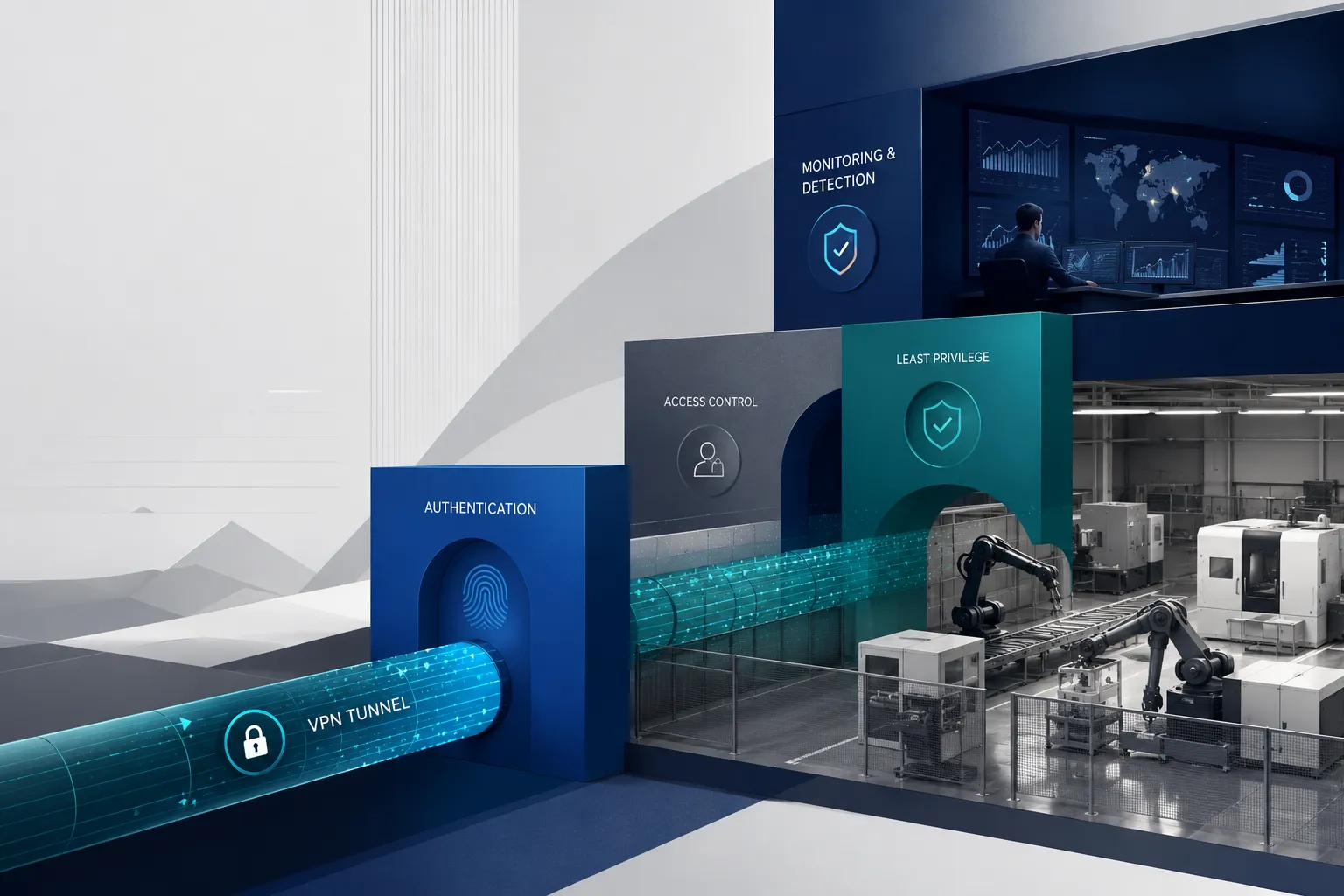
Effective vendor access control starts with multi-factor authentication (MFA) for all vendor connections. Password-only authentication is no longer sufficient given the sophistication of modern cyber threats. Require vendors to use authenticator apps, hardware tokens, or biometric verification in addition to passwords.
Network segmentation creates critical barriers between vendor access points and your most sensitive systems. Use firewalls, VLANs, or microsegmentation to ensure vendor connections can only reach the specific systems they need to support. This prevents lateral movement if a vendor account becomes compromised.
Session recording and monitoring provide visibility into vendor activities while creating accountability for both security and operational purposes. Record all vendor sessions and monitor them for unusual activity, unauthorized access attempts, or policy violations. This data also helps with troubleshooting and knowledge transfer.
Endpoint security requirements ensure vendor devices meet your security standards before connecting to your network. Require updated antivirus software, current operating system patches, and endpoint detection tools on any device that will access your systems. Consider providing dedicated vendor workstations for high-risk connections.
Credential management eliminates the security risks of shared passwords and static credentials. Use unique accounts for each vendor, rotate passwords regularly, and immediately disable access when vendor relationships end. Consider implementing privileged access management (PAM) solutions for automated credential rotation.
Access logging and auditing create the documentation needed for compliance and incident response. Log all vendor access attempts, successful connections, activities performed, and session durations. Review these logs regularly to identify unusual patterns or potential security issues.
Incident response procedures must include specific steps for vendor-related security events. Define how to quickly revoke vendor access, investigate potential breaches, and coordinate with vendors during security incidents. Practice these procedures regularly to ensure they work when needed.
Regular security assessments of vendor access controls help identify gaps before they become problems. Conduct quarterly reviews of vendor permissions, annual penetration testing of remote access systems, and ongoing vulnerability scans of vendor connection points.
How Much Does Vendor Access Management Software Cost
Vendor access management solutions typically cost between $15-50 per user per month for cloud-based platforms, with on-premises solutions ranging from $50,000-200,000 for initial licensing plus annual maintenance fees of 15-20% of the license cost.
Cloud-based solutions offer the most cost-effective entry point for small to mid-sized manufacturers. These platforms typically charge $15-25 per vendor user per month and include features like session recording, MFA integration, and basic reporting. Setup costs are minimal, and you can start with a small number of vendors and scale up as needed.
Enterprise platforms designed for large manufacturing operations cost $35-50 per user monthly but include advanced features like privileged access management, automated workflows, and integration with industrial control systems. These solutions often require 3-12 months for full implementation.
On-premises solutions require higher upfront investment but provide complete control over your vendor access infrastructure. Expect to spend $50,000-100,000 for a basic system supporting 50-100 vendors, or $150,000-300,000 for enterprise-grade platforms with advanced automation and integration capabilities.
Hidden costs can significantly impact your total investment. Factor in staff training ($5,000-15,000), system integration ($10,000-50,000), ongoing administration (0.5-1.0 FTE), and vendor onboarding time (2-4 hours per vendor initially).
ROI calculations should include both cost savings and risk reduction. The average manufacturing cybersecurity incident costs $3.2 million, while production downtime averages $50,000 per hour. A vendor access management system that prevents even one major incident typically pays for itself within the first year.
Most manufacturers find that cloud-based solutions provide the best value for organizations with fewer than 200 vendors, while larger operations benefit from on-premises or hybrid deployments that offer greater customization and control.
What’s the Difference Between VPN and Zero Trust for Vendor Access
Traditional VPNs create a tunnel that gives vendors network-level access once they authenticate, essentially treating them as trusted users on your internal network. Zero Trust Network Access (ZTNA) takes the opposite approach, verifying every access request and limiting vendors to specific applications rather than network segments.
VPN limitations become apparent in manufacturing environments where vendors need access to multiple systems across different network segments. Once connected via VPN, vendors can often reach systems beyond their authorized scope. VPNs also create performance bottlenecks and single points of failure that can impact critical maintenance activities.
ZTNA advantages include application-level access controls, better performance, and reduced attack surface. Instead of connecting to your network, vendors connect directly to specific applications or systems. This approach eliminates lateral movement risks and provides granular control over vendor activities.
Performance differences are particularly important for manufacturing applications. ZTNA solutions often provide faster connections because they don’t route all traffic through centralized VPN gateways. This improved performance is crucial for real-time diagnostics and control system interactions.
Scalability favors ZTNA for growing manufacturing operations. Adding new vendors or applications is simpler with ZTNA because you don’t need to manage network routing or subnet conflicts. Each vendor gets direct access to their authorized applications without impacting other users.
Cost considerations vary by deployment size. VPNs typically have lower initial costs but higher ongoing management overhead. ZTNA solutions cost more upfront but reduce administrative burden and provide better security outcomes. For most manufacturers, ZTNA delivers better ROI within 12-18 months.
Implementation complexity differs significantly between the two approaches. VPNs require network infrastructure changes and ongoing firewall management. ZTNA solutions can often be deployed without major network modifications, making them attractive for manufacturers with limited IT resources.
How Do I Set Up Least Privilege Access for Maintenance Contractors
Least privilege access means giving maintenance contractors the minimum permissions necessary to complete their specific tasks, nothing more. Start by cataloging exactly what systems, applications, and data each contractor type needs to access for their work.
Role-based access templates simplify least privilege implementation by creating standard permission sets for different contractor categories. Create separate templates for electrical contractors, mechanical maintenance, software support, and equipment vendors. Each template should specify exactly which systems that contractor type can access.
Task-specific permissions provide even more granular control for high-risk activities. A contractor updating PLC firmware needs different access than one performing routine calibration. Define permission sets based on specific maintenance tasks rather than broad contractor categories.
Time-bound access automatically enforces least privilege by limiting how long contractors can use elevated permissions. Most maintenance tasks can be completed within 4-8 hours, so there’s no security reason to grant longer access periods. Automatic expiration prevents forgotten accounts from creating ongoing risks.

System-level restrictions prevent contractors from accessing administrative functions they don’t need for maintenance work. Remove permissions for user management, system configuration, and data export unless specifically required for the maintenance task. Focus access on operational functions only.
Data access limitations protect sensitive information while allowing contractors to perform their work. Contractors typically need to read system parameters and logs but rarely need access to production data, quality records, or business information. Separate operational access from data access in your permission structure.
Approval workflows ensure least privilege decisions get proper review before implementation. Require supervisor approval for any access that exceeds standard templates, and document the business justification for expanded permissions. This process prevents privilege creep over time.
Regular access reviews verify that contractor permissions remain aligned with their actual work requirements. Quarterly reviews should examine what systems contractors actually accessed versus what they were authorized to access. Remove unused permissions and adjust templates based on actual usage patterns.
What Compliance Standards Apply to Vendor Access in Manufacturing
Manufacturing facilities must comply with various cybersecurity frameworks that include specific requirements for third-party access management. The most common standards include NIST Cybersecurity Framework, ISO 27001, and industry-specific regulations like FDA 21 CFR Part 11 for pharmaceutical manufacturing.
NIST Cybersecurity Framework requires manufacturers to identify, protect, detect, respond, and recover from cybersecurity threats, including those from third-party access. Specific requirements include access control (PR.AC), data security (PR.DS), and continuous monitoring (DE.CM) functions that directly impact vendor access management.
ISO 27001 mandates documented information security management systems that include supplier relationship security controls. Section A.15 specifically addresses information security in supplier relationships, requiring risk assessments, security agreements, and ongoing monitoring of third-party access.
FDA regulations for pharmaceutical and medical device manufacturers require validated computer systems with controlled access, audit trails, and electronic signatures. Vendor access to these systems must maintain data integrity and regulatory compliance throughout the maintenance process.
ITAR compliance for defense contractors includes strict requirements for controlling access to technical data and defense articles. Vendor access must be limited to authorized personnel with appropriate security clearances and cannot involve foreign nationals without specific approvals.
SOX compliance affects publicly traded manufacturers and requires controls over financial reporting systems. Vendor access to ERP, quality, or production systems that impact financial data must include appropriate segregation of duties and audit trails.
Cyber insurance requirements increasingly include specific mandates for third-party access controls. Many policies now require MFA, session monitoring, and documented vendor access procedures to maintain coverage. Failure to meet these requirements can void claims related to vendor-originated breaches.
State and local regulations may impose additional requirements depending on your location and industry sector. California’s SB-327, New York’s SHIELD Act, and similar state laws can impact vendor access requirements for manufacturers handling personal information.
How Do Manufacturers Monitor What Vendors Do on Their Systems
Effective vendor activity monitoring requires real-time visibility into vendor sessions combined with automated analysis to identify unusual or unauthorized activities. Modern monitoring solutions can track everything from login attempts to specific commands executed during vendor sessions.
Session recording captures complete vendor interactions for later review and compliance documentation. Record both screen activity and command-line interactions to create comprehensive audit trails. Store recordings in tamper-proof systems with appropriate retention periods for your compliance requirements.
Real-time alerting notifies security teams immediately when vendors perform high-risk activities or access unauthorized systems. Configure alerts for activities like administrative commands, data exports, system configuration changes, or access outside approved time windows.
Behavioral analytics establish baseline patterns for each vendor and alert on deviations that might indicate compromised credentials or malicious activity. Monitor factors like login times, systems accessed, commands used, and session duration to identify anomalies.
Command logging provides detailed records of every action vendors take during their sessions. This granular visibility is essential for troubleshooting, compliance auditing, and incident investigation. Ensure logs capture sufficient detail to reconstruct vendor activities if needed.
Network traffic analysis monitors data flows during vendor sessions to identify potential data exfiltration or unauthorized system communications. Look for unusual data volumes, connections to external systems, or traffic patterns that don’t match normal maintenance activities.
Automated compliance checking compares vendor activities against your security policies and compliance requirements in real-time. Automatically flag policy violations, unauthorized access attempts, or activities that require additional approval or documentation.
Integration with SIEM systems centralizes vendor activity monitoring with your broader security operations. This integration enables correlation between vendor activities and other security events, improving your ability to detect sophisticated attacks.
Regular monitoring reviews ensure your oversight processes remain effective as vendor relationships and system configurations evolve. Monthly reviews should examine monitoring coverage, alert effectiveness, and any gaps in visibility that need addressing.
What Should I Do If a Vendor’s Credentials Get Compromised
Immediate credential revocation is your priority when you suspect a vendor account compromise. Disable the affected account across all systems within minutes, not hours, to prevent further unauthorized access. Most modern access management systems allow instant credential suspension without impacting other vendor accounts.
Incident response activation should follow your established cybersecurity incident procedures with specific focus on vendor-related threats. Notify your incident response team, document the suspected compromise, and begin containment procedures to prevent lateral movement through your network.
Forensic investigation helps determine the scope and impact of the compromise. Examine session logs, system access records, and network traffic to understand what systems the attacker accessed and what actions they performed. This analysis guides your recovery efforts and helps prevent similar incidents.
System integrity verification ensures the compromised vendor didn’t modify critical systems or data during their unauthorized access. Check for unauthorized configuration changes, malware installation, or data modifications that could impact production or safety systems.
Communication protocols should include notification to the affected vendor, relevant stakeholders, and potentially regulatory authorities depending on your compliance requirements. Coordinate with the vendor to understand how their credentials were compromised and what steps they’re taking to prevent recurrence.
Network segmentation review examines whether existing access controls properly limited the impact of the compromise. Use this incident as an opportunity to strengthen segmentation and reduce the potential damage from future vendor account compromises.
Credential reset procedures must extend beyond just the compromised account. Consider resetting all credentials for that vendor organization and reviewing access permissions for similar vendor accounts that might be at risk.
Lessons learned analysis helps prevent similar incidents by identifying the root cause and implementing appropriate preventive measures. Common improvements include stronger authentication requirements, better monitoring, or enhanced vendor security training.
Documentation requirements ensure proper incident records for compliance, insurance, and legal purposes. Maintain detailed timelines, impact assessments, and remediation steps for regulatory reporting and future reference.
Which Industries Need Stricter Vendor Access Controls Than Others
Pharmaceutical and medical device manufacturing face the strictest vendor access requirements due to FDA validation requirements and patient safety considerations. These facilities must maintain validated computer systems where any vendor access could impact product quality or regulatory compliance.
Defense contractors operating under ITAR or DFARS regulations must implement stringent controls over vendor access to technical data and controlled systems. Foreign national restrictions, security clearance requirements, and export control compliance create additional complexity for vendor access management.
Food and beverage manufacturers subject to FDA, USDA, or HACCP requirements need vendor access controls that maintain food safety and traceability systems. Vendor activities that could impact product safety, labeling, or recall procedures require enhanced oversight and documentation.
Chemical and petrochemical facilities face both safety and security regulations that impact vendor access. Process safety management (PSM) requirements, environmental compliance, and potential terrorism concerns create multi-layered vendor access control requirements.
Automotive manufacturers dealing with IATF 16949 quality standards and increasingly connected vehicle systems need robust vendor access controls to protect both quality systems and cybersecurity-sensitive automotive technologies.
Utilities and energy companies operating critical infrastructure face NERC CIP requirements for bulk electric systems and similar regulations for other energy infrastructure. These standards include specific vendor access controls designed to protect grid reliability and national security.
Aerospace manufacturers must balance complex supply chain requirements with security needs for both commercial and defense applications. Vendor access to design data, manufacturing processes, and quality systems requires careful control and monitoring.
Industries with less stringent requirements include general manufacturing, textiles, and consumer goods production, though these sectors still benefit significantly from vendor access controls for operational security and business protection.
Common Mistakes Manufacturers Make with Third-Party Access
Shared credential usage represents the most dangerous mistake manufacturers make with vendor access. Using generic “vendor” accounts or sharing passwords among multiple contractor employees eliminates accountability and makes it impossible to track individual activities or revoke specific access when relationships end.
Permanent access grants create ongoing security risks long after vendor work is completed. Many manufacturers set up vendor access for a specific project but never revoke it, leaving dormant accounts that can be compromised months or years later. These forgotten accounts often have excessive permissions that no longer match current business needs.
Inadequate network segmentation allows vendors to access systems beyond their legitimate work requirements. Without proper segmentation, a vendor authorized to service one piece of equipment can often reach unrelated systems, creating unnecessary risk and compliance violations.
Missing activity monitoring leaves manufacturers blind to vendor activities and unable to detect unauthorized access or malicious behavior. Without session logging and real-time monitoring, security incidents can go undetected for months while attackers maintain persistent access.
Weak authentication requirements rely on password-only access that’s easily compromised through credential stuffing, phishing, or social engineering attacks. Manufacturers that don’t require MFA for vendor access face significantly higher breach risks.
Inconsistent access procedures create operational confusion and security gaps when different vendors follow different access methods. Ad hoc access arrangements make it difficult to maintain security standards and often result in excessive permissions to avoid operational delays.
Poor vendor vetting fails to assess vendor cybersecurity practices before granting access. Manufacturers often focus on technical capabilities while ignoring vendor security posture, creating supply chain risks that can impact their own operations.
Inadequate documentation makes it impossible to demonstrate compliance or investigate security incidents effectively. Without proper records of vendor access grants, activities, and reviews, manufacturers face regulatory and insurance complications.
How Long Should Vendor Access Be Granted For
Most vendor access should be limited to 4-8 hour windows that align with specific maintenance tasks or support activities. This timeframe allows vendors to complete routine work while minimizing security exposure from persistent access credentials.
Emergency maintenance may require 24-48 hour access windows to address critical production issues, but these extended periods should trigger additional monitoring and approval requirements. Emergency access should automatically expire and require renewal if work extends beyond the initial timeframe.
Project-based access for longer initiatives like system upgrades or installations can extend to 30-90 days, but should include weekly access reviews and the ability to suspend access during project breaks. Long-term projects benefit from milestone-based access renewal rather than single extended grants.
Routine maintenance contracts work best with recurring short-term access rather than permanent credentials. Schedule regular 4-8 hour windows that align with your maintenance calendar, allowing vendors to complete their work within predictable timeframes.
Training and knowledge transfer activities typically need 1-3 day access windows with the ability to extend for complex systems. These sessions should include supervised access components to maximize knowledge transfer to your internal team.
Seasonal or periodic access for vendors who support systems quarterly or annually should use just-in-time provisioning rather than maintaining dormant accounts. Activate access only when needed and automatically deactivate after each maintenance cycle.
Access extension procedures should require explicit approval and business justification when vendors need more time than originally granted. Extensions should be the exception rather than the rule, with investigation into why additional time is needed.
The key principle is matching access duration to actual business need while defaulting to shorter timeframes when in doubt. Automated expiration with easy renewal processes provides the best balance between security and operational efficiency.
What’s the Best Way to Revoke Vendor Access When They’re Done
Automated expiration provides the most reliable method for revoking vendor access because it doesn’t depend on manual processes that can be forgotten or delayed. Configure all vendor accounts with automatic expiration dates that align with project timelines or maintenance windows.
Immediate revocation capabilities ensure you can instantly disable vendor access when work completes early, emergencies arise, or security concerns develop. Modern access management systems should allow credential suspension within minutes across all connected systems.
Workflow-based revocation integrates access termination with your project management and vendor management processes. When work orders close or contracts end, automatic workflows should trigger access reviews and revocation procedures.
Multi-system coordination ensures vendor access gets revoked across all platforms, applications, and network segments simultaneously. Centralized identity management systems prevent the common problem of disabling access in some systems while leaving it active in others.
Grace period policies can provide brief extensions (24-48 hours) for vendors to complete documentation, knowledge transfer, or final system checks after main work is complete. These extensions should require explicit approval and have their own automatic expiration.
Verification procedures confirm that access revocation was successful across all systems. Automated testing should verify that disabled credentials can no longer authenticate and that any active sessions are terminated.
Documentation requirements should capture when access was revoked, who authorized the revocation, and confirmation that all systems properly disabled the credentials. This documentation supports compliance requirements and incident investigation if needed.
Clean-up processes remove vendor accounts entirely after appropriate retention periods rather than just disabling them. Completely removing unused accounts reduces administrative overhead and eliminates the risk of accidental reactivation.
Do I Need Separate Access Policies for Different Types of Vendors
Yes, different vendor types require tailored access policies because their work involves different systems, risk levels, and operational requirements. A one-size-fits-all approach either creates security gaps or operational inefficiencies that impact both vendor performance and your security posture.
Equipment manufacturers typically need deep access to specific machines or systems they support, but this access should be limited to their equipment only. Create policies that provide administrative access to their systems while preventing access to unrelated equipment or business systems.
Software vendors require different access patterns focused on applications, databases, and integration points rather than physical equipment. Their policies should emphasize data protection, change management, and testing procedures that don’t impact production systems.
Maintenance contractors need operational access to multiple systems but rarely require administrative privileges. Focus their policies on diagnostic access, parameter monitoring, and routine maintenance functions while restricting configuration changes.
Emergency service providers may need broader access during critical situations but should operate under enhanced monitoring and approval procedures. Create expedited access procedures that maintain security while allowing rapid response to production emergencies.
Consulting and integration firms working on projects need temporary elevated access with strong oversight and documentation requirements. Their policies should include knowledge transfer obligations and progressive access reduction as projects near completion.
Audit and compliance firms require read-only access to systems and data with strong confidentiality protections. Their access policies should emphasize data protection, export restrictions, and detailed activity logging for regulatory purposes.
Risk-based policy variations should consider factors like vendor security maturity, access frequency, systems involved, and potential impact of compromise. Higher-risk vendors need more restrictive policies with additional controls and monitoring.
Each vendor category should have standardized policy templates that can be customized for specific vendor relationships while maintaining consistent security baselines across your organization.