
Why Traditional Cybersecurity Falls Short in Manufacturing
Most cybersecurity approaches treat all business systems the same way. That works fine for office environments where you can shut down computers for updates or isolate infected systems without major consequences. Manufacturing is different.
When a cyberattack hits your production line, every minute of downtime costs money. I’ve worked with manufacturing clients who lose thousands of dollars per hour when production stops. One automotive parts supplier told me that a four-hour outage cost them $180,000 in lost production and customer penalties.
Traditional cybersecurity also focuses heavily on data protection. While that’s important, manufacturers face a unique challenge: operational technology (OT) attacks that target physical processes. These attacks can shut down production lines, damage equipment, or even create safety hazards.
The solution isn’t choosing between security and operations. It’s building cyberattack preparedness for manufacturing that protects both simultaneously.
Common Manufacturing Cyberattack Scenarios You Need to Plan For
Understanding how attacks typically unfold helps you prepare more effectively. Here are the most common scenarios we see:
Ransomware targeting business systems first – Attackers often start with office computers and email systems, then move laterally into production networks. The initial infection might seem minor, but it’s actually reconnaissance for the main attack.
Direct OT system compromise – Some attacks target industrial control systems directly through vulnerable remote access tools or outdated software on production equipment. These can shut down entire production lines instantly.
Supply chain infiltration – Attackers compromise vendors or suppliers to gain access to your systems. This is particularly dangerous because the initial access comes from trusted sources.
Insider threats during system updates – Whether malicious or accidental, employees with system access can introduce vulnerabilities during routine maintenance or updates.
Each scenario requires different response strategies, but they all share one common thread: the faster you can isolate the threat while maintaining production capability, the better your outcome.
Building Cyber Resilience That Protects Production
Cyber resilience goes beyond traditional security measures. It’s about maintaining operational capability even when systems are under attack or compromised.
Network segmentation is your first line of defense. Separate your business IT systems from operational technology networks. This prevents attackers who compromise office computers from immediately accessing production controls. Use firewalls and monitoring tools to control traffic between segments.
Implement redundant control systems for critical production processes. If your primary control system gets compromised, backup systems can maintain operations while you address the security incident. These backups should be isolated from your main network to prevent simultaneous compromise.
Establish clear operational priorities before an incident occurs. Which production lines are most critical? What’s the minimum staffing needed to maintain essential operations? Having these decisions made in advance prevents delays during crisis response.
Deploy monitoring that covers both IT and OT environments. Many manufacturers have good visibility into their business systems but limited monitoring of production networks. Comprehensive monitoring helps you detect threats early and understand their potential impact on operations.
The goal isn’t to make your systems attack-proof; that’s impossible. Instead, focus on making your operations resilient enough to continue functioning even when systems are compromised.
Creating an Incident Response Plan That Keeps Production Running
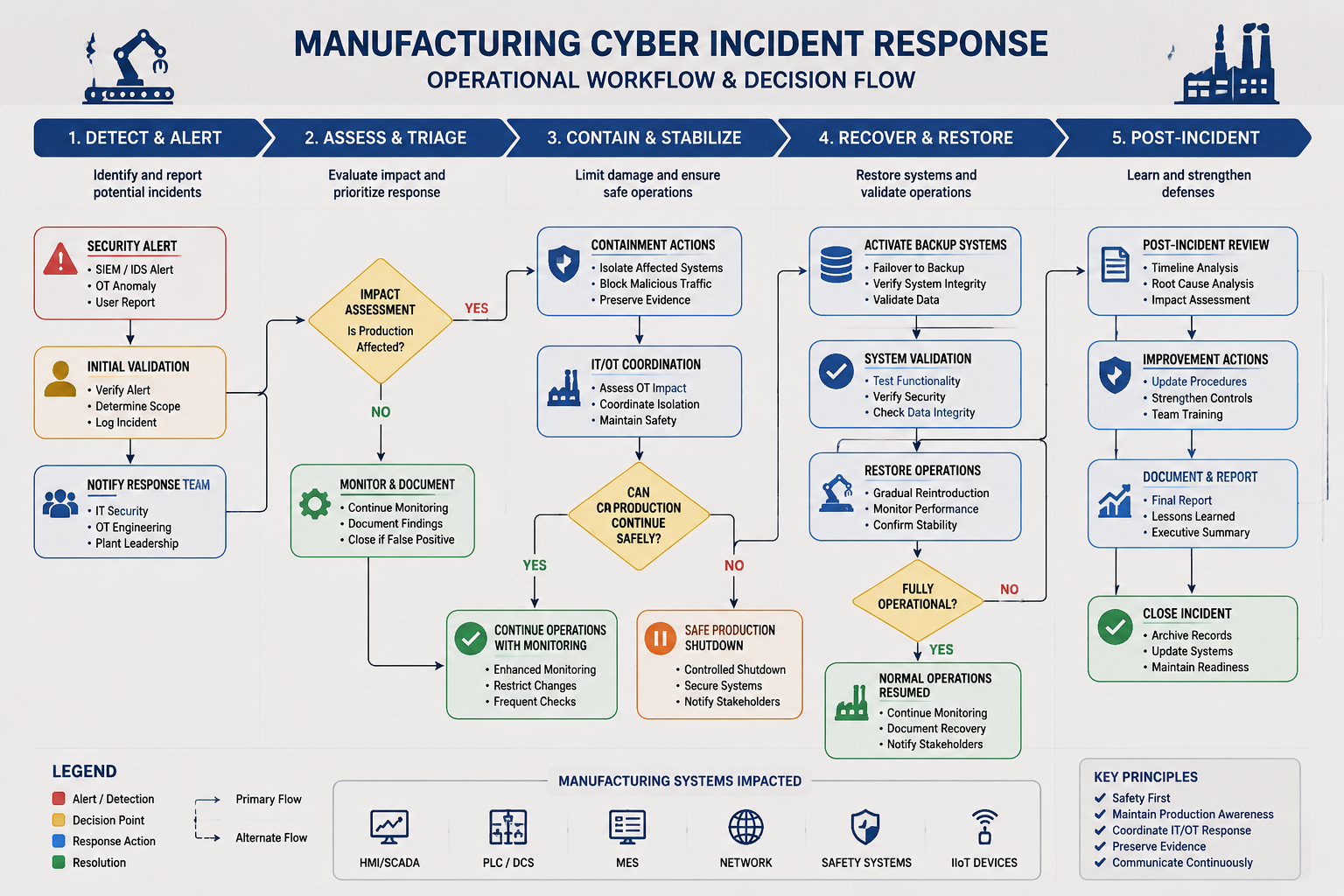
Standard incident response plans often recommend isolating infected systems immediately. In manufacturing, that approach can be more damaging than the attack itself. Your incident response plan needs to balance security response with operational continuity.
Start with threat assessment and containment. When an incident occurs, quickly determine whether it affects production systems. If the threat is contained to business IT systems, you might be able to maintain production while addressing the security issue.
Establish communication protocols that keep production teams informed without creating panic. Production managers need to know about potential threats to their systems, but they also need clear guidance on whether to continue operations or initiate shutdown procedures.
Define decision criteria for production shutdown. Under what circumstances do you stop production entirely? Create specific triggers based on safety risks, system integrity, or regulatory requirements. Having these criteria defined in advance prevents hesitation during critical moments.
Plan for manual operations when automated systems are compromised. Many manufacturing processes can continue with manual controls, at least temporarily. Train operators on manual procedures and ensure backup communication methods are available.
Coordinate with external partners, including suppliers, customers, and regulatory bodies. They need to understand how cyber incidents might affect deliveries, quality, or compliance requirements.
Your incident response plan should read like an operational playbook, not just a technical checklist. Every step should consider the impact on production and include guidance for maintaining operations when possible.
Backup and Recovery Strategies for Manufacturing Systems
Manufacturing backup strategies need to address both data recovery and operational continuity. Traditional data backups aren’t sufficient when production control systems are involved.
Implement air-gapped backups for critical control system configurations. These backups should be completely isolated from your network and updated regularly. When ransomware encrypts your production systems, air-gapped backups provide a clean recovery path.
Maintain spare hardware for critical control systems. Software backups are useless if the underlying hardware is damaged or compromised. Having spare programmable logic controllers (PLCs), human-machine interfaces (HMIs), and networking equipment enables faster recovery.
Test recovery procedures regularly using non-production systems. Many organizations have great backup systems that fail during actual recovery attempts. Regular testing reveals gaps in your recovery procedures and helps teams practice under pressure.
Document system configurations and dependencies. When recovering from a cyberattack, you need to understand how systems connect and depend on each other. Detailed documentation speeds recovery and helps prevent configuration errors that could cause additional downtime.
Establish recovery time objectives that align with business needs. How long can each production line be down before the impact becomes critical? Use these timeframes to prioritize recovery efforts and resource allocation.
Remember that recovery isn’t just about getting systems back online; it’s about restoring full operational capability with confidence that the threat has been eliminated.
Coordinating IT and OT Teams for Effective Cyber Response
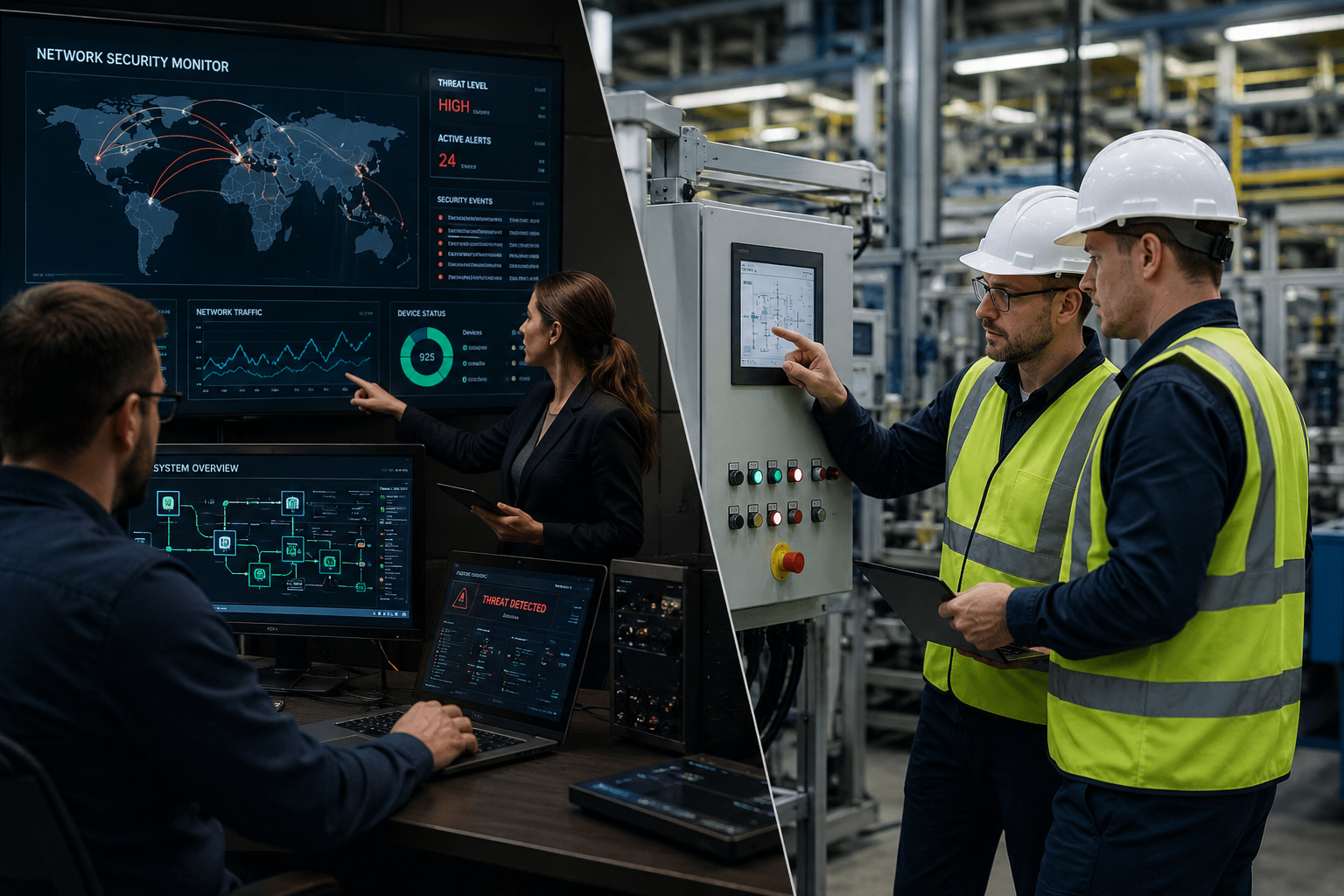
The biggest challenge in manufacturing cybersecurity isn’t technical; it’s organizational. IT and OT teams often work in silos, using different tools, priorities, and communication methods. Effective cyberattack preparedness for manufacturing requires these teams to work together seamlessly.
Establish joint training programs that help IT teams understand production processes and OT teams understand cybersecurity principles. IT professionals need to grasp the operational impact of their security decisions. OT professionals need to understand why security measures are necessary and how to implement them without disrupting production.
Create shared communication channels for incident response. During a cyber incident, IT and OT teams need to coordinate quickly. Establish dedicated communication channels, shared dashboards, and regular check-in procedures that keep both teams informed.
Develop integrated monitoring systems that provide visibility across both IT and OT environments. When possible, use monitoring tools that can correlate events across different system types. This helps teams understand the full scope of an incident and coordinate their response accordingly.
Define clear roles and responsibilities for different types of incidents. Who has the authority to shut down production systems? Who makes decisions about network isolation? Having these roles defined prevents conflicts and delays during crisis response.
Implement change management processes that consider both security and operational impacts. Changes to either IT or OT systems can affect the other environment. Joint review processes help identify potential issues before they become problems.
The goal is to create a unified response capability that leverages the expertise of both teams while maintaining clear accountability and decision-making authority.
Maintaining Uptime During Cyber Incidents
Keeping production running during a cyberattack requires a careful balance between security response and operational continuity. The key is having multiple options available depending on the nature and scope of the threat.
Implement graduated response procedures based on threat severity. Minor incidents might only require increased monitoring and limited access restrictions. Major incidents might necessitate isolation of specific systems while maintaining core production capability through backup systems.
Use network microsegmentation to isolate affected systems without shutting down entire production lines. If one machine or control system is compromised, microsegmentation prevents the attack from spreading while allowing other systems to continue operating.
Deploy mobile command centers for critical incident response. When your main IT infrastructure is compromised, mobile units can provide temporary monitoring and control capability. These systems should be pre-configured and regularly tested to ensure they’re ready when needed.
Establish alternative communication methods for coordinating response activities. If your primary communication systems are compromised, teams need backup methods for coordination. This might include dedicated radio systems, satellite phones, or isolated communication networks.
Plan for extended incident duration. Some cyberattacks can take days or weeks to fully resolve. Your continuity plans need to account for sustained operations under degraded conditions, including staff rotation, supply chain coordination, and customer communication.
The most successful manufacturers I’ve worked with treat cyber incidents like any other operational challenge; they have multiple contingency plans and the flexibility to adapt their response based on changing conditions.
Training Your Team for Manufacturing-Specific Cyber Threats
Generic cybersecurity training doesn’t address the unique challenges manufacturing employees face. Production workers interact with specialized systems and face different threat scenarios than typical office workers.
Focus on operational technology security in your training programs. Teach production workers about the cybersecurity risks specific to industrial control systems, including the importance of software updates, secure remote access, and suspicious network activity.
Emphasize the connection between cybersecurity and safety. In manufacturing environments, cyberattacks can create physical safety hazards. Help employees understand that cybersecurity isn’t just about protecting data; it’s about protecting people and equipment.
Train on incident recognition and reporting specific to manufacturing environments. What does a cyberattack look like on a production line? How should workers respond when they notice unusual system behavior? Clear guidance helps employees become effective early warning systems.
Practice manual procedures regularly. When automated systems are compromised, workers need to fall back on manual processes. Regular practice ensures these skills stay sharp and procedures remain current.
Include vendors and contractors in your training programs. Third-party workers often have access to critical systems but may not understand your security requirements. Extending training to these groups closes potential security gaps.
Remember that training isn’t a one-time event; it’s an ongoing process that needs to evolve with changing threats and operational requirements.