

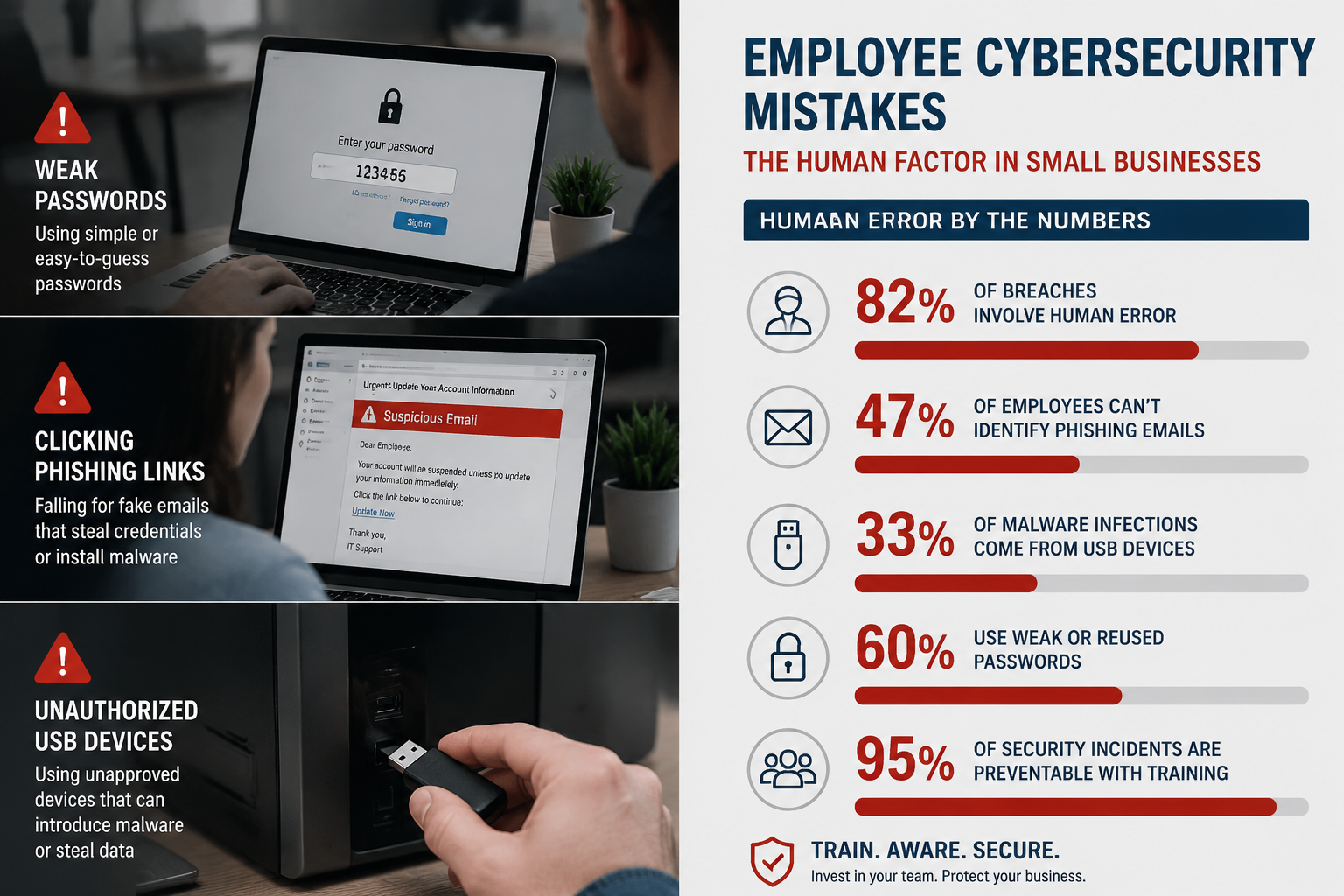
Why Employees Are the Number One Cybersecurity Target
Cybercriminals have shifted their focus from breaking through technical defenses to exploiting human psychology. Your employees handle sensitive data, have access to business systems, and make split-second decisions about emails, links, and downloads throughout their workday.
The math is simple for hackers: it’s easier to trick someone into clicking a malicious link than to break through properly configured firewalls and security software. This is why social engineering attacks have become the preferred method for cybercriminals targeting small businesses.
Your team members often work under pressure, juggle multiple tasks, and may not have extensive technical backgrounds. These normal workplace conditions create the perfect environment for successful cyberattacks. A busy accountant rushing to meet a deadline might not scrutinize that urgent “invoice” email as carefully as they should.
The human element becomes even more critical when you consider that small businesses:
- Often lack dedicated IT security staff to monitor threats in real-time
- May not have enterprise-level security tools that automatically filter sophisticated attacks
- Rely on employees to be the first line of defense against cyber threats
- Handle sensitive customer and financial data that makes them attractive targets
The good news? This same human element can become your strongest asset with proper employee cybersecurity training for small businesses. When your team knows what to look for and how to respond, they transform from potential victims into active defenders of your business.
What Is Employee Cybersecurity Training and Why Does It Matter
Employee cybersecurity training for small businesses is a structured program that teaches your team to recognize, avoid, and respond to cyber threats. Unlike generic online courses, effective training focuses on the specific risks your business faces and provides practical skills employees can use immediately.
This training matters because traditional security tools can’t protect against every threat. Firewalls, antivirus software, and email filters catch many attacks, but sophisticated cybercriminals constantly develop new methods to bypass these defenses. Your employees need to recognize what automated systems might miss.
Effective cybersecurity training covers three essential areas:
- Recognition: Teaching employees to identify phishing emails, suspicious links, and social engineering attempts
- Response: Providing clear procedures for reporting potential threats and handling security incidents
- Prevention: Establishing security habits like strong password creation and safe file sharing practices
The training becomes especially valuable when it’s tailored to your industry and business operations. A dental practice faces different threats than a manufacturing company, and your training should reflect those specific risks. This personalized approach helps employees understand why security matters to their daily work, not just to the business in general.
Regular training also keeps security awareness fresh in employees’ minds. Cyber threats evolve constantly, and what worked six months ago might not protect against today’s attacks. Ongoing education ensures your team stays current with emerging threats and maintains good security habits over time.
Common Cybersecurity Mistakes Employees Make at Work
Understanding the most frequent employee security mistakes helps you focus your training efforts where they’ll have the biggest impact. These errors happen in every industry and at businesses of all sizes, but small companies often feel the consequences more severely.
Password-related mistakes top the list of security vulnerabilities:
- Using simple passwords like “password123” or company names with numbers
- Reusing the same password across multiple business applications and personal accounts
- Writing passwords on sticky notes or storing them in unsecured documents
- Sharing login credentials with coworkers instead of requesting proper access
Email and communication errors create significant risks:
- Clicking links in emails without verifying the sender’s identity
- Downloading attachments from unknown or suspicious sources
- Responding to urgent requests for sensitive information without confirmation
- Using personal email accounts for business communications
File sharing and data handling mistakes expose sensitive information:
- Saving confidential files to personal cloud storage accounts
- Sending sensitive documents through unsecured messaging apps
- Leaving confidential information visible on screens in public areas
- Failing to properly dispose of printed documents containing sensitive data
Remote work introduces additional vulnerabilities:
- Using unsecured public Wi-Fi networks for business activities
- Allowing family members to use work devices for personal tasks
- Failing to lock computers when stepping away from home offices
- Installing unauthorized software or browser extensions on company devices
The pattern across all these mistakes is clear: they happen when employees prioritize convenience over security or simply don’t understand the risks involved. This is exactly why employee cybersecurity training for small businesses focuses on making secure behaviors as convenient as possible while clearly explaining the “why” behind each security requirement.
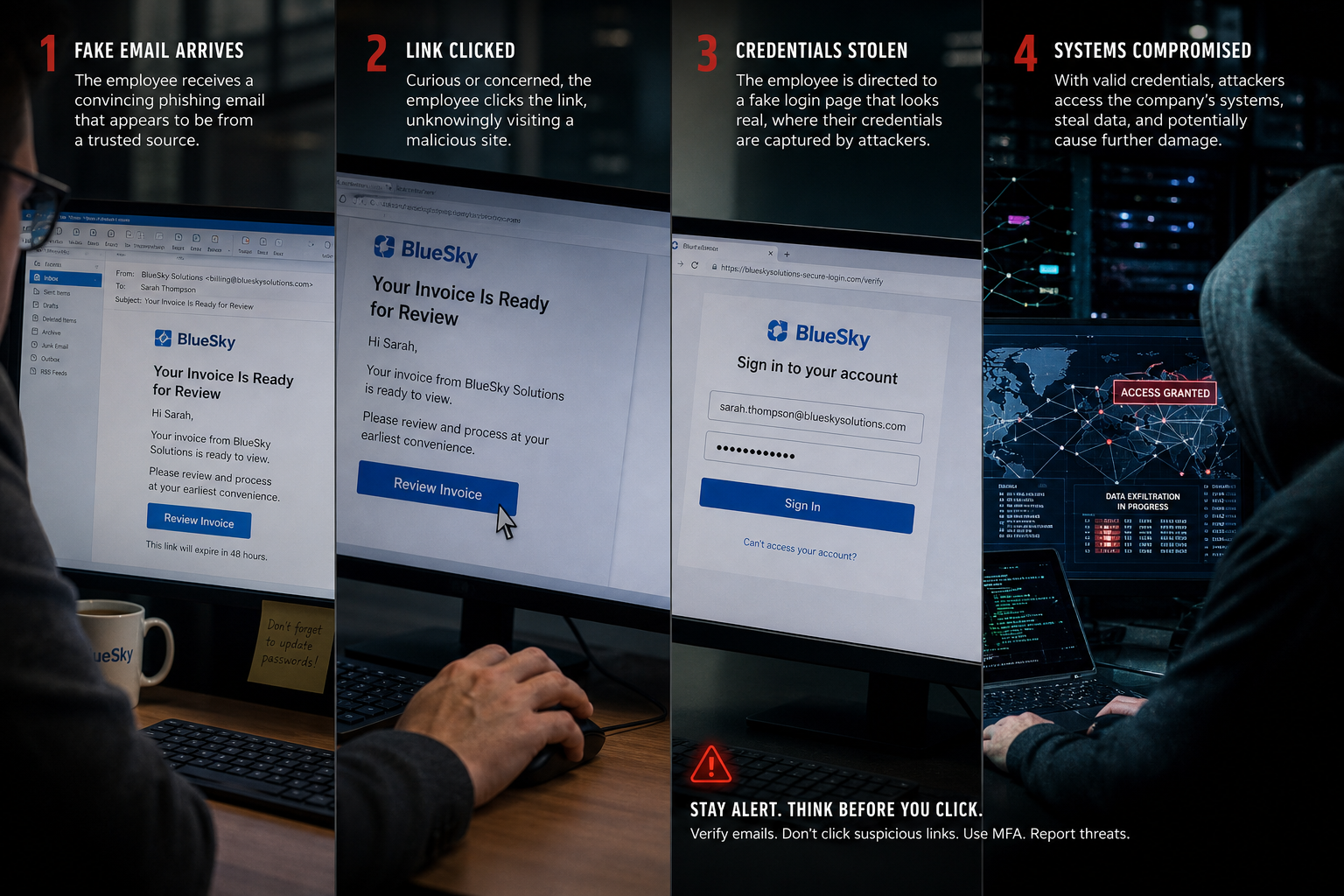
How Phishing and Social Engineering Work Against Your Business
Phishing attacks succeed because they exploit human psychology rather than technical vulnerabilities. Cybercriminals research your business, study your industry, and craft messages designed to trigger immediate action without careful consideration.
Modern phishing attacks often impersonate trusted sources:
- Fake emails from banks requesting account verification
- Messages appearing to come from software vendors about urgent security updates
- Communications that look like they’re from company executives requesting sensitive information
- Invoices or payment requests from vendors your business actually uses
Social engineering tactics make these attacks more convincing:
- Creating artificial urgency (“Your account will be suspended in 24 hours”)
- Appealing to authority (“The CEO needs this information immediately”)
- Exploiting helpfulness (“Can you help me access this file?”)
- Using fear tactics (“Your computer may be infected”)
Spear phishing targets your business specifically:
Unlike mass phishing campaigns, spear phishing attacks research your company and create highly targeted messages. Attackers might study your website, social media profiles, and public records to craft emails that reference real projects, vendors, or company events.
These personalized attacks often succeed because they contain enough accurate information to seem legitimate. An employee might receive an email that mentions a real client name and recent project, making the subsequent request for information appear routine rather than suspicious.
The attack chain typically follows this pattern:
- Initial contact through a convincing email or message
- Request for information or action (clicking a link, downloading a file)
- Credential harvesting or malware installation
- Lateral movement through your business systems
- Data theft or ransomware deployment
Understanding this process helps employees recognize attacks at the earliest stages, when they’re easiest to stop. Employee cybersecurity training for small businesses should walk through real examples of these attack chains so your team knows exactly what to watch for.
How Much Does Cybersecurity Training Cost for Small Businesses
Cybersecurity training costs vary significantly based on your business size, training format, and level of customization. However, these costs pale in comparison to the average $200,000 impact of a successful cyberattack on a small business.
Basic online training platforms typically charge:
- $15-50 per employee per year for generic cybersecurity courses
- $30-100 per employee annually for industry-specific training modules
- $500-2,000 for small business packages covering 10-25 employees
More comprehensive training programs include:
- $100-300 per employee per year for interactive training with phishing simulations
- $2,000-10,000 annually for managed training programs with ongoing support
- $5,000-15,000 for custom training development tailored to your specific business needs
In-person training sessions range from:
- $1,500-5,000 for half-day workshops covering basic security awareness
- $3,000-10,000 for full-day comprehensive training programs
- $500-1,500 per hour for ongoing consultation and specialized training topics
Free and low-cost options provide basic coverage:
- Government resources like CISA’s cybersecurity training materials
- Vendor-provided training from your IT service provider or security software company
- Industry association resources specific to your business sector
The key is matching your investment to your risk level and business needs. A healthcare practice handling patient records requires more comprehensive training than a retail business with minimal data storage. Your IT partner can help assess your specific requirements and recommend cost-effective training solutions.
Remember that training costs should be viewed as insurance against much larger potential losses. The peace of mind that comes from knowing your team can recognize and respond to threats makes this investment essential for business continuity.
Best Cybersecurity Training Platforms for Small Teams
Choosing the right training platform depends on your team size, technical comfort level, and specific industry requirements. The best platforms combine engaging content with practical exercises that reinforce learning through hands-on experience.
Top-rated platforms for small businesses include:
KnowBe4 offers comprehensive security awareness training with extensive phishing simulation capabilities. Their platform provides industry-specific content and detailed reporting that help track employee progress over time. Pricing starts around $25 per employee annually.
Proofpoint Security Awareness Training focuses on real-world scenarios and includes advanced phishing simulations that adapt based on employee performance. Their content library covers emerging threats and provides regular updates as new attack methods develop.
SANS Securing the Human delivers enterprise-quality training designed for smaller organizations. Their modules cover technical and non-technical employees with role-specific content that addresses different risk levels within your organization.
Cybersafe provides affordable training specifically designed for small businesses. Their platform includes basic security awareness, phishing simulations, and compliance tracking without the complexity of enterprise solutions.
Key features to look for in any platform:
- Regular content updates reflecting the current threat landscape
- Phishing simulation tools that test real-world response
- Progress tracking and reporting for compliance documentation
- Mobile-friendly access for remote and traveling employees
- Integration capabilities with your existing business systems
Industry-specific considerations matter:
Healthcare practices need HIPAA-focused training, while financial services require different compliance elements. Manufacturing companies face unique operational technology risks that generic training might not address adequately.
Your IT service provider can often recommend platforms they support and help with implementation. This partnership approach ensures your training integrates smoothly with your existing security infrastructure and provides ongoing technical support when needed.
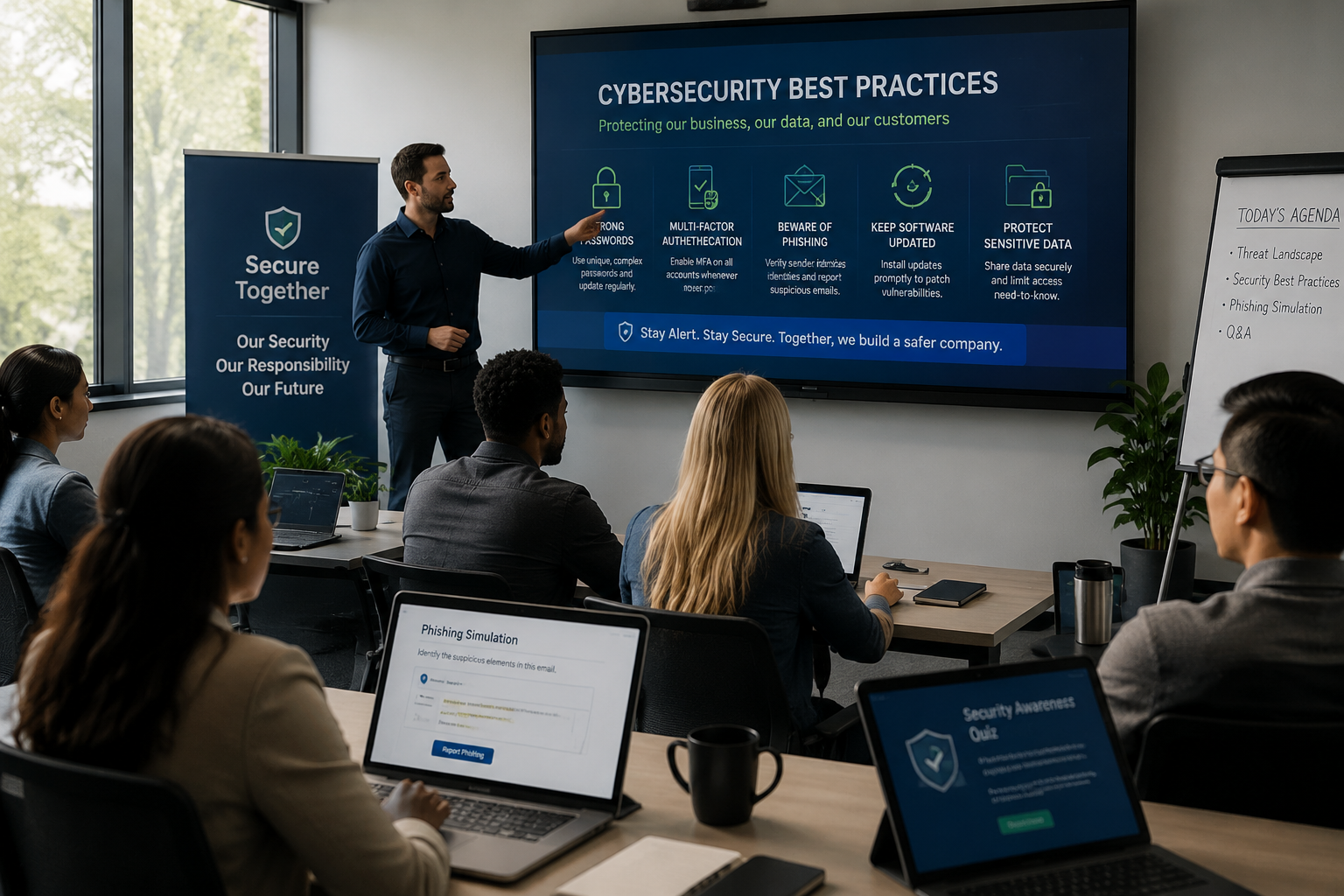
How Often Should Employees Do Cybersecurity Training
Regular, ongoing training proves far more effective than annual sessions that employees quickly forget. Cybersecurity threats evolve constantly, and your team’s awareness needs to stay current with emerging attack methods and techniques.
Recommended training frequency for maximum effectiveness:
- Monthly micro-learning sessions lasting 10-15 minutes keep security awareness fresh without overwhelming busy schedules
- Quarterly comprehensive reviews covering new threats and reinforcing core security principles
- Annual formal training providing in-depth coverage of security policies and procedures
- Immediate training following security incidents or when new threats emerge targeting your industry
Phishing simulations should run more frequently:
- Weekly or bi-weekly simulated phishing emails help maintain vigilance
- Immediate micro-training for employees who fall for simulations
- Graduated difficulty levels that increase as employee awareness improves
- Real-time feedback that explains why specific emails were suspicious
Event-driven training addresses immediate needs:
- New employee onboarding includes a comprehensive security orientation
- Role changes trigger training specific to new access levels and responsibilities
- Security incident response includes lessons learned and prevention strategies
- Software updates or system changes require training on new security features
Seasonal considerations affect training timing:
- Holiday seasons bring increased phishing attempts using seasonal themes
- Tax season creates opportunities for financial fraud and data theft
- Back-to-school periods often see education-themed phishing campaigns
- Major news events frequently inspire social engineering attacks
The goal is to make cybersecurity awareness a natural part of your workplace culture rather than a periodic obligation. Short, frequent touchpoints work better than lengthy sessions that employees endure rather than engage with actively.
Your training schedule should also account for business cycles and employee availability. Avoid scheduling intensive training during your busiest periods, but maintain basic awareness activities even during peak times.
What Topics Should Be Covered in Employee Security Training
Comprehensive employee cybersecurity training for small businesses should address both foundational security concepts and specific threats your team encounters daily. The training needs to be practical, relevant, and immediately applicable to their work environment.
Essential foundational topics include:
Password Security and Authentication
- Creating strong, unique passwords for each business account
- Using password managers to generate and store complex passwords securely
- Understanding multi-factor authentication and how it protects business accounts
- Recognizing and avoiding password-related social engineering attempts
Email Security and Phishing Recognition
- Identifying suspicious sender addresses and email formatting
- Verifying urgent requests through alternative communication channels
- Understanding how malicious attachments and links compromise systems
- Proper procedures for reporting suspected phishing attempts
Safe Internet Browsing and Downloads
- Recognizing legitimate websites versus convincing fake sites
- Understanding the risks associated with downloading software and files
- Using company-approved applications and avoiding unauthorized installations
- Identifying and avoiding malicious advertisements and pop-ups
Data Protection and Privacy
- Handling sensitive customer and business information appropriately
- Understanding data classification levels and corresponding protection requirements
- Proper procedures for sharing files internally and with external partners
- Secure disposal methods for both digital and physical sensitive documents
Advanced topics for comprehensive coverage:
Remote Work Security
- Securing home office environments and personal devices used for work
- Using VPNs and understanding secure connection requirements
- Recognizing risks associated with public Wi-Fi and unsecured networks
- Maintaining the physical security of work materials in home and mobile environments
Social Media and Online Presence
- Understanding how personal social media activity can impact business security
- Recognizing social engineering attempts through social media platforms
- Proper handling of business-related social media accounts and communications
- Privacy settings and information sharing considerations
Incident Response and Reporting
- Immediate steps to take when a security incident is suspected
- Who to contact and how quickly to report potential threats
- Preserving evidence while minimizing damage from ongoing attacks
- Understanding the business impact of delayed incident reporting
The training should use real examples relevant to your industry and business operations. Generic scenarios don’t resonate as strongly as situations employees might actually encounter in their daily work.
How to Get Employees to Actually Complete Cybersecurity Training
Employee engagement with cybersecurity training often determines its effectiveness, yet many businesses struggle with low completion rates and minimal retention. The key lies in making training relevant, convenient, and rewarding rather than treating it as a compliance checkbox.
Make training relevant to daily work:
- Use examples from your specific industry and business operations
- Address actual threats your employees have encountered or reported
- Connect security practices to protecting customer relationships and business reputation
- Explain how security incidents directly impact job security and business continuity
Design training for busy schedules:
- Break comprehensive topics into 5-10-minute micro-learning modules
- Offer mobile-friendly access so employees can train during commutes or breaks
- Provide flexible scheduling that accommodates different work patterns and time zones
- Send gentle reminders rather than demanding immediate completion
Create positive reinforcement systems:
- Recognize employees who complete training promptly and demonstrate good security practices
- Share success stories about how employee vigilance prevented actual security incidents
- Provide certificates or other acknowledgments for training completion
- Celebrate improvements in overall security awareness metrics
Address resistance and concerns directly:
- Explain why each security requirement exists and how it protects the business
- Provide easy alternatives when security measures seem inconvenient
- Listen to employee feedback about training content and delivery methods
- Adjust policies based on practical workplace realities and employee input
Leadership involvement increases participation:
- Have executives complete the same training and share their experiences
- Include security awareness in regular team meetings and business communications
- Demonstrate that cybersecurity is a business priority, not just an IT requirement
- Provide resources and support for employees who need additional help
Track meaningful metrics:
Focus on behavior change rather than just completion rates. Monitor phishing simulation results, security incident reports, and employee confidence levels with security procedures. These metrics provide better insight into training effectiveness than simple completion statistics.
Your IT partner can help implement tracking systems and provide ongoing support to maintain engagement levels. This collaborative approach ensures training remains current and continues meeting your business needs as threats evolve.
Is Cybersecurity Training Required by Law for Small Businesses
Legal requirements for cybersecurity training vary significantly by industry, location, and the types of data your business handles. While general small businesses may not face specific training mandates, many industries have regulatory requirements that include employee education components.
Industries with specific training requirements:
- Healthcare: HIPAA requires workforce training on privacy and security procedures for all employees handling protected health information
- Financial services: Various regulations, including GLBA and state banking laws, mandate security awareness training for employees
- Government contractors: NIST compliance often requires documented cybersecurity training for all personnel with system access
- Education: FERPA compliance may require training on protecting student information and privacy
State and local requirements vary:
Some states have enacted data protection laws that include training requirements for businesses handling personal information. California’s CCPA, New York’s SHIELD Act, and similar legislation in other states may apply depending on your customer base and data handling practices.
Industry standards often drive requirements:
Even without legal mandates, industry standards like PCI DSS for payment processing require security awareness training. Professional licensing boards and industry associations may also establish training expectations for member businesses.
Contractual obligations create requirements:
- Client contracts may specify cybersecurity training requirements for your employees
- Insurance policies might require documented security training to maintain coverage
- Vendor agreements often include security training as a condition of partnership
Documentation proves compliance:
Regardless of specific legal requirements, maintaining records of employee cybersecurity training demonstrates due diligence in protecting sensitive information. This documentation can be crucial during regulatory audits, legal proceedings, or insurance claims.
Best practice exceeds minimum requirements:
Smart businesses implement comprehensive employee cybersecurity training for small businesses regardless of legal mandates. The cost of training pales in comparison to potential regulatory fines, legal liability, and business disruption from security incidents.
Your legal and IT advisors can help determine specific requirements for your business and ensure your training program meets all applicable standards while providing practical protection for your operations.
What’s the Difference Between Phishing Simulations and Formal Training
Phishing simulations and formal cybersecurity training serve complementary but distinct purposes in building your business’s security defenses. Understanding their differences helps you implement both effectively as part of a comprehensive security awareness program.
Phishing simulations provide real-world testing:
These controlled exercises send fake phishing emails to your employees to test their ability to recognize and respond to actual threats. Simulations use current attack techniques and measure how your team performs under normal working conditions without the pressure of formal training environments.
Formal training delivers structured education:
Classroom sessions, online courses, and structured learning modules teach cybersecurity concepts, policies, and procedures. This education provides the knowledge foundation that employees need to understand why security matters and how to implement best practices consistently.
Key differences in approach and outcomes:
Timing and frequency:
- Simulations run continuously or regularly throughout the year
- Formal training typically occurs at scheduled intervals (monthly, quarterly, annually)
- Simulations provide an immediate, real-time assessment of security awareness
- Training builds knowledge over time through structured curriculum progression
Learning methodology:
- Simulations use experiential learning through hands-on testing
- Training uses instructional design with explanations, examples, and guided practice
- Simulations reveal knowledge gaps and behavioral patterns
- Training fills knowledge gaps and establishes proper procedures
Measurement and feedback:
- Simulations measure click rates, reporting rates, and response times
- Training measures comprehension, retention, and policy understanding
- Simulation results identify individuals needing additional support
- Training results demonstrate overall program effectiveness and compliance
Both elements work together effectively:
Employees who receive regular formal training perform significantly better on phishing simulations. Conversely, simulation results help identify topics that need additional emphasis in formal training sessions.
Implementation best practices:
Start with foundational training to establish basic security awareness, then introduce phishing simulations to test and reinforce learning. Use simulation results to customize future training content and identify employees who might benefit from additional support or different learning approaches.
Your IT service provider can help coordinate both simulation and training programs to ensure they complement each other and provide comprehensive security awareness development for your team.
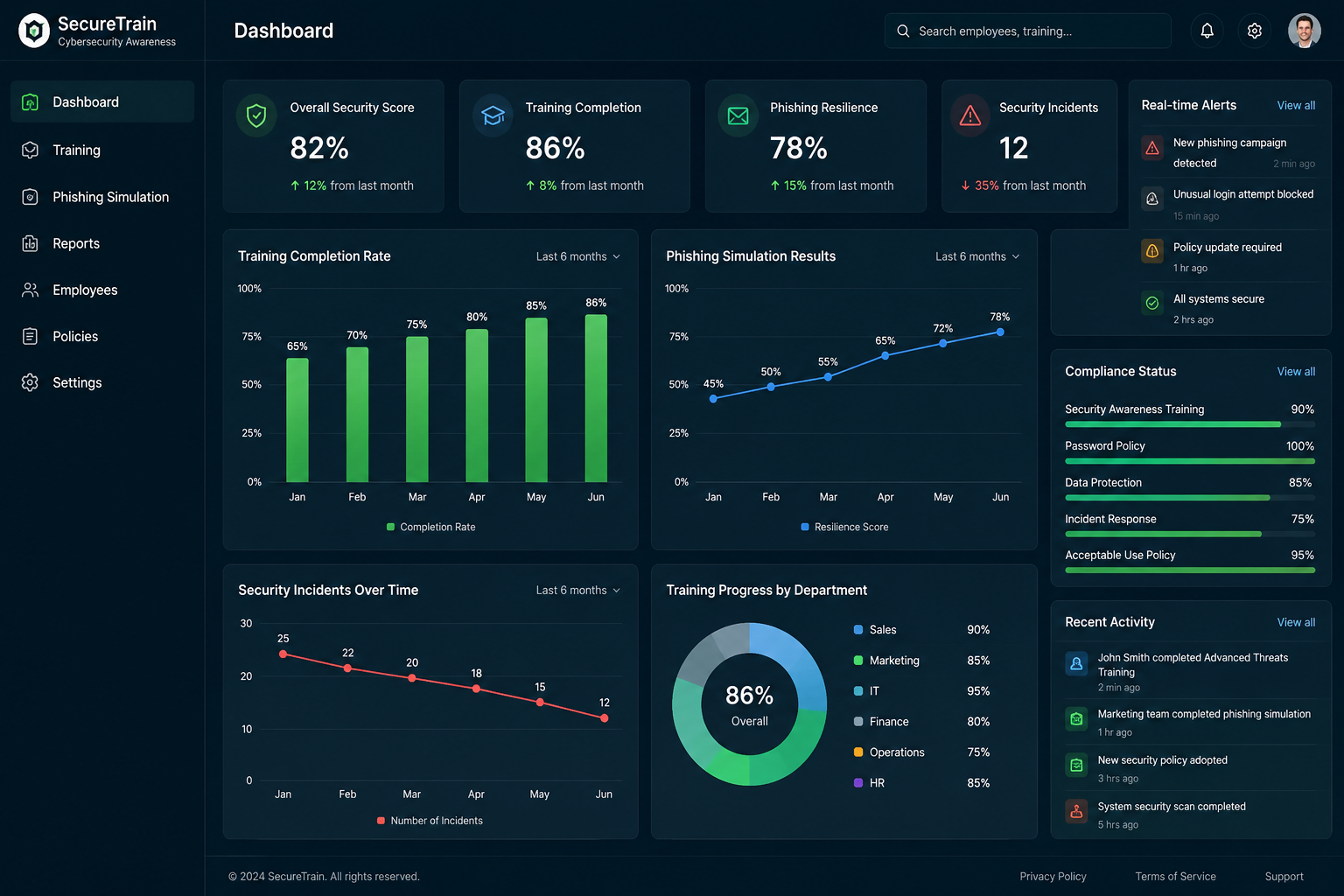
How Do You Measure if Cybersecurity Training is Working
Measuring cybersecurity training effectiveness requires tracking both behavioral changes and business outcomes rather than just completion rates. Effective measurement helps you identify what’s working, where improvements are needed, and how training impacts your overall security posture.
Key performance indicators for training effectiveness:
Phishing simulation metrics:
- Click rates on simulated phishing emails (should decrease over time)
- Reporting rates for suspicious emails (should increase as awareness grows)
- Time between receiving and reporting suspicious messages (faster reporting indicates better awareness)
- Repeat offender rates (employees who consistently fall for simulations need additional support)
Behavioral change indicators:
- Increased reports of suspicious emails and activities from employees
- Improved password hygiene and multi-factor authentication adoption
- Reduced security policy violations and risky behaviors
- More proactive security questions and concerns raised by staff
Business impact measurements:
- Reduction in successful phishing attacks and security incidents
- Decreased downtime from security-related issues
- Lower costs associated with incident response and recovery
- Improved compliance audit results and regulatory standing
Employee confidence and engagement:
- Survey results showing increased confidence in recognizing threats
- Higher participation rates in voluntary security training sessions
- More security-conscious decision-making in daily work activities
- Positive feedback about training relevance and usefulness
Tracking methods and tools:
Automated monitoring systems:
Most training platforms provide detailed analytics on completion rates, quiz scores, and simulation performance. These systems can track individual progress and identify trends across your organization.
Regular assessment surveys:
Short questionnaires can measure employee confidence levels, perceived training value, and self-reported behavior changes. Anonymous surveys often provide more honest feedback about training effectiveness.
Incident tracking and analysis:
Document all security incidents, including near-misses and successful employee interventions. Look for patterns that indicate whether training is preventing incidents or if additional focus areas are needed.
Benchmark comparisons:
Compare your metrics against industry standards and similar businesses. Many training platforms provide anonymized benchmark data that helps contextualize your results.
Continuous improvement approach:
Use measurement results to refine training content, delivery methods, and frequency. Regular assessment ensures your program evolves with changing threats and maintains effectiveness over time.
Your IT partner can help implement measurement systems and interpret results to guide program improvements. This data-driven approach ensures your investment in employee cybersecurity training for small businesses delivers measurable security improvements.
Free Cybersecurity Training Options for Small Business Employees
Budget constraints shouldn’t prevent small businesses from implementing basic cybersecurity training. Numerous high-quality free resources provide foundational security awareness education, though they may lack the customization and advanced features of paid platforms.
Government and nonprofit resources:
CISA (Cybersecurity and Infrastructure Security Agency) offers comprehensive free training materials specifically designed for small businesses. Their resources include interactive modules, downloadable guides, and industry-specific recommendations.
NIST (National Institute of Standards and Technology) provides cybersecurity frameworks and training materials that help small businesses implement structured security programs without high cost.
SANS Institute offers free community resources, including security awareness materials, though its premium training requires payment.
Multi-State Information Sharing and Analysis Center (MS-ISAC) provides free cybersecurity resources and training specifically for small businesses and local governments.
Industry association resources:
Many trade associations offer cybersecurity training as a member benefit. Check with your industry organizations for specialized training that addresses sector-specific threats and compliance requirements.
Vendor-provided training:
- Microsoft offers free security training for businesses using its platforms
- Google provides cybersecurity resources through its small business programs
- Major antivirus and security software vendors often include basic training with their products
Online learning platforms:
- Coursera and edX offer free cybersecurity courses from universities and industry experts
- YouTube channels from reputable cybersecurity organizations provide current threat information
- Professional association webinars often cover timely security topics at no cost
Limitations of free resources:
- Generic content may not address your specific industry risks
- Limited or no phishing simulation capabilities
- Minimal progress tracking and reporting features
- No ongoing support or customization options
- Less frequent updates compared to commercial platforms
Maximizing free resource effectiveness:
Combine multiple free sources to create comprehensive coverage. Use government resources for foundational training, industry materials for specific threats, and vendor resources for platform-specific security features.
Transitioning to paid solutions:
Start with free resources to establish basic security awareness, then invest in commercial solutions as your business grows or faces increased security requirements. This approach helps you understand training needs before making significant investments.
Your IT service provider can help identify the most relevant free resources for your business and assist with implementation to ensure maximum effectiveness from these cost-effective training options.
What Happens if an Employee Falls for a Phishing Scam
When an employee falls for a phishing scam, quick response and systematic damage control can minimize business impact while turning the incident into a valuable learning opportunity. Your response approach determines whether this becomes a minor setback or a major business crisis.
Immediate response steps (first 30 minutes):
- Have the affected employee immediately disconnect from the network to prevent lateral movement
- Change all passwords for accounts the employee accessed recently, especially if credentials were compromised
- Contact your IT support team or managed service provider for professional incident response
- Document exactly what happened, including timestamps and actions taken
Assessment and containment (first few hours):
- Determine what information was compromised and which systems were accessed
- Check for unauthorized access attempts across your business network
- Scan all connected devices for malware or suspicious activity
- Notify key stakeholders, including management and potentially affected clients
Investigation and recovery (first 24-48 hours):
- Work with cybersecurity professionals to assess the full scope of the breach
- Implement additional security measures to prevent similar incidents
- Restore systems from clean backups if a malware infection occurred
- Begin compliance reporting if regulatory requirements apply
Long-term response and prevention:
- Provide additional training for the affected employee without blame or punishment
- Review and update security policies based on lessons learned
- Share the incident (anonymously) as a training case study for other employees
- Strengthen technical controls to catch similar attacks in the future
Cost considerations and business impact:
The average cost of a successful phishing attack on small businesses ranges from $25,000 to $200,000, including downtime, recovery efforts, and potential regulatory fines. However, quick response and proper preparation can significantly reduce these costs.
Legal and compliance implications:
Depending on your industry and the type of data compromised, you may need to notify customers, regulatory agencies, or law enforcement. Having an incident response plan prepared in advance ensures you meet all notification requirements within the required timeframes.
Insurance considerations:
Many cyber liability insurance policies require specific response procedures and professional incident response services. Following proper procedures ensures your coverage remains valid and claims are processed efficiently.
Creating a learning culture:
Treat phishing incidents as learning opportunities rather than reasons for punishment. Employees who fear retribution are less likely to report incidents quickly, which delays response and increases damage. Focus on improving processes and training rather than assigning blame.
Your IT partner should have established incident response procedures and can provide 24/7 monitoring to detect and respond to threats quickly. This professional support proves invaluable during the stress and time pressure of an actual security incident.
Can Small Businesses Do Cybersecurity Training In-House or Do We Need a Vendor
Small businesses can successfully implement basic cybersecurity training in-house, but the decision depends on your internal expertise, available time, and specific security requirements. A hybrid approach often provides the best balance of cost-effectiveness and comprehensive coverage.
In-house training advantages:
- Complete control over content and scheduling
- Ability to customize training for specific business operations and risks
- Lower ongoing costs after initial development investment
- Direct integration with existing employee development programs
In-house training requirements:
- Staff member with cybersecurity knowledge and training development skills
- Time to research current threats and create relevant content
- Ability to update materials regularly as threats evolve
- Resources to track progress and measure effectiveness
Vendor solutions provide expertise and efficiency:
- Professional content development based on current threat intelligence
- Automated delivery systems that reduce administrative burden
- Phishing simulation tools and advanced tracking capabilities
- Regular updates reflecting emerging threats and attack methods
Hybrid approaches maximize benefits:
Many successful small businesses combine in-house and vendor resources. Use professional platforms for foundational training and phishing simulations, while supplementing with internal sessions covering company-specific policies and procedures.
Factors favoring vendor solutions:
- Limited internal IT expertise or cybersecurity knowledge
- Compliance requirements demand documented professional training
- Need for sophisticated phishing simulations and detailed reporting
- Desire for ongoing support and threat intelligence updates
Factors supporting in-house development:
- Strong internal cybersecurity expertise and training capabilities
- Highly specialized industry requirements not addressed by generic training
- Significant budget constraints preventing commercial platform adoption
- Existing learning management systems that can accommodate security training
Implementation considerations:
Start with your current capabilities and resources. If you have team members with cybersecurity backgrounds, they might effectively deliver basic awareness training. However, consider professional solutions for advanced topics like incident response and technical security procedures.
Cost-benefit analysis:
Calculate the total cost of internal development, including staff time, content creation, and ongoing maintenance. Compare this against commercial solutions that might provide more comprehensive coverage at similar or lower total costs.
Your IT service provider can assess your current capabilities and recommend the most effective approach for your specific situation. They might also offer training services as part of comprehensive managed security programs, providing professional expertise without additional vendor relationships.
How Long Does It Take to Train Employees on Cybersecurity Basics
The time required for effective cybersecurity training depends on your employees’ current knowledge level, the comprehensiveness of your program, and your business’s specific security requirements. Most small businesses can establish basic security awareness within 30-60 days using a structured approach.
Initial foundational training timeline:
- Week 1-2: Basic security awareness covering passwords, email safety, and phishing recognition (2-4 hours total)
- Week 3-4: Company-specific policies, procedures, and incident reporting (1-2 hours total)
- Week 5-6: Hands-on practice with phishing simulations and security tools (1 hour total)
- Week 7-8: Assessment, feedback, and reinforcement of key concepts (30 minutes total)
Ongoing maintenance and reinforcement:
- Monthly micro-learning sessions (10-15 minutes each)
- Quarterly policy reviews and updates (30 minutes each)
- Annual comprehensive refresher training (2-3 hours total)
- Immediate training following security incidents or new threat emergence
Factors affecting training duration:
Employee technical background:
Teams with strong technical skills often complete basic training faster but may need more advanced topics. Non-technical employees might need additional time for foundational concepts but require less depth in technical procedures.
Industry-specific requirements:
Healthcare practices need HIPAA-specific training that adds 1-2 hours to basic programs. Financial services require additional compliance training. Manufacturing businesses need operational technology security coverage.
Business complexity and risk level:
Companies handling sensitive data or operating in high-risk industries need more comprehensive training. Simple retail operations might complete basic training in less time than professional services firms.
Training delivery method:
- Self-paced online training allows flexible scheduling but may take longer to complete
- Instructor-led sessions provide faster knowledge transfer but require coordinated scheduling
- Blended approaches balance efficiency with engagement and retention
Accelerated training approaches:
For urgent security needs, intensive training programs can establish basic awareness within 1-2 weeks. However, retention and long-term behavior change typically require ongoing reinforcement over several months.
Measuring progress and competency:
Use phishing simulation results and knowledge assessments to determine when employees have achieved adequate security awareness. Some team members may need additional time or different training approaches to reach competency levels.
New employee onboarding:
Build cybersecurity training into new hire orientation to establish security awareness from day one. This typically adds 1-2 hours to onboarding but ensures a consistent security culture across your organization.
The key is starting immediately with basic training while building toward more comprehensive coverage over time. Your IT partner can help design a timeline that balances business needs with practical training constraints.