
What Causes Manufacturing Downtime and How Much Does It Really Cost?
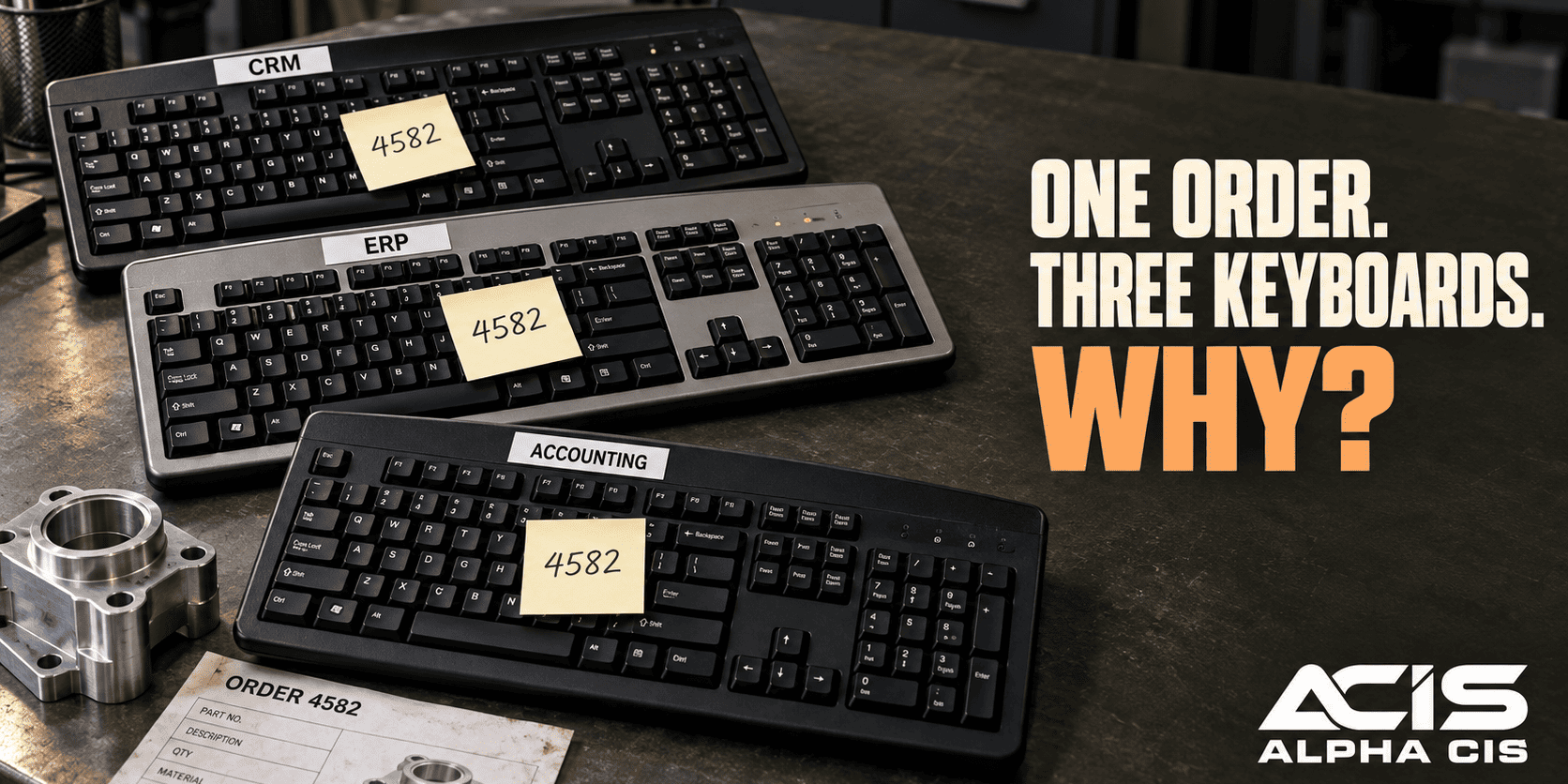
Manufacturing downtime has a handful of recurring causes: equipment failure, changeovers, material shortages, quality holds, operator or staffing gaps, and planned maintenance that runs long. The direct cost is never just the stopped machine. It includes idle labor, delayed orders, overtime to catch up, expedited shipping, missed delivery commitments, scrap or rework, and the administrative time spent documenting and explaining what happened.
Don’t rely on a generic “every hour of downtime costs $X” number you saw in a blog post. Your real cost per hour depends on your labor rates, your order backlog, your customer contracts, and how close you are to a shipping deadline when the line stops. A tool and die shop running one shift with a loose schedule has a very different downtime cost than an automotive supplier running three shifts against just-in-time delivery windows.
Here’s what to actually add up for your own operation:
- Lost production value: units not made, valued at what they would have sold for
- Idle labor: wages paid while people wait for the line to restart
- Overtime: hours needed to make up lost production
- Expedited shipping: cost to air-freight or rush a shipment that would have gone ground
- Missed delivery commitments: penalties, credits, or strained customer relationships
- Scrap and rework: material and labor wasted on parts that didn’t meet spec during the disruption
- Administrative recovery work: the hours spent writing reports, updating schedules, and explaining the gap to customers or leadership
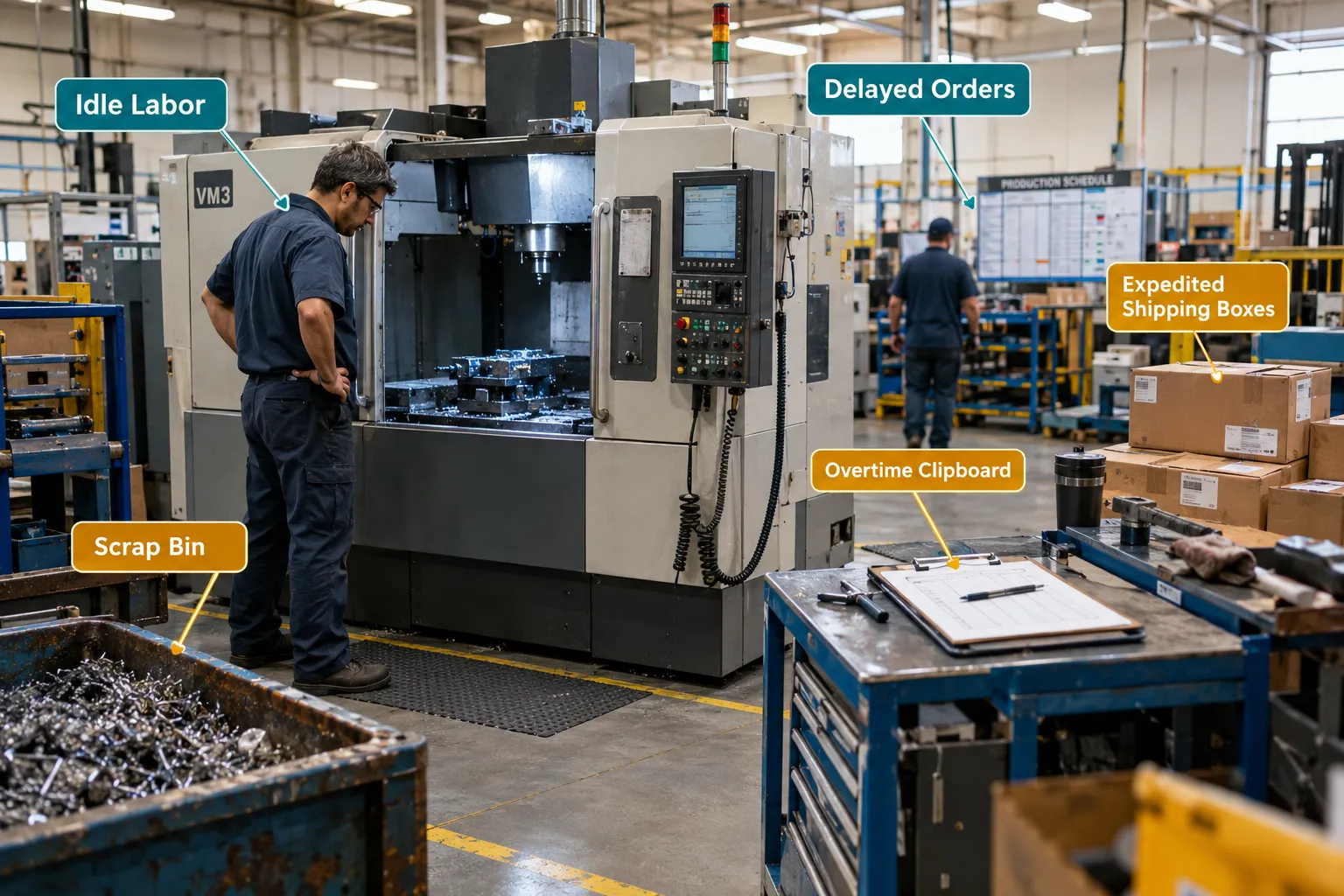
Add those categories up over a month using your own numbers, and you get a far more honest picture of what downtime costs than any industry-wide average.
Where Does AI Actually Fit in Manufacturing Automation?
AI’s role in manufacturing downtime reduction is mostly about information, not machine control. Specialized industrial control systems and safety systems remain responsible for actually running and protecting the equipment. AI’s job is to make the information flowing around that equipment faster, clearer, and more useful to the people who have to respond.
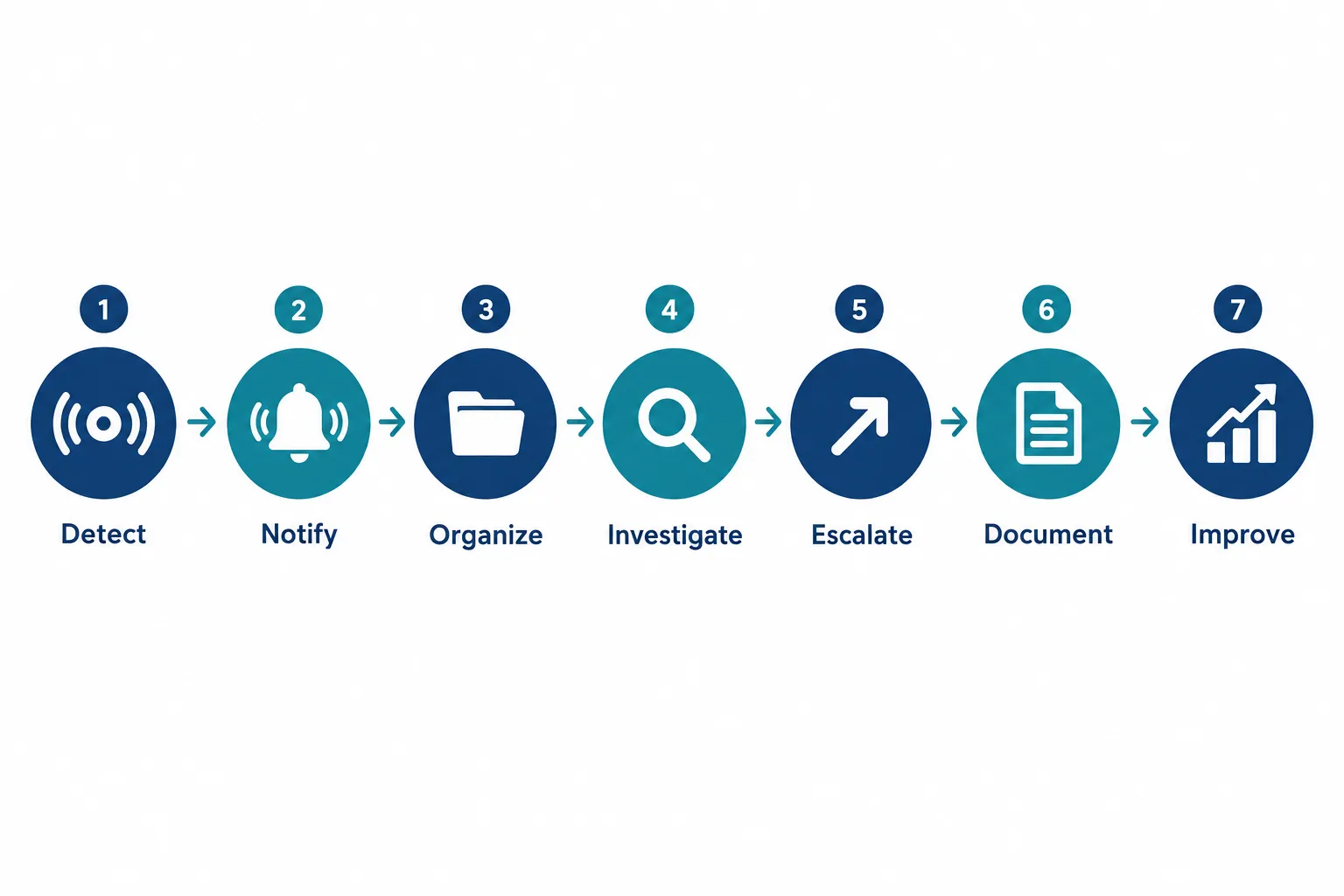
A useful way to picture this is a simple chain: Detect, Notify, Organize, Analyze, Escalate, Document, Improve. Each link in that chain is a place where manual work, delay, and lost information typically creep in. AI and automation can strengthen different links in that chain, and you don’t need to automate all seven at once to see a return.
The fastest way to reduce downtime may not be making the machine smarter. It may be making the response around the machine faster.
This framework matters because it separates two very different conversations. One is “can a sensor and a model predict a failure before it happens?” The other is “can we stop losing twenty minutes every time a machine stops because nobody knows who to call?” Both are worth solving, but they require different tools and different expectations.
How Does Predictive Maintenance AI Work in Factories?
Predictive maintenance AI works by analyzing data from connected sensors and machine controllers to flag patterns that historically preceded a failure, such as rising vibration, temperature drift, or unusual cycle times. It requires three ingredients: reliable sensors on the right equipment, enough historical data tied to actual failure events, and a model trained specifically on that equipment and that failure pattern.
Here’s what that data requirement looks like in practice:
| Requirement | What it means | Why it matters |
|---|---|---|
| Sensor coverage | Vibration, temperature, current, or cycle sensors on critical assets | No sensor data means no pattern to detect |
| Historical failure records | Past breakdowns tagged with cause, date, and machine | The model needs examples of “this led to that” |
| Data quality | Consistent, timestamped, and clean readings | Gaps or mislabeled data produce false confidence |
| Enough volume | Months or years of operating history, ideally across multiple failure events | Too little data means the model is guessing |
Decision rule: choose predictive maintenance AI if you already have connected sensors and a documented maintenance history on a specific piece of equipment with recurring failure patterns. If you don’t have that data yet, start by capturing it consistently before investing in prediction.
A common mistake is buying a predictive maintenance platform before the plant has the sensors or the historical records to feed it. The software isn’t the bottleneck in that scenario. The missing data is.
What Data Do You Need to Train AI for Manufacturing, and Can AI Monitoring Replace Traditional Maintenance?
AI monitoring is not a replacement for scheduled maintenance, inspections, or technician judgment. It’s a layer that adds pattern detection and faster alerts on top of the maintenance program you already run. Traditional maintenance relies on fixed schedules and technician experience; AI monitoring adds continuous observation and early warning when there’s enough quality data behind it.
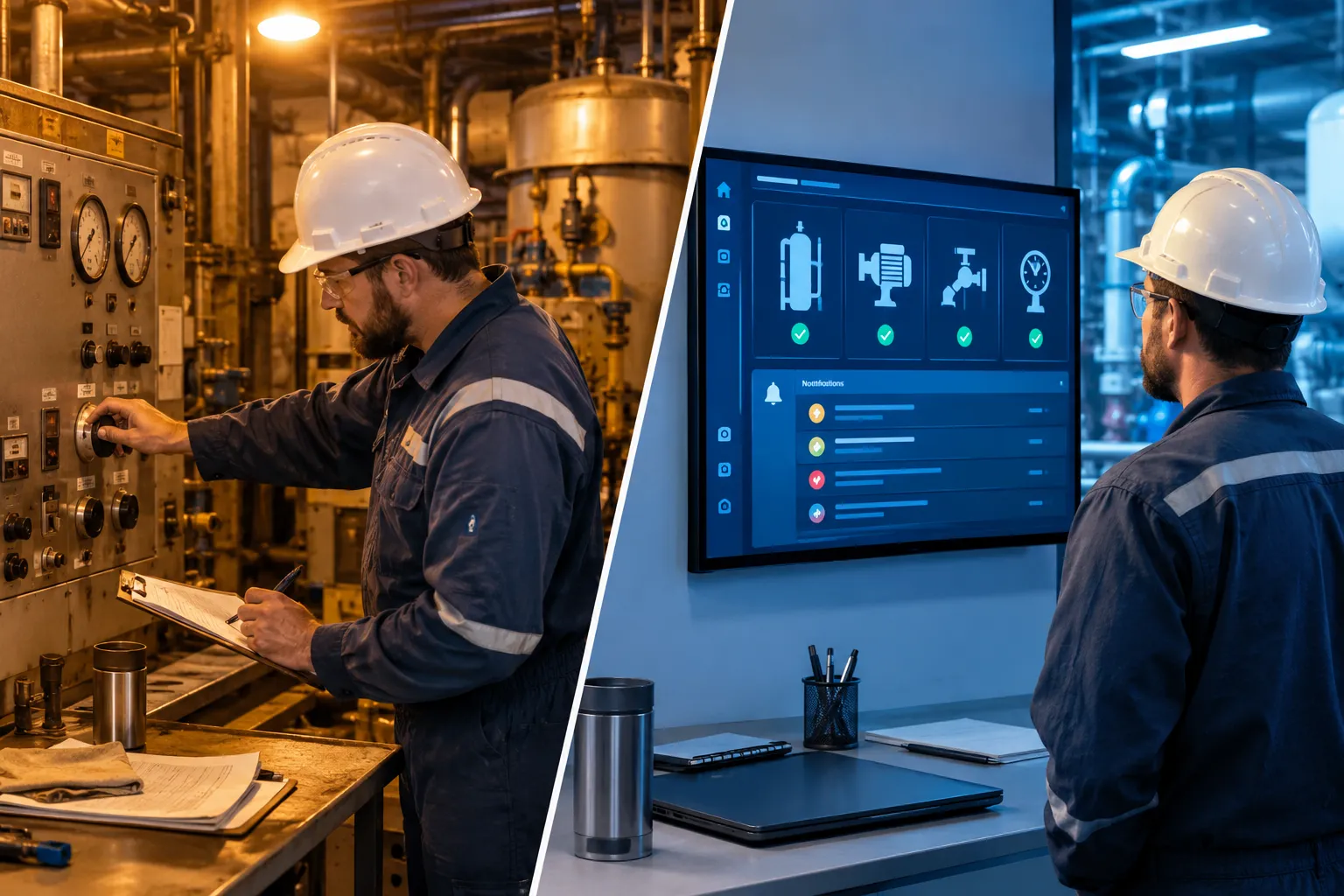
The data AI needs to be useful generally falls into these buckets:
- Machine status data: run, stop, fault, and alarm states from the equipment or PLC
- Cycle and production data: parts per cycle, cycle time, throughput trends
- Maintenance records: work orders, parts replaced, technician notes
- Downtime event logs: start time, duration, cause, and resolution for past stoppages
- Operator notes: free-text observations that often contain the earliest warning signs
AI does best when it can combine structured sensor data with the unstructured notes humans already write down. A model that only sees sensor numbers misses the operator who wrote “noticed a grinding sound around 2pm” three days before a bearing failed. A model that only sees text misses the vibration spike that started climbing a week earlier. The combination is where the value usually sits.
Automating the Downtime Workflow: Notification, Documentation, and Shift Handoffs
Automating the workflow around a downtime event means routing the right information to the right person immediately, instead of relying on a chain of phone calls and memory. This is where AI for manufacturing downtime reduction overlaps heavily with straightforward workflow automation, and it’s usually the fastest win available.
Automatically notify the right people
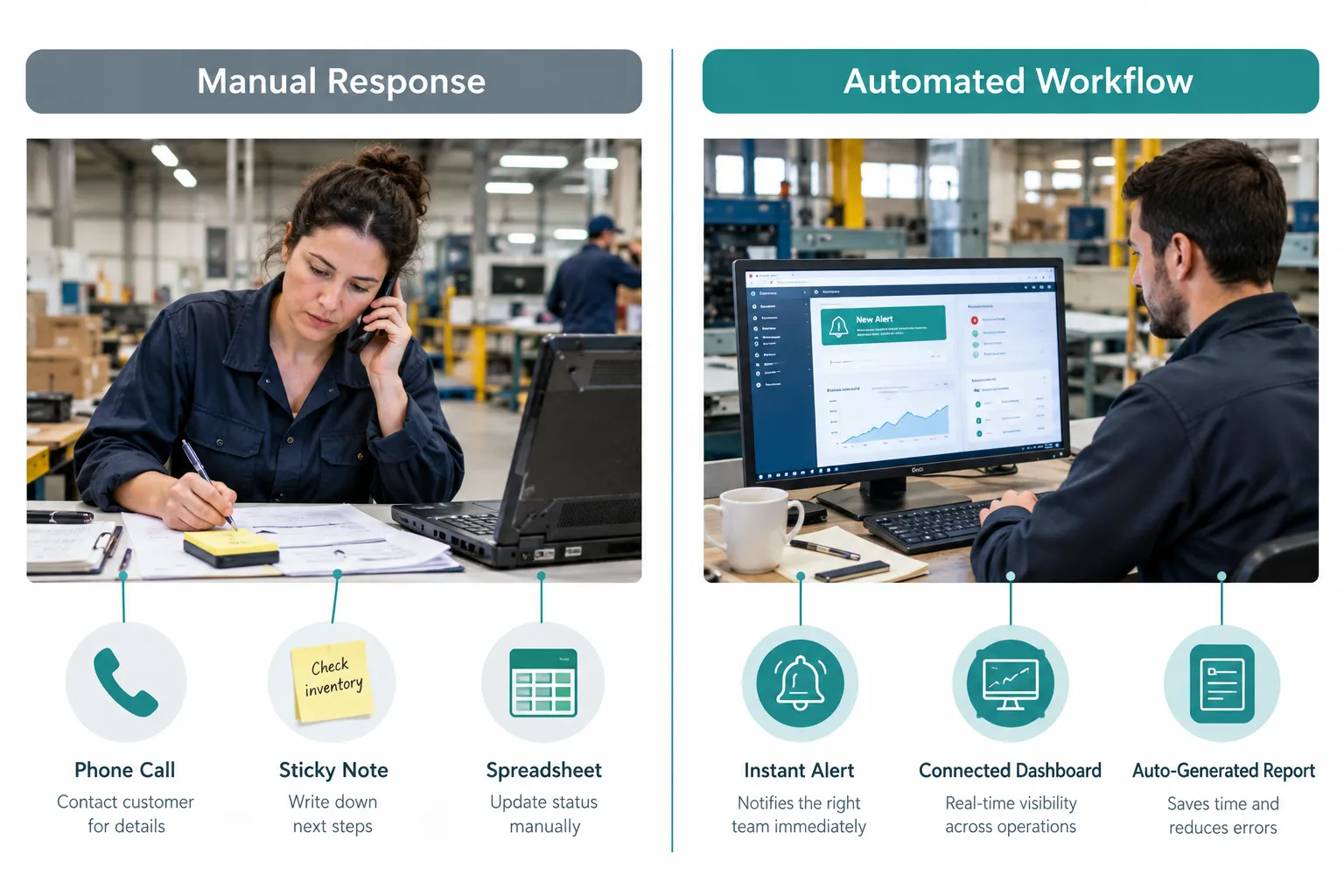
The common manual pattern looks like this: a production event happens, an operator notices, the operator finds a supervisor, the supervisor calls maintenance, and someone eventually updates the office. Every step adds delay and every handoff risks losing detail.
An automated version routes the event directly: production event triggers a workflow, and the workflow sends a notification based on machine, severity, department, shift, or issue type. Maintenance on the relevant line gets pinged in seconds, not after three phone calls.
Turn downtime events into structured records
Downtime information usually arrives scattered: operator notes scrawled on a form, a few lines from the machine controller, a maintenance tech’s verbal explanation, and an email summary sent later. AI can help organize that unstructured mix into one consistent record, such as machine, issue, start time, duration, notes, suspected cause, and action taken.
Human review still matters here. Anything that affects maintenance decisions, safety procedures, or production planning should get a quick human check before it’s treated as final, even if AI did the first pass at organizing it.
Make shift handoffs better
Information loss between shifts is one of the most common and most fixable downtime problems. An AI-assisted workflow can summarize the prior shift’s downtime events, unresolved issues, maintenance activity, delayed jobs, and open action items into a short handoff note. The incoming supervisor doesn’t have to reconstruct the story from scattered emails and sticky notes.
Edge case: if your plant already runs tight, well-documented shift handoffs on paper, this automation delivers less value. It matters most where handoffs are informal or verbal.
Finding Patterns and Automating Escalation in Production Downtime
Once downtime records are consistent, you can analyze them for recurring causes, repeat offenders among your equipment, and response-time trends across shifts. AI is useful here for summarizing large volumes of records quickly, but it only works as well as the data feeding it.
Patterns worth tracking once you have clean records:
- Recurring equipment issues by machine
- Repeated root causes across unrelated incidents
- Downtime concentration by shift or by product run
- Average time from event detection to maintenance response
- Frequency of failures on specific assets over time
Better automation starts with better data. If your downtime log is inconsistent today, pattern analysis will surface noise, not insight. Fix the recording step first.
Escalation can also be automated with straightforward rules, no AI required for this part:
- Downtime detected
- Event classified by type and severity
- Maintenance notified automatically
- Supervisor notified if downtime exceeds a set threshold
- Work order or task created automatically
- Status tracked until resolution
- Resolution recorded and the downtime report updated
That sequence alone, built with traditional workflow automation, closes most of the gap between “something broke” and “the right person is already working on it.”
AI vs Traditional Automation in Downtime Management: What’s the Difference?
Traditional automation handles rule-based, predictable tasks reliably: notifications, thresholds, routing, task creation, and scheduled reports. AI adds value where the information is messy or unstructured: reading operator notes, summarizing incidents, classifying free text, and spotting patterns across large record sets. The strongest setup usually combines both rather than picking one.
| Capability | Traditional Automation | AI |
|---|---|---|
| Send alert when a threshold is crossed | Yes | Not needed |
| Route notification by machine or shift | Yes | Not needed |
| Read and summarize operator’s handwritten notes | No | Yes |
| Classify unstructured incident text | Limited | Yes |
| Create a work order automatically | Yes | Not needed |
| Spot recurring failure patterns across months of records | Limited | Yes |
| Generate a plain-language incident summary | No | Yes |
Choose traditional automation first if: your problem is speed and routing, like getting alerts to the right person faster. Add AI when: your bottleneck is making sense of unstructured information, like notes, emails, and verbal reports, at scale.
Can AI Actually Reduce Production Downtime, or Is It Overhyped?
AI can meaningfully reduce the business impact of downtime by shrinking response time and improving the quality of information available during and after an event, but it does not eliminate downtime. Claims that AI will “predict and prevent” every failure are overstated unless the plant already has the sensors, historical data, and models built specifically for that equipment.
What’s realistic: AI-assisted workflows can shorten the time between a stoppage and a qualified response, reduce the administrative hours spent reconstructing what happened, and surface recurring causes that were previously buried in scattered notes. What’s not realistic: expecting AI to diagnose a mechanical failure it has never seen data for, or to replace the judgment of an experienced maintenance technician.
Common mistake: treating AI as a standalone fix rather than part of a workflow. AI applied to bad data, missing sensors, or a disorganized maintenance program will not produce reliable results. It amplifies whatever process it’s layered on top of, good or bad.
How Long Does It Take to See ROI from Manufacturing AI, and Which Industries Benefit Most?
Manufacturers typically see measurable workflow improvements, like faster notification and documentation, within weeks to a few months, while predictive maintenance programs that depend on historical model training often take longer, sometimes a year or more, to prove out on a specific asset. ROI timing depends heavily on how much manual, informal process you’re replacing.
Industries that tend to see the clearest benefit share a few traits:
- High downtime cost per hour: automotive, food and beverage, pharmaceutical, and metal fabrication operations running tight schedules
- Multiple shifts: more shift handoffs means more opportunity for lost information
- Complex equipment with existing sensors: CNC, injection molding, and packaging lines that already generate machine data
- Repetitive, high-volume production: more cycles means more data to learn from
Decision rule: if your plant runs a single shift with simple equipment and informal downtime tracking is already working fine, start with the lowest-cost workflow automation first. If you run multiple shifts with tight delivery windows and recurring unplanned stops, the ROI case for a broader rollout is stronger.
Do Small Manufacturers Need AI, or Just Large Factories? What Tools and Costs Should You Expect?
Small and mid-sized manufacturers don’t need a full predictive maintenance platform to benefit from AI. Many get meaningful value from AI-assisted notification, documentation, and reporting workflows that cost far less and deploy much faster than an enterprise predictive maintenance system.
A few practical notes on tools and cost expectations:
- Workflow automation platforms (notification routing, task creation, reporting) are usually the lowest-cost, fastest-to-deploy option and don’t require AI at all to deliver value.
- AI-assisted documentation and summarization tools add moderate cost and typically integrate with systems you already use, like your maintenance management software or shared email.
- Full predictive maintenance platforms with sensor deployment, historical modeling, and ongoing tuning represent the largest investment and the longest timeline, and they make the most sense for high-value, well-instrumented equipment.
There’s no single, reliable industry-wide price point to quote here because cost depends on the number of machines, the sensors already in place, and whether you’re buying software, hardware, or both. The right move is to price a defined pilot, like one production line or one downtime workflow, rather than a plant-wide rollout.
Decision rule: if you’re a smaller operation, start with workflow automation around detection, notification, and documentation. Reserve full predictive maintenance for specific high-cost equipment once you have the sensor and data foundation in place.
What Happens If AI Predictions Are Wrong, and Is AI Better Than Human Technicians?
AI predictions can be wrong, producing false alarms or missed warnings, which is why human review should stay part of any maintenance or safety decision. AI is not better than an experienced maintenance technician at diagnosing a specific mechanical problem; it’s better at scanning large volumes of data for patterns a person wouldn’t have time to find manually.
A false positive from an AI alert costs you an unnecessary inspection. A missed detection costs you the downtime event you hoped to avoid. Neither outcome is acceptable as a reason to remove human judgment from the loop. The practical answer is to treat AI output as a flag worth investigating, not a verdict.
Edge case: if your maintenance team already has strong tribal knowledge and low unplanned downtime, AI’s marginal value is lower. It adds the most where institutional knowledge is thin, staff turnover is high, or the plant is too large for any one person to track everything by memory.
How Do You Implement AI for Downtime Without Disrupting Production, and What Mistakes Should You Avoid?
Implement AI for downtime reduction by starting with a single, well-defined workflow on one line, running it alongside your existing process, and expanding only after you’ve measured a real improvement. This avoids disrupting production because nothing about the existing control or safety systems changes; you’re adding an information layer, not replacing machine operations.
A practical rollout checklist:
- Pick one downtime workflow, like detection plus notification, on one line or one machine
- Define what you’re measuring before you start (response time, reporting time, recurring causes)
- Run the new workflow alongside the old process for a defined period
- Review accuracy and usefulness with the people actually using it, not just leadership
- Fix data gaps before expanding to more lines or more AI capability
- Expand only after the pilot shows a measurable improvement
Common mistakes to avoid:
- Rolling out plant-wide before piloting on one line
- Buying a predictive maintenance platform before sensors or historical data exist
- Skipping the baseline measurement, so you can’t prove improvement later
- Removing human review too early from maintenance or safety-related outputs
- Treating the software purchase as the finish line instead of the data and process work around it
What AI Cannot Fix
AI cannot fix a machine that’s failing because of poor maintenance, missing spare parts, bad equipment design, or unsafe operating procedures. It also cannot compensate for missing sensors, inconsistent downtime logging, or poor production planning upstream of the equipment.
What AI and automation can do is improve the workflow surrounding these problems: faster notification when they occur, better documentation of patterns, and clearer visibility into how often and where they happen. But if your root cause is a ten-year-old motor that’s overdue for replacement, no amount of workflow automation changes that fact. The operational issue still needs a decision and a budget, not a dashboard.
Calculate Your Downtime Opportunity
A simple starting formula: downtime hours per month multiplied by your estimated cost per production hour equals your direct downtime opportunity. From there, layer in labor, overtime, missed shipments, expedited freight, scrap, and administrative recovery time to get a fuller picture.
This is an internal business estimate, not a guaranteed savings figure. Treat it as a planning tool to decide where automation investment makes sense, not a promise of what any vendor will deliver.
Example: From Manual Downtime Reporting to an Automated Workflow
Before: a machine stops, an operator records the issue on paper, a supervisor gets contacted in person or by radio, maintenance investigates when they can get free, someone updates a shared spreadsheet hours later, and the plant manager sees a summary the next morning.
After: the production event is detected automatically, a workflow creates the event record, the right team gets notified immediately, available information gets organized into a consistent record, maintenance responds and logs the resolution, and the downtime report updates itself.
The point isn’t that AI fixed the machine. The point is that the business responded faster and captured better information, which is where the real savings in labor hours and decision quality show up.
Where Should a Manufacturer Start With AI for Manufacturing Downtime?
Start with one measurable downtime workflow, like detection plus notification plus documentation, rather than trying to automate everything at once. Measure response time, downtime duration, reporting time, recurring causes, maintenance response time, and administrative hours before and after, then decide whether expanding automation makes financial sense for your plant.
This approach keeps risk low, gives you real numbers instead of assumptions, and builds the internal case for further investment using your own data instead of a vendor’s marketing claims.