

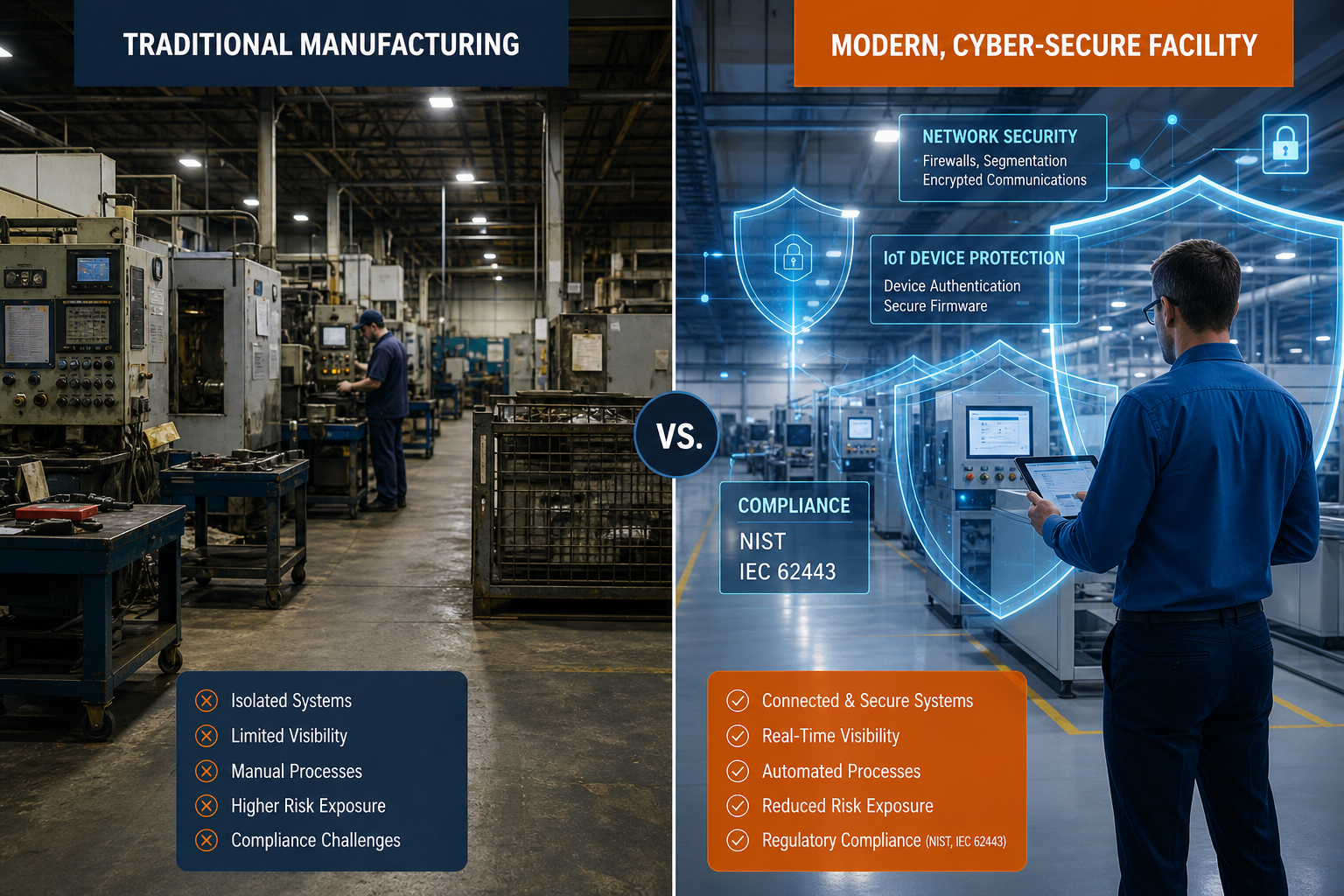
What Is Manufacturing Cybersecurity Compliance and Why Does It Matter
Manufacturing cybersecurity compliance means following specific security standards and frameworks designed to protect both your information technology (IT) systems and operational technology (OT) that runs your production lines. Unlike other industries that focus mainly on data protection, manufacturers must secure everything from office computers to programmable logic controllers (PLCs) that control machinery.
The stakes are higher in manufacturing because a cyberattack can shut down production lines, not just steal data. When a ransomware attack hits your plant floor systems, you’re looking at potential downtime costs of thousands of dollars per hour, plus the expense of getting systems back online safely.
Why compliance matters right now:
- Customer requirements: Major customers increasingly require cybersecurity certifications before awarding contracts
- Cyber insurance: Insurance companies are tightening requirements and may deny claims if basic security standards aren’t met
- Regulatory pressure: Industry-specific regulations are expanding, especially for defense contractors and critical infrastructure
- Supply chain security: Being part of larger supply chains means your security affects your partners’ compliance
The good news is that proper manufacturing cybersecurity compliance actually improves your operations. You’ll have better visibility into your systems, more reliable backups, and faster incident response, all of which reduce downtime and eliminate IT headaches.
How Manufacturing Cybersecurity Differs From Other Industries
Manufacturing cybersecurity compliance is unique because you’re protecting two distinct but connected environments: your business IT systems and your operational technology that controls production. This creates complexity that most other industries don’t face.
The key differences:
Operational Technology (OT) Focus: Your production systems often run on older software that can’t be updated frequently without shutting down operations. This means you need specialized security approaches that don’t disrupt manufacturing processes.
Uptime Requirements: While a bank might handle a few hours of system downtime, manufacturers often need 24/7 operations. Security measures must be designed to maintain continuous production while providing protection.
Physical Safety Concerns: A cybersecurity incident in manufacturing can pose real physical risks if safety systems are compromised. This adds layers of compliance requirements around functional safety standards.
Legacy System Integration: Many manufacturers operate equipment that’s decades old but still functional. Compliance frameworks must account for securing these systems without expensive replacements.
Supply Chain Complexity: Manufacturing involves multiple suppliers, contractors, and partners who all need appropriate security measures. Your compliance extends beyond your facility walls.
The practical impact is that manufacturing cybersecurity compliance requires industry expertise. Generic IT security approaches often fall short because they don’t account for the unique challenges of protecting production environments while maintaining operations.
What Are the Main Cybersecurity Compliance Standards for Manufacturers
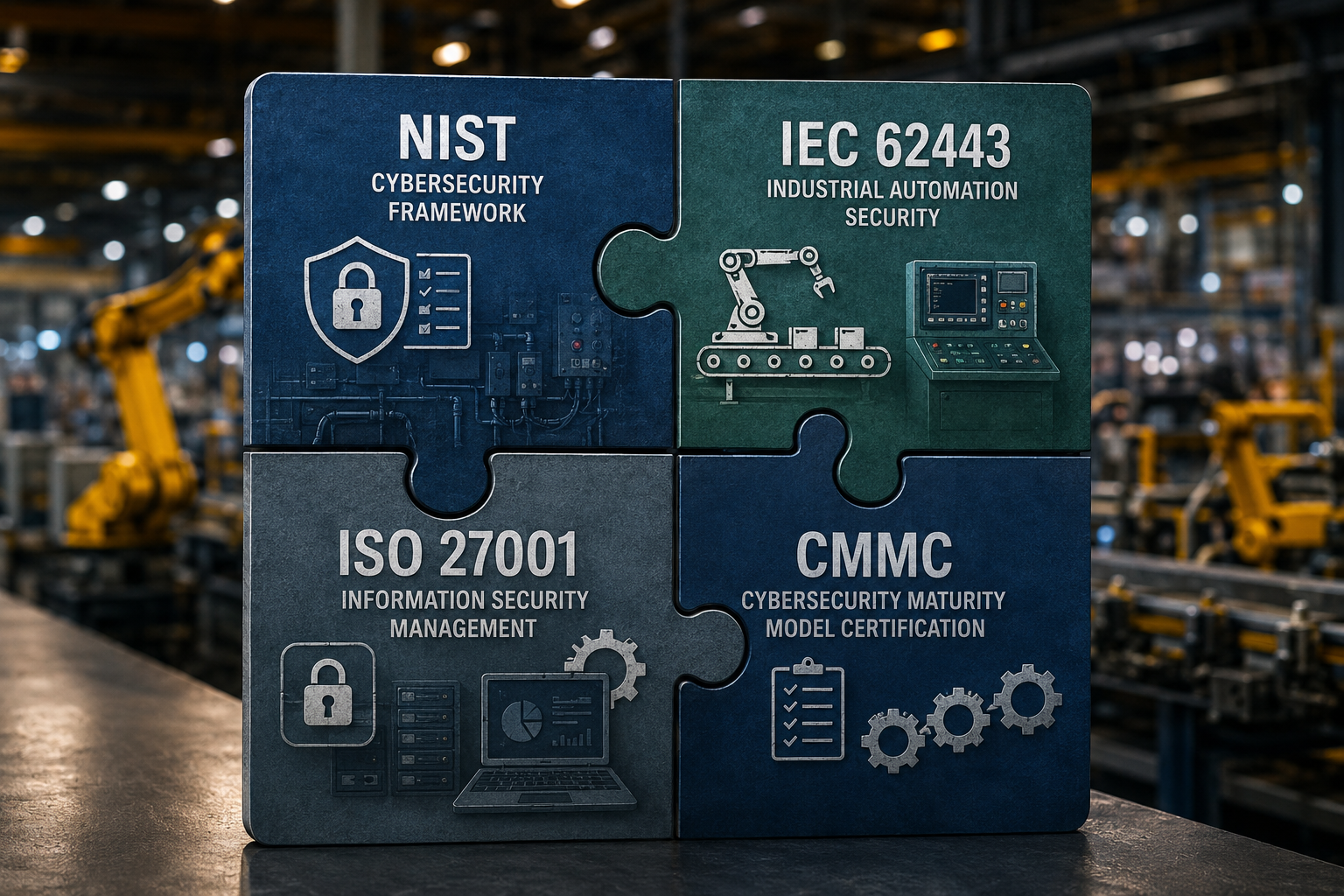
Several key frameworks guide manufacturing cybersecurity compliance, each with different focus areas and requirements. Understanding which ones apply to your business helps you prioritize your security investments effectively.
NIST Cybersecurity Framework: This is often the starting point for manufacturers because it provides a flexible, risk-based approach. The framework covers five core functions: Identify, Protect, Detect, Respond, and Recover. It’s particularly useful for manufacturers because it can be adapted to both IT and OT environments.
IEC 62443 Series: Specifically designed for industrial automation and control systems, this international standard addresses the unique security needs of manufacturing operations. It provides detailed guidance for securing everything from individual components to entire industrial networks.
ISO 27001: This information security management standard helps manufacturers establish comprehensive security programs. While not manufacturing-specific, it’s often required by large customers and provides a solid foundation for overall cybersecurity governance.
CMMC (Cybersecurity Maturity Model Certification): Essential for defense contractors and their supply chains. If you work with the Department of Defense, CMMC compliance isn’t optional; it’s required to maintain contracts.
Industry-Specific Standards: Depending on your sector, you might need additional compliance. Automotive manufacturers often follow ISO/SAE 21434, while pharmaceutical companies need to consider FDA cybersecurity guidance.
The key is understanding that these frameworks often complement each other rather than compete. Many manufacturers use NIST as their foundation, then add IEC 62443 for OT-specific requirements and ISO 27001 for comprehensive management systems.
Do I Need ISO 27001 or NIST for My Manufacturing Business
The choice between ISO 27001 and NIST Cybersecurity Framework depends on your specific business requirements, customer demands, and compliance goals. Many manufacturers actually benefit from using both frameworks together rather than choosing just one.
Choose NIST Cybersecurity Framework if:
- You’re starting your cybersecurity compliance journey and need a flexible, cost-effective approach
- Your customers don’t specifically require ISO 27001 certification
- You want to focus on practical security improvements rather than formal documentation
- You need something that works well with operational technology (OT) environments
Choose ISO 27001 if:
- Large customers or contracts specifically require ISO 27001 certification
- You’re in highly regulated industries or work with government contracts
- You want a comprehensive management system that covers all aspects of information security
- You’re willing to invest in the formal certification process and ongoing audits
Consider both when:
- You serve diverse markets with varying compliance requirements
- You want the practical benefits of NIST with the formal recognition of ISO 27001
- Your business is growing, and you anticipate needing formal certification in the future
Cost considerations: NIST implementation typically costs less initially because it doesn’t require formal certification. ISO 27001 involves certification audits, annual surveillance audits, and three-year recertification cycles, which add ongoing costs but provide formal recognition.
The reality is that both frameworks share similar security objectives. Starting with NIST often provides a solid foundation that makes eventual ISO 27001 certification more manageable if your business needs change.
What’s the Difference Between IEC 62443 and the NIST Cybersecurity Framework
IEC 62443 and NIST Cybersecurity Framework serve different but complementary purposes in manufacturing cybersecurity compliance. Understanding their distinct roles helps you implement the right combination for your operations.
IEC 62443 Focus: This standard specifically addresses industrial automation and control systems (IACS). It provides detailed technical requirements for securing the operational technology that runs your production lines, including PLCs, SCADA systems, and industrial networks.
NIST Framework Focus: NIST provides a broader, more flexible approach to cybersecurity that covers both IT and OT environments. It’s designed as a risk management framework rather than a technical specification.
Key Differences:
Technical Depth: IEC 62443 gets into specific technical requirements like network segmentation, access controls for industrial systems, and security levels for different components. NIST focuses more on overall processes and risk management approaches.
Implementation Approach: IEC 62443 follows a zone-and-conduit model that’s specifically designed for industrial environments. NIST uses functional categories that can be applied across different types of systems and organizations.
Certification: IEC 62443 offers formal certification for both products and systems. NIST doesn’t have a formal certification program, making it more flexible but less formal.
Industry Adoption: Many manufacturers use NIST as their overall cybersecurity framework, then apply IEC 62443 standards specifically to their operational technology environments.
Practical Application: You might use NIST to establish your overall cybersecurity program and risk management processes, while implementing IEC 62443 requirements for your plant floor systems and industrial networks.
The most effective approach often combines both frameworks, NIST for enterprise-wide cybersecurity governance and IEC 62443 for OT-specific security requirements.
How Much Does It Cost to Implement Manufacturing Cybersecurity Compliance
Manufacturing cybersecurity compliance costs vary significantly based on your facility size, current security posture, and chosen frameworks, but most manufacturers should budget 2-5% of their total IT spending for comprehensive compliance programs.
Typical Cost Ranges:
Small Manufacturers (10-50 employees): $25,000-$75,000 annually for basic compliance, including managed security services, employee training, and essential security tools. This usually covers NIST framework implementation with 24/7 monitoring and same-day support.
Mid-Size Manufacturers (50-200 employees): $75,000-$200,000 annually for comprehensive programs including formal framework implementation, regular assessments, and dedicated security resources.
Large Manufacturers (200+ employees): $200,000+ annually for enterprise-level compliance, including multiple framework certifications, internal security teams, and advanced security technologies.
One-Time Implementation Costs:
- Initial security assessment and gap analysis: $10,000-$25,000
- Network segmentation and infrastructure upgrades: $15,000-$50,000
- Security tool deployment and configuration: $20,000-$75,000
- Employee training and policy development: $5,000-$15,000
Ongoing Annual Costs:
- Managed cybersecurity services with proactive solutions: $30,000-$100,000
- Compliance audits and assessments: $15,000-$40,000
- Security tool licensing and maintenance: $10,000-$30,000
- Employee training updates: $2,000-$8,000
Cost-Saving Strategies:
- Partner with a reliable managed security provider for 24/7 monitoring instead of building internal teams
- Start with the NIST framework implementation before pursuing formal certifications
- Leverage industry expertise through managed services rather than hiring specialized internal staff
- Focus on high-impact security measures that provide immediate protection and peace of mind
Remember that compliance costs are often offset by reduced cyber insurance premiums, avoided downtime costs, and improved operational efficiency.
How Long Does It Take to Become Compliant With Manufacturing Cybersecurity
Most manufacturers can achieve basic manufacturing cybersecurity compliance within 6-12 months, though the timeline depends heavily on your starting point, chosen frameworks, and available resources. The key is taking a phased approach that provides immediate security improvements while building toward full compliance.
Typical Implementation Timeline:
Months 1-2: Assessment and Planning
- Conduct a comprehensive security assessment of both IT and OT systems
- Identify compliance gaps and prioritize remediation efforts
- Develop an implementation roadmap with clear milestones
- Establish partnerships with managed security providers for ongoing support
Months 3-6: Core Security Implementation
- Deploy essential security controls like network segmentation and endpoint protection
- Implement 24/7 monitoring and incident response capabilities
- Establish backup and recovery procedures
- Begin employee security awareness training
Months 6-9: Framework Alignment
- Align security controls with chosen compliance frameworks (NIST, IEC 62443, etc.)
- Document policies and procedures
- Conduct internal assessments and address remaining gaps
- Implement proactive solutions for ongoing compliance maintenance
Months 9-12: Validation and Certification
- Prepare for external audits or assessments
- Complete formal certification processes if required
- Establish ongoing compliance monitoring and improvement processes
- Achieve full compliance status with peace of mind
Factors That Accelerate Timeline:
- Working with experienced managed security providers who offer industry expertise
- Starting with existing security foundations rather than building from scratch
- Focusing on practical security improvements over extensive documentation
- Having executive support and dedicated project resources
Factors That Extend Timeline:
- Complex legacy systems requiring specialized security approaches
- Multiple compliance frameworks with overlapping requirements
- Limited internal resources or competing business priorities
- Extensive customization needs or unique operational requirements
The goal is to achieve meaningful security improvements quickly while building sustainable compliance processes that eliminate IT headaches long-term.
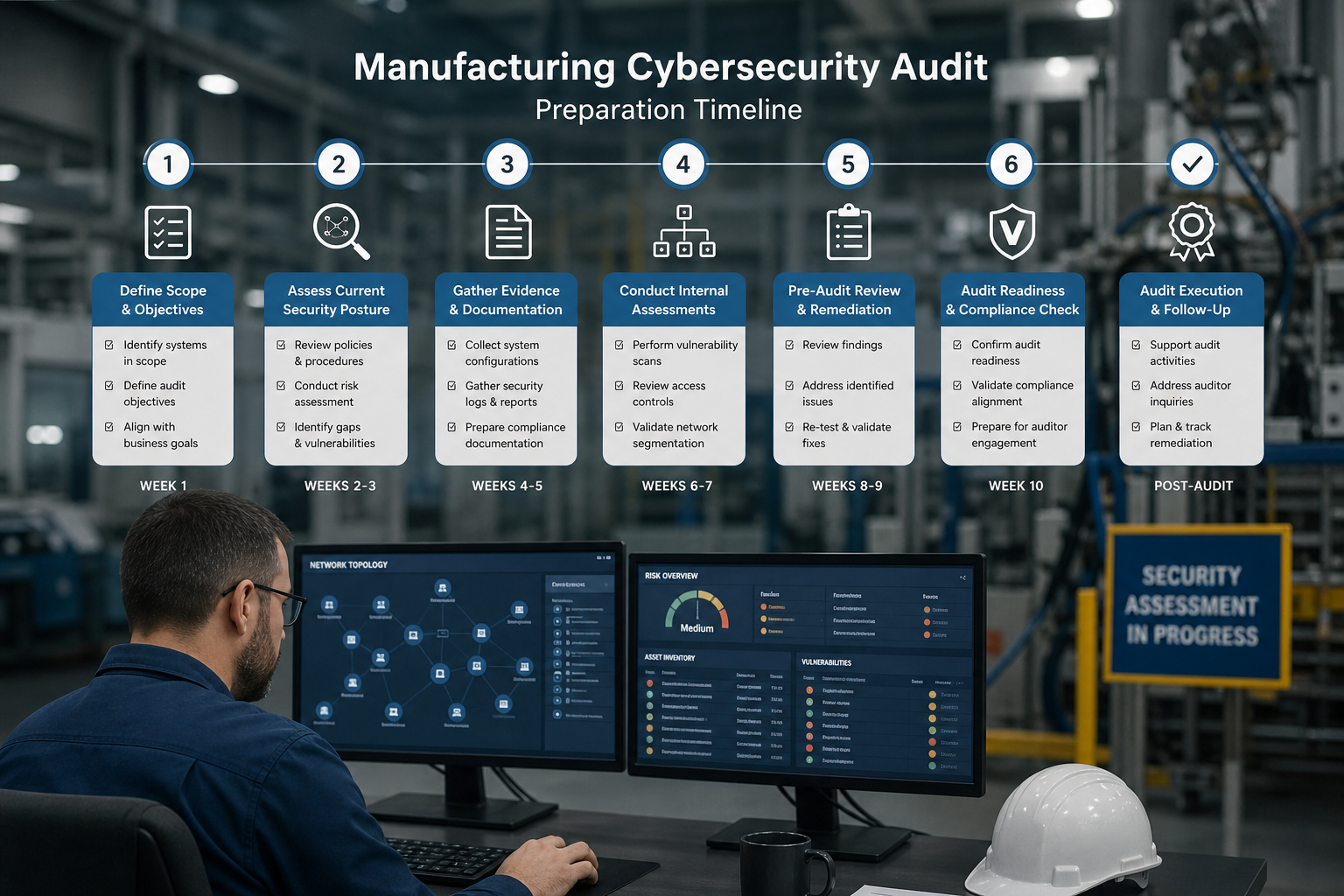
What Are Common Mistakes Manufacturers Make With Cybersecurity Compliance
The biggest mistake manufacturers make is treating cybersecurity compliance as a one-time project rather than an ongoing business process. This approach leads to gaps that create vulnerabilities and compliance failures during audits or customer assessments.
Treating IT and OT Security Separately: Many manufacturers handle office IT security completely separately from operational technology security. This creates gaps at the intersection points and misses the reality that modern manufacturing environments are increasingly connected.
Waiting Until Audit Time: Some manufacturers only focus on compliance when facing an audit or customer assessment. This reactive approach is expensive, stressful, and often results in rushed implementations that don’t provide real security benefits.
Focusing Only on Documentation: Compliance frameworks require documentation, but some manufacturers spend so much time on paperwork that they neglect actual security improvements. The goal is better security, not just better documentation.
Ignoring Employee Training: Technical security controls are important, but employees remain the biggest security risk in most organizations. Manufacturers often underestimate the importance of ongoing security awareness training for both office and plant floor workers.
Choosing the Wrong Framework: Not all compliance frameworks are equally relevant for every manufacturer. Choosing based on what competitors are doing rather than actual business requirements wastes time and resources.
Underestimating Ongoing Costs: Initial compliance implementation is just the beginning. Many manufacturers fail to budget for ongoing monitoring, regular assessments, and continuous improvement activities.
DIY Approach for Specialized Areas: While manufacturers excel at making things, cybersecurity requires specialized expertise that’s often more cost-effective to outsource to reliable partners who provide industry expertise and 24/7 monitoring.
Neglecting Remote Workers: The shift to hybrid work means manufacturing cybersecurity compliance now extends beyond facility walls to home offices and mobile devices used by employees.
The key is viewing compliance as an investment in operational reliability and business growth rather than just a regulatory burden.
Can Small Manufacturers Skip Cybersecurity Compliance Requirements
Small manufacturers cannot afford to skip cybersecurity compliance requirements in 2026, as customer contracts, cyber insurance policies, and supply chain partnerships increasingly require basic security standards regardless of company size.
Why Small Manufacturers Can’t Skip Compliance:
Customer Contract Requirements: Even small manufacturers often serve larger customers who require cybersecurity certifications or attestations. Losing a major customer contract due to compliance gaps can be devastating for smaller operations.
Cyber Insurance Demands: Insurance companies are tightening requirements and may deny claims or refuse coverage for manufacturers without basic cybersecurity measures. The cost of a cyber incident without insurance coverage could put a small manufacturer out of business.
Supply Chain Security: Being part of larger supply chains means your security affects your partners’ compliance. Supply chain attacks often target smaller, less secure companies as entry points to larger organizations.
Regulatory Expansion: Compliance requirements are expanding to cover smaller manufacturers, especially those in critical infrastructure sectors or defense supply chains.
Practical Approaches for Small Manufacturers:
Start with the NIST Framework: Focus on the most critical security functions first: Identify, Protect, Detect, Respond, and Recover. This provides a structured approach without overwhelming complexity.
Leverage Managed Services: Partner with reliable managed security providers who offer industry expertise, 24/7 monitoring, and same-day support. This provides enterprise-level security without the overhead of internal teams.
Focus on High-Impact Controls: Prioritize security measures that provide the biggest risk reduction, such as network segmentation, endpoint protection, and employee training.
Phased Implementation: Implement compliance gradually over 6-12 months, focusing on immediate security improvements while building toward full compliance.
Cost-Effective Solutions: Use cloud-based security tools and managed services that provide straightforward pricing without large upfront investments.
The reality is that small manufacturers often face the same cyber threats as larger companies but with fewer resources to recover from incidents. Compliance provides essential protection and peace of mind.
What Happens if a Manufacturer Fails a Cybersecurity Audit
Failing a manufacturing cybersecurity compliance audit can have immediate and long-term business consequences, but the specific impact depends on the type of audit, your industry, and how you respond to identified deficiencies.
Immediate Consequences:
Contract Loss or Suspension: Customer audits that reveal significant gaps often result in contract suspension until issues are resolved. For defense contractors, CMMC audit failures mean immediate loss of eligibility for new contracts.
Increased Insurance Costs: Cyber insurance audits that identify deficiencies typically result in higher premiums, reduced coverage, or policy cancellation. Some insurers may refuse to renew policies until gaps are addressed.
Regulatory Action: For manufacturers in regulated industries, audit failures can trigger regulatory investigations, fines, or mandatory remediation timelines.
Reputation Damage: Word of audit failures often spreads through industry networks, potentially affecting relationships with other customers and partners.
Remediation Requirements:
Corrective Action Plans: Most audits require formal remediation plans with specific timelines and milestones. You’ll need to demonstrate progress through follow-up assessments.
Enhanced Monitoring: Failed audits often result in more frequent future audits or continuous monitoring requirements until compliance is demonstrated.
Third-Party Validation: Some audit failures require independent verification of remediation efforts, adding cost and complexity to the recovery process.
How to Minimize Impact:
Immediate Response: Acknowledge gaps honestly and present a clear remediation plan with realistic timelines. Customers and auditors appreciate transparency and proactive solutions.
Professional Support: Engage experienced managed security providers who can quickly implement necessary controls and provide ongoing industry expertise.
Communication: Keep stakeholders informed of progress and demonstrate commitment to achieving compliance and maintaining security.
The key is treating audit findings as opportunities to improve security and operational reliability rather than just compliance checkboxes.
Which Manufacturing Cybersecurity Compliance Applies to My Industry
Different manufacturing sectors face varying cybersecurity compliance requirements based on their products, customers, and regulatory environment. Understanding which standards apply to your specific industry helps you focus compliance efforts effectively.
Defense and Aerospace Manufacturing: CMMC (Cybersecurity Maturity Model Certification) is mandatory for Department of Defense contractors and subcontractors. You’ll also need NIST SP 800-171 compliance and may require additional standards like ITAR for export-controlled technologies.
Automotive Manufacturing: ISO/SAE 21434 for cybersecurity engineering is becoming standard, especially for connected vehicle components. Traditional automotive suppliers often need ISO 27001 and may require specific customer standards from major OEMs.
Pharmaceutical and Medical Device Manufacturing: FDA cybersecurity guidance applies to medical device manufacturers, while pharmaceutical companies must consider GxP compliance alongside cybersecurity requirements. ISO 27001 is commonly required by industry partners.
Chemical and Process Manufacturing: Facilities handling hazardous materials often fall under critical infrastructure requirements. IEC 62443 is particularly important for process control systems, and you may need additional standards for environmental compliance.
Food and Beverage Manufacturing: FDA cybersecurity guidance applies to food safety systems, while supply chain partners often require basic cybersecurity certifications. Focus on protecting systems that could affect food safety or traceability.
Electronics and Technology Manufacturing: Customer requirements vary widely, but ISO 27001 and NIST frameworks are common. Export control compliance (EAR/ITAR) may add cybersecurity requirements for certain products.
General Manufacturing: Most manufacturers benefit from starting with the NIST Cybersecurity Framework as a foundation, then adding industry-specific requirements based on customer contracts and regulatory needs.
Universal Requirements: Regardless of industry, most manufacturers need basic cybersecurity measures for cyber insurance, customer contracts, and operational protection. This typically includes network security, endpoint protection, backup systems, and employee training.
The key is conducting a thorough assessment of your specific requirements rather than assuming generic standards will meet all your compliance needs.
How Do I Know if My Manufacturing Facility Is Actually Secure
Determining whether your manufacturing facility is truly secure requires ongoing assessment that goes beyond compliance checkboxes to evaluate real-world security effectiveness and operational resilience.
Key Security Indicators:
Network Visibility: You should have complete visibility into all devices connected to your networks, including both IT systems and operational technology. If you can’t identify every device, you can’t secure it effectively.
Incident Response Capability: Test your ability to detect, respond to, and recover from security incidents. Regular tabletop exercises help identify gaps in your response procedures and team capabilities.
System Backup and Recovery: Regularly test your backup systems and recovery procedures. The ability to quickly restore operations after an incident is crucial for manufacturing environments that can’t afford extended downtime.
Employee Security Awareness: Conduct regular phishing simulations and security training assessments. Employees who can identify and report security threats are your first line of defense.
Vulnerability Management: Maintain current inventories of all software and systems, with regular vulnerability assessments and timely patching procedures that don’t disrupt operations.
Assessment Methods:
Professional Security Assessments: Engage experienced security professionals to conduct comprehensive evaluations of both IT and OT environments. External assessments often identify blind spots that internal teams miss.
Penetration Testing: Authorized testing that simulates real-world attacks helps identify vulnerabilities that could be exploited by actual threats.
Continuous Monitoring: Implement 24/7 security monitoring that provides real-time threat detection and response capabilities. This ongoing visibility is essential for maintaining security in dynamic manufacturing environments.
Compliance Audits: Regular compliance assessments help ensure you’re meeting required standards while identifying areas for improvement.
Red Flags That Indicate Security Gaps:
- Inability to quickly identify all network-connected devices
- Backup systems that haven’t been tested in the past six months
- Employees who regularly fall for phishing simulations
- Security incidents that go undetected for days or weeks
- Patching procedures that consistently lag behind vendor recommendations
True security requires ongoing attention and proactive solutions rather than periodic compliance activities.
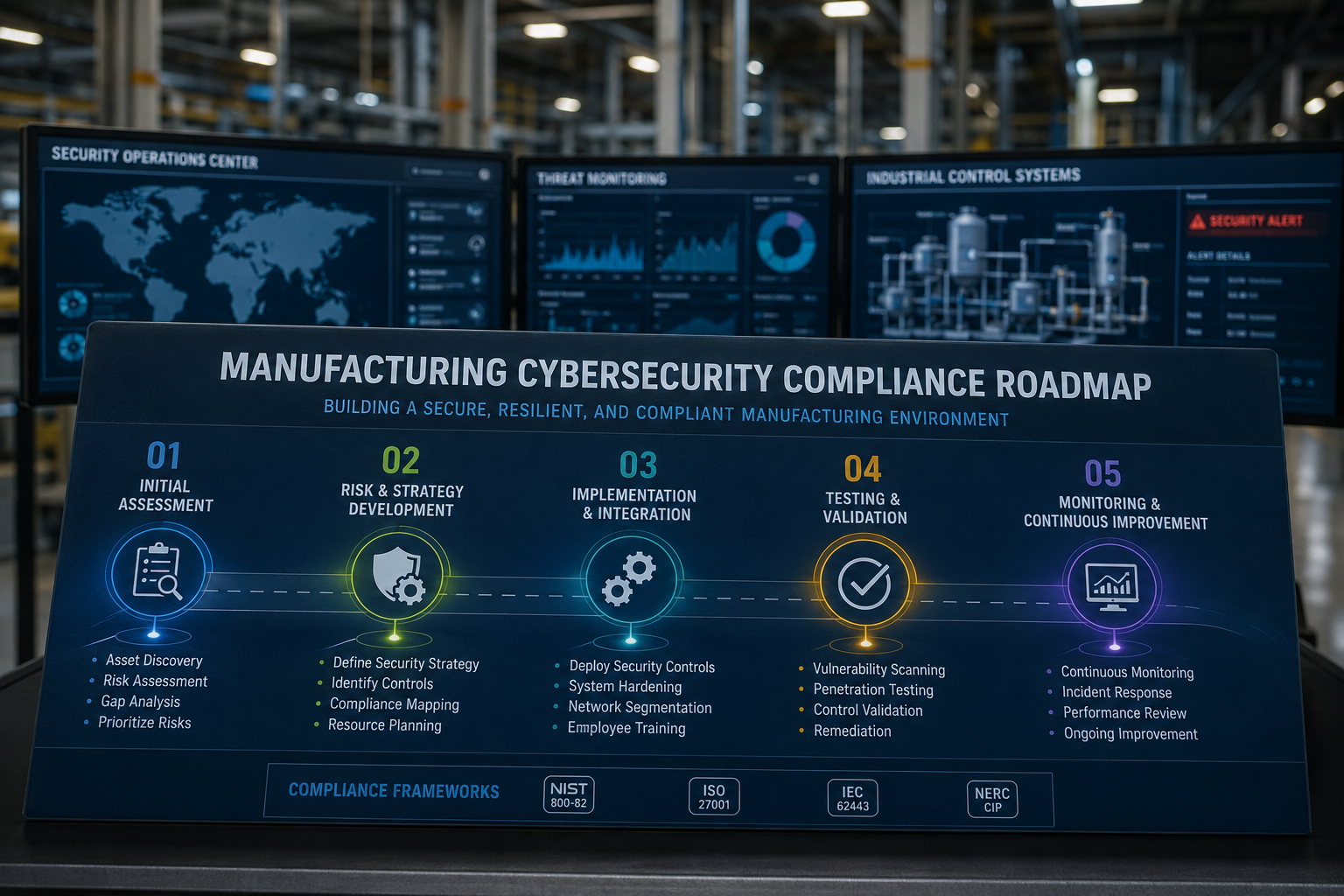
What’s the First Step to Get Manufacturing Cybersecurity Compliant
The first step to achieving manufacturing cybersecurity compliance is conducting a comprehensive security assessment that evaluates both your current security posture and specific compliance requirements. This foundation assessment guides all subsequent security investments and ensures you’re addressing the most critical gaps first.
Comprehensive Security Assessment Components:
Asset Inventory: Document all IT and OT systems, including computers, servers, industrial control systems, and network devices. You can’t secure what you don’t know exists.
Current Security Controls Review: Evaluate existing security measures like firewalls, antivirus software, backup systems, and access controls to understand what’s already working and what needs improvement.
Compliance Gap Analysis: Compare your current state against applicable frameworks (NIST, IEC 62443, ISO 27001) to identify specific requirements you’re not meeting.
Risk Assessment: Identify your most critical systems and data, then evaluate potential threats and vulnerabilities that could impact operations.
Network Architecture Review: Map network connections between IT and OT systems to identify segmentation needs and potential attack paths.
Immediate Actions After Assessment:
Prioritize Critical Gaps: Focus first on security measures that provide the biggest risk reduction, such as network segmentation between IT and OT systems.
Establish Baseline Security: Implement essential controls like endpoint protection, network monitoring, and backup systems that provide immediate protection.
Develop Implementation Roadmap: Create a phased plan that balances security improvements with operational requirements and budget constraints.
Engage Professional Support: Partner with managed security providers who offer industry expertise, 24/7 monitoring, and same-day support to accelerate implementation.
Why Professional Assessment Matters:
- Identifies blind spots that internal teams often miss
- Provides an objective evaluation of current security effectiveness
- Ensures compliance efforts focus on actual business requirements
- Establishes a baseline for measuring improvement progress
- Delivers peace of mind that you’re addressing real risks
Starting with a thorough assessment prevents wasted effort on unnecessary security measures while ensuring critical gaps get addressed first.
Do Manufacturers Need Cybersecurity Compliance for Remote Workers
Yes, manufacturers absolutely need cybersecurity compliance coverage for remote workers in 2026, as hybrid work arrangements have expanded the attack surface beyond traditional facility boundaries to include home offices, mobile devices, and cloud-based systems.
Why Remote Worker Security Is Critical:
Expanded Attack Surface: Remote workers access manufacturing systems from various locations and devices, creating new entry points for cyber threats. A compromised home computer can provide access to your production networks.
Compliance Scope Expansion: Most cybersecurity frameworks now explicitly address remote access security. NIST, ISO 27001, and industry-specific standards include requirements for securing remote connections and mobile devices.
Customer and Insurance Requirements: Major customers and cyber insurance providers increasingly require comprehensive security that covers all access points, including remote workers.
Supply Chain Security: Remote workers often interact with suppliers and customers, making their security part of broader supply chain protection requirements.
Essential Remote Worker Security Controls:
Secure Remote Access: Implement VPN or zero-trust network access that requires authentication and encryption for all remote connections to manufacturing systems.
Endpoint Protection: Ensure all remote devices have current antivirus software, endpoint detection and response capabilities, and automatic security updates.
Multi-Factor Authentication: Require additional authentication factors beyond passwords for accessing any manufacturing systems or sensitive data.
Device Management: Maintain inventory and security oversight of all devices that can access company systems, whether company-owned or personal.
Security Training: Provide specific training for remote workers on home network security, phishing recognition, and incident reporting procedures.
Data Protection: Implement controls that prevent sensitive manufacturing data from being stored on unsecured personal devices or cloud services.
Practical Implementation:
- Deploy managed security solutions that provide 24/7 monitoring across all access points
- Establish clear policies for remote access to operational technology systems
- Regular security assessments that include remote work environments
- Incident response procedures that account for remote worker security events
Remote worker security isn’t optional; it’s an integral part of comprehensive manufacturing cybersecurity compliance that provides peace of mind for all access scenarios.
Building Your Manufacturing Cybersecurity Compliance Roadmap
Creating an effective manufacturing cybersecurity compliance roadmap requires balancing immediate security needs with long-term compliance goals while maintaining operational efficiency. The key is developing a phased approach that provides quick wins while building toward comprehensive compliance.
Phase 1: Foundation and Assessment (Months 1-3)
Start with a comprehensive security assessment that covers both IT and OT environments. This baseline evaluation identifies your current security posture, compliance gaps, and most critical vulnerabilities. Simultaneously, implement essential security controls that provide immediate protection: network segmentation between IT and OT systems, endpoint protection for all devices, and basic backup procedures.
Establish partnerships with reliable managed security providers who can offer industry expertise and 24/7 monitoring. This provides immediate security improvements while you build internal capabilities.
Phase 2: Core Security Implementation (Months 3-6)
Deploy comprehensive security monitoring and incident response capabilities. This includes 24/7 network monitoring, automated threat detection, and documented response procedures. Implement multi-factor authentication for all system access and establish secure remote access procedures for employees and vendors.
Begin formal employee security training programs that address both general cybersecurity awareness and manufacturing-specific threats. Regular training reduces human error risks and supports compliance requirements.
Phase 3: Framework Alignment (Months 6-9)
Align your security program with chosen compliance frameworks such as the NIST Cybersecurity Framework or IEC 62443. Document policies and procedures that demonstrate compliance with specific requirements. Conduct regular vulnerability assessments and penetration testing to validate security effectiveness.
Implement advanced security controls like network micro-segmentation, industrial system monitoring, and enhanced backup and recovery procedures that support business continuity requirements.
Phase 4: Validation and Continuous Improvement (Months 9-12)
Prepare for external audits and customer assessments through internal compliance reviews and gap remediation. Establish ongoing compliance monitoring processes that ensure continuous adherence to requirements.
Implement proactive solutions for emerging threats and evolving compliance requirements. This includes regular security assessments, framework updates, and technology improvements that maintain your security posture.
Ongoing Operations:
- Monthly security assessments and compliance reviews
- Quarterly penetration testing and vulnerability assessments
- Annual framework updates and compliance certifications
- Continuous employee training and awareness programs
The goal is to achieve sustainable compliance that provides peace of mind while supporting business growth and operational excellence.
How Managed IT and Cybersecurity Services Support Manufacturing Compliance
Managed IT and cybersecurity services provide manufacturers with specialized expertise, 24/7 monitoring, and proactive solutions that make compliance achievable without the overhead of building extensive internal security teams. This approach is particularly valuable for manufacturers who need enterprise-level security with straightforward pricing and reliable support.
Core Managed Security Services for Manufacturing:
24/7 Security Monitoring: Continuous monitoring of both IT and OT networks provides real-time threat detection and response capabilities. Managed security providers use specialized tools and expertise to identify threats that internal teams might miss, especially during off-hours when manufacturing operations continue.
Compliance Framework Implementation: Experienced providers understand manufacturing-specific compliance requirements and can guide the implementation of frameworks like NIST, IEC 62443, and ISO 27001. They provide industry expertise that accelerates compliance while avoiding common pitfalls.
Incident Response and Recovery: Professional incident response teams provide immediate support during security events, minimizing downtime and ensuring proper forensic procedures. This same-day support is crucial for manufacturers who can’t afford extended production disruptions.
Vulnerability Management: Regular vulnerability assessments, penetration testing, and patch management services help maintain security without disrupting operations. Managed providers understand manufacturing environments and can schedule activities around production requirements.
Employee Training and Awareness: Comprehensive security awareness programs tailored to manufacturing environments help reduce human error risks. This includes both general cybersecurity training and manufacturing-specific threat education.
Benefits of Managed Approach:
Cost Effectiveness: Managed services typically cost less than hiring specialized internal staff while providing access to broader expertise and advanced security tools.
Scalability: Services can scale with your business growth without requiring additional internal resources or infrastructure investments.
Expertise Access: Managed providers offer specialized knowledge of manufacturing cybersecurity requirements and emerging threats that would be expensive to develop internally.
Peace of Mind: Professional management of security operations allows manufacturing leaders to focus on core business activities while maintaining confidence in their security posture.
Compliance Support: Ongoing compliance monitoring, documentation, and audit preparation services ensure continuous adherence to requirements without internal resource strain.
Choosing the Right Managed Provider:
- Look for providers with specific manufacturing industry expertise
- Ensure they understand both IT and OT security requirements
- Verify 24/7 monitoring and same-day support capabilities
- Confirm experience with your specific compliance frameworks
- Evaluate their approach to personalized service and local support
The right managed security partnership provides reliable, comprehensive protection that eliminates IT headaches while ensuring ongoing compliance and operational security.