

What Is Network Segmentation and Why Does Manufacturing Need It
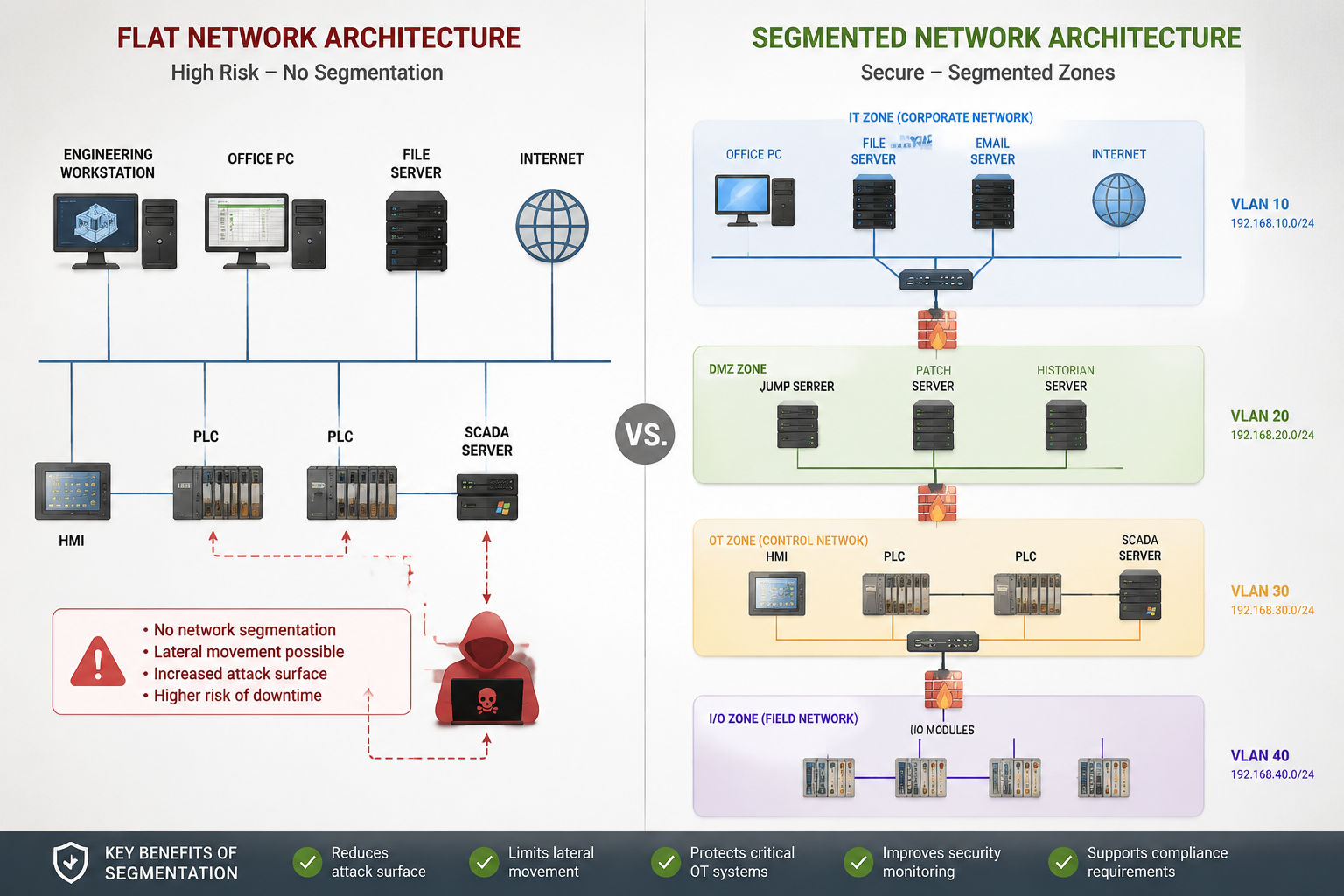
Network segmentation for manufacturing means dividing your facility’s network into separate, controlled zones that limit how systems communicate with each other. Instead of having office computers, production equipment, and control systems all connected on the same network, segmentation creates barriers that prevent unauthorized access and contain security threats.
Manufacturing facilities face unique cybersecurity challenges that make segmentation essential. Your production environment likely contains a mix of modern IT systems and legacy operational technology that wasn’t designed with security in mind. When these systems share the same network, a single infected laptop can potentially shut down your entire production line.
The manufacturing-specific risks include:
- Legacy PLCs and HMIs with minimal security features connecting to modern networks
- Mixed environments where office workers and production systems share network resources
- Remote access requirements for vendors and maintenance teams
- Compliance mandates from cyber insurance providers and industry regulations
- High downtime costs make security incidents extremely expensive
Consider a typical scenario: an employee opens a malicious email attachment on their office computer. Without network segmentation, that malware can spread directly to your production control systems, potentially causing a complete shutdown. With proper segmentation, the threat stays contained in the office network while production continues uninterrupted.
The key difference is that manufacturing networks must balance security with operational requirements. You can’t simply air-gap everything because modern production requires integration between business systems and manufacturing operations. Network segmentation for manufacturing provides that balance through controlled connectivity.
How Does Network Segmentation Improve Manufacturing Security
Network segmentation dramatically improves manufacturing security by creating multiple layers of defense that prevent lateral movement of threats and protect critical production systems. When implemented correctly, segmentation can reduce the impact of successful cyberattacks by 70-80% compared to flat network architectures.
Primary security improvements include:
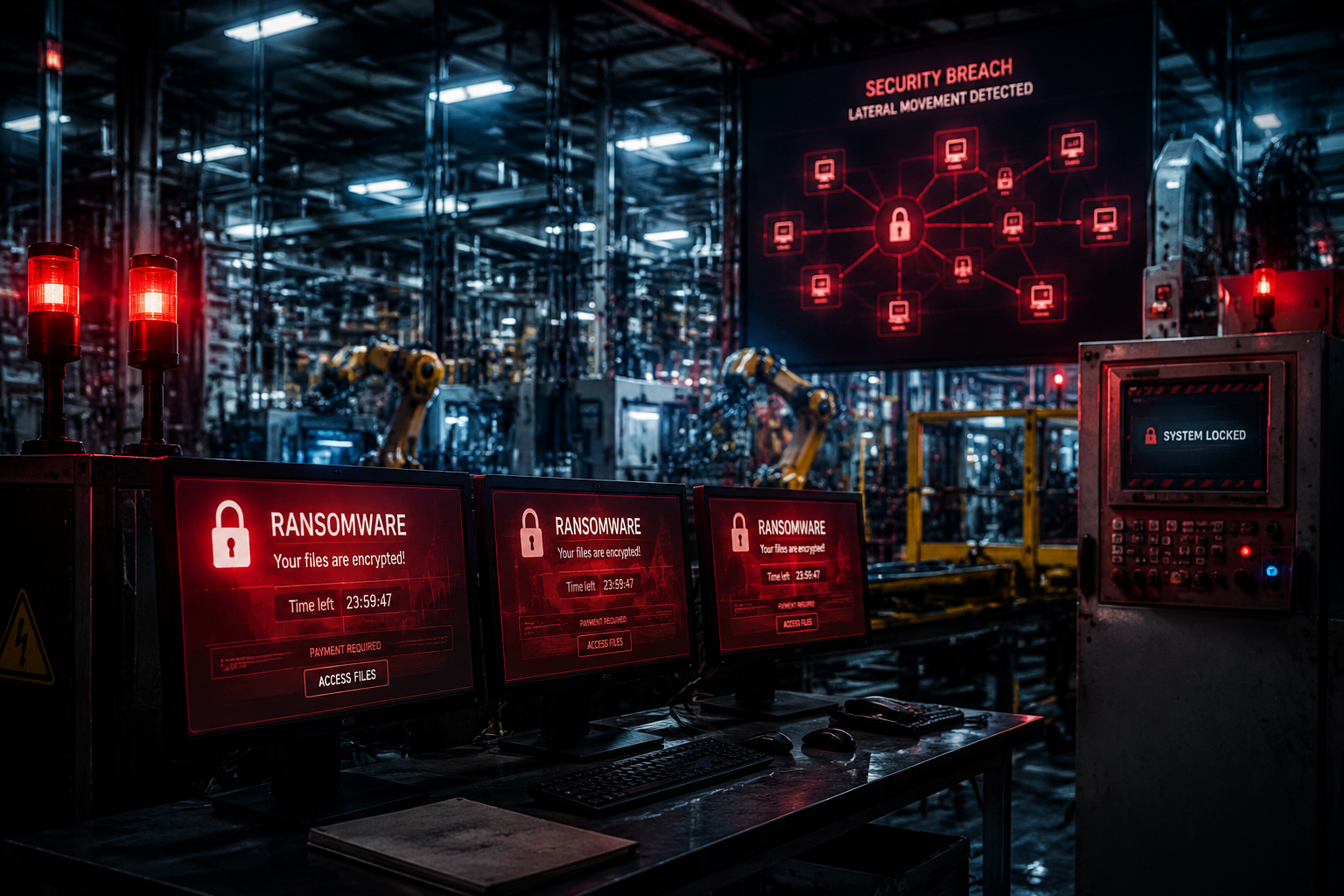
Threat Containment: Malware that infects one network segment cannot automatically spread to other zones. If ransomware hits your office computers, it stays isolated from production equipment and control systems.
Access Control: Each network segment can have specific access rules that determine which users and systems can communicate across zones. This prevents unauthorized access to sensitive manufacturing systems.
Monitoring and Detection: Segmented networks make it easier to monitor traffic between zones and detect suspicious activity. Unusual communication patterns become immediately visible when crossing segment boundaries.
Reduced Attack Surface: By limiting connectivity between systems, segmentation reduces the number of potential attack paths that cybercriminals can exploit to reach critical assets.
Real-world security benefits:
- Ransomware protection: Production systems continue operating even when office networks are compromised
- Insider threat mitigation: Employees can only access systems necessary for their specific roles
- Vendor access control: External maintenance teams get limited access to specific equipment without broader network privileges
- Legacy system protection: Older PLCs and HMIs gain security through network-level controls rather than system replacement
The manufacturing industry has become a prime target for cybercriminals because production downtime creates immediate pressure to pay ransoms. Network segmentation removes that pressure by ensuring that even successful attacks cannot completely shut down operations.
Network Segmentation vs Air-Gapped Networks: Which Is Better
Network segmentation is generally better than air-gapped networks for most manufacturing facilities because it provides strong security while maintaining the connectivity modern production requires. Air-gapped systems offer maximum security by completely isolating networks, but they create operational challenges that often outweigh their security benefits.
Air-gapped networks physically separate systems with no network connections between them. While this provides excellent security, it creates significant operational limitations:
- Data transfer difficulties: Moving information between systems requires manual processes like USB drives
- Remote monitoring limitations: Supervisors cannot access production data from office systems
- Integration challenges: Business systems cannot automatically collect production metrics
- Maintenance complications: Technicians must physically access isolated systems for updates and troubleshooting
Network segmentation provides a middle ground that addresses most security concerns while preserving operational flexibility:
- Controlled connectivity: Systems can communicate across segments through monitored, rule-based connections
- Automated data flow: Production metrics can feed business systems through secure channels
- Remote access capability: Authorized users can access manufacturing systems from appropriate network zones
- Easier maintenance: Updates and monitoring can occur through controlled network connections
Choose air-gapping when:
- You have highly sensitive or classified manufacturing processes
- Regulatory requirements specifically mandate physical network separation
- Your facility can operate effectively with manual data transfer processes
- Security concerns outweigh operational efficiency needs
Choose network segmentation when:
- You need integration between business and manufacturing systems
- Remote monitoring and access are operational requirements
- Your facility relies on automated data collection and reporting
- You want strong security without sacrificing modern manufacturing capabilities
Most manufacturing facilities benefit more from well-implemented network segmentation because it addresses security concerns while supporting the connectivity that modern production requires.
How Much Does It Cost to Implement Network Segmentation in a Factory
Network segmentation implementation costs for manufacturing facilities typically range from $15,000 to $75,000, depending on facility size, network complexity, and existing infrastructure. This investment is significantly less than the average cost of recovering from a successful ransomware attack, which often exceeds $200,000 in downtime and remediation expenses.
Cost breakdown by facility size:
Small Manufacturing Facilities (5-25 employees):
- Basic segmentation: $15,000-$30,000
- Includes: Managed firewalls, VLAN configuration, basic monitoring
- Timeline: 2-4 weeks implementation
Medium Manufacturing Facilities (25-75 employees):
- Standard segmentation: $30,000-$50,000
- Includes: Multiple security zones, advanced firewalls, comprehensive monitoring
- Timeline: 4-8 weeks implementation
Large Manufacturing Facilities (75+ employees):
- Enterprise segmentation: $50,000-$75,000+
- Includes: Complex multi-zone architecture, redundant security systems, 24/7 monitoring
- Timeline: 8-12 weeks implementation
Factors that influence costs:
- Existing network infrastructure: Newer networks require less hardware replacement
- Number of production systems: More PLCs and HMIs increase complexity
- Compliance requirements: Industry-specific standards may require additional security measures
- Remote access needs: Secure remote connectivity adds implementation complexity
- Monitoring requirements: Advanced threat detection and response capabilities increase costs
Return on investment considerations:
The average manufacturing cyberattack costs $50,000-$500,000 in downtime, recovery, and lost production. Network segmentation typically pays for itself by preventing just one successful attack. Additionally, many cyber insurance providers offer premium discounts for properly segmented networks, providing ongoing cost savings.
Financing options:
Many IT service providers offer monthly payment plans that spread segmentation costs over 12-36 months, making implementation more budget-friendly while providing immediate security benefits.
What Happens If a Manufacturing Plant Doesn’t Use Network Segmentation
Manufacturing facilities without network segmentation face catastrophic risks that can shut down production, compromise sensitive data, and threaten business continuity. When office computers and production systems share the same network, a single security incident can spread throughout the entire facility within minutes.
Immediate consequences of unsegmented networks:
Complete Production Shutdown: Ransomware or malware that enters through office systems can directly infect PLCs, HMIs, and other control equipment, forcing a complete halt to manufacturing operations until systems are restored.
Data Theft and Espionage: Cybercriminals can access proprietary manufacturing processes, customer data, and intellectual property through any connected device, potentially compromising competitive advantages and violating customer trust.
Extended Downtime: Without segmentation, recovering from cyberattacks requires cleaning and rebuilding entire networks rather than isolated segments, extending downtime from days to weeks.
Compliance Violations: Many industry standards and cyber insurance policies now require network segmentation, making unsegmented facilities non-compliant and potentially uninsurable.
Real-world scenarios without segmentation:
- Email phishing attack spreads from accounting computer to production control systems, shutting down assembly lines for 72 hours
- USB malware from a maintenance laptop infects the entire network, requiring a complete system rebuild and two weeks of downtime
- A remote access breach gives cybercriminals control over both business systems and manufacturing equipment simultaneously
- Insider threat allows a disgruntled employee to access and sabotage production systems from any network connection
Financial impact:
Manufacturing facilities without segmentation face average incident costs of $300,000-$2 million, including downtime, recovery, regulatory fines, and lost customer confidence. The automotive industry reports particularly high costs due to just-in-time manufacturing requirements.
Competitive disadvantage:
Companies with unsegmented networks cannot take advantage of modern Industry 4.0 technologies because connecting advanced systems to flat networks creates unacceptable security risks. This limits automation, data analytics, and operational efficiency improvements.
The question isn’t whether a cyberattack will happen, but when. Facilities without network segmentation have no defense against the inevitable spread of threats throughout their entire operation.
Network Segmentation for Small vs Large Manufacturing Facilities
Network segmentation approaches differ significantly between small and large manufacturing facilities, but both sizes benefit from tailored strategies that match their operational complexity and security needs. Small facilities can implement effective segmentation with simpler, more cost-effective solutions, while large facilities require comprehensive multi-zone architectures.
Small Manufacturing Facilities (5-50 employees):
Small facilities typically need basic three-zone segmentation that separates office systems, production equipment, and external access. This approach provides strong security without overwhelming limited IT resources.
Recommended zones:
- Corporate zone: Office computers, email, business applications
- Production zone: PLCs, HMIs, manufacturing equipment
- DMZ: Remote access, vendor connections, external-facing systems
Implementation advantages:
- Lower complexity: Fewer systems and connections to manage
- Faster deployment: Basic segmentation can be implemented in 2-4 weeks
- Cost-effective: Managed firewall solutions provide enterprise-level security at small business prices
- Easier maintenance: Simple architecture requires less ongoing management
Large Manufacturing Facilities (100+ employees):
Large facilities require comprehensive multi-zone segmentation that accounts for multiple production lines, diverse equipment types, and complex operational requirements.
Recommended zones:
- Corporate network: Business systems, email, administrative functions
- Production zones: Separate segments for each production line or process area
- Control system zone: SCADA systems, historians, engineering workstations
- Safety system zone: Emergency shutdown systems, fire suppression, safety PLCs
- Vendor zone: Controlled access for maintenance and support teams
- Guest network: Visitor access isolated from all operational systems
Implementation considerations:
- Phased deployment: Large facilities often implement segmentation in phases to minimize operational disruption
- Redundancy requirements: Critical systems may need backup connectivity across multiple zones
- Advanced monitoring: Larger networks require sophisticated threat detection and response capabilities
- Compliance complexity: Multiple regulatory requirements may apply to different facility areas
Key differences in approach:
Small facilities can often use managed security services that provide enterprise-level protection without requiring dedicated IT staff. The focus is on essential protection with straightforward management.
Large facilities typically need dedicated cybersecurity teams and more sophisticated tools to manage complex segmented architectures. The focus is on comprehensive protection with detailed monitoring and response capabilities.
Both sizes should prioritize protecting production systems while maintaining necessary connectivity for modern manufacturing operations.
Can Network Segmentation Slow Down Production Systems
Network segmentation, when properly implemented, does not slow down production systems and often improves overall network performance by reducing unnecessary traffic and optimizing data flows. However, poorly designed segmentation can create bottlenecks that impact manufacturing operations.
Why properly implemented segmentation improves performance:
Reduced Network Congestion: Segmentation limits broadcast traffic and keeps non-essential communications from flooding production networks. Office file transfers and internet browsing no longer compete with time-critical manufacturing data.
Optimized Traffic Routing: Production systems communicate directly within their segments without routing through unnecessary network hops or security checkpoints that aren’t relevant to their operations.
Quality of Service (QoS) Controls: Segmented networks can prioritize manufacturing traffic over less critical communications, ensuring production systems get the bandwidth they need when they need it.
Dedicated Resources: Production segments can have dedicated network infrastructure that isn’t shared with bandwidth-intensive office applications like video conferencing or large file downloads.
Common implementation mistakes that can slow production:
- Over-segmentation: Creating too many small segments that require excessive inter-zone communication
- Inadequate bandwidth allocation: Not providing sufficient network capacity for production segments
- Poorly configured firewalls: Security rules that create unnecessary delays for legitimate manufacturing traffic
- Insufficient QoS policies: Failing to prioritize time-sensitive production communications
Best practices for maintaining performance:
Right-size segments based on actual communication patterns rather than organizational charts. Systems that need frequent, high-speed communication should typically remain in the same segment.
Monitor performance metrics during and after implementation to identify any bottlenecks or latency issues that need adjustment.
Test thoroughly in non-production environments before deploying segmentation changes to critical manufacturing systems.
Plan for growth by ensuring segmented networks have adequate capacity for future expansion and increased data requirements.
Work with experienced partners who understand both manufacturing operations and network security to avoid common pitfalls that can impact performance.
The key is balancing security with operational requirements through careful planning and implementation. Most manufacturing facilities see improved network performance after proper segmentation because production systems no longer compete with office traffic for network resources.
How to Segment a Network in a Manufacturing Environment Step by Step
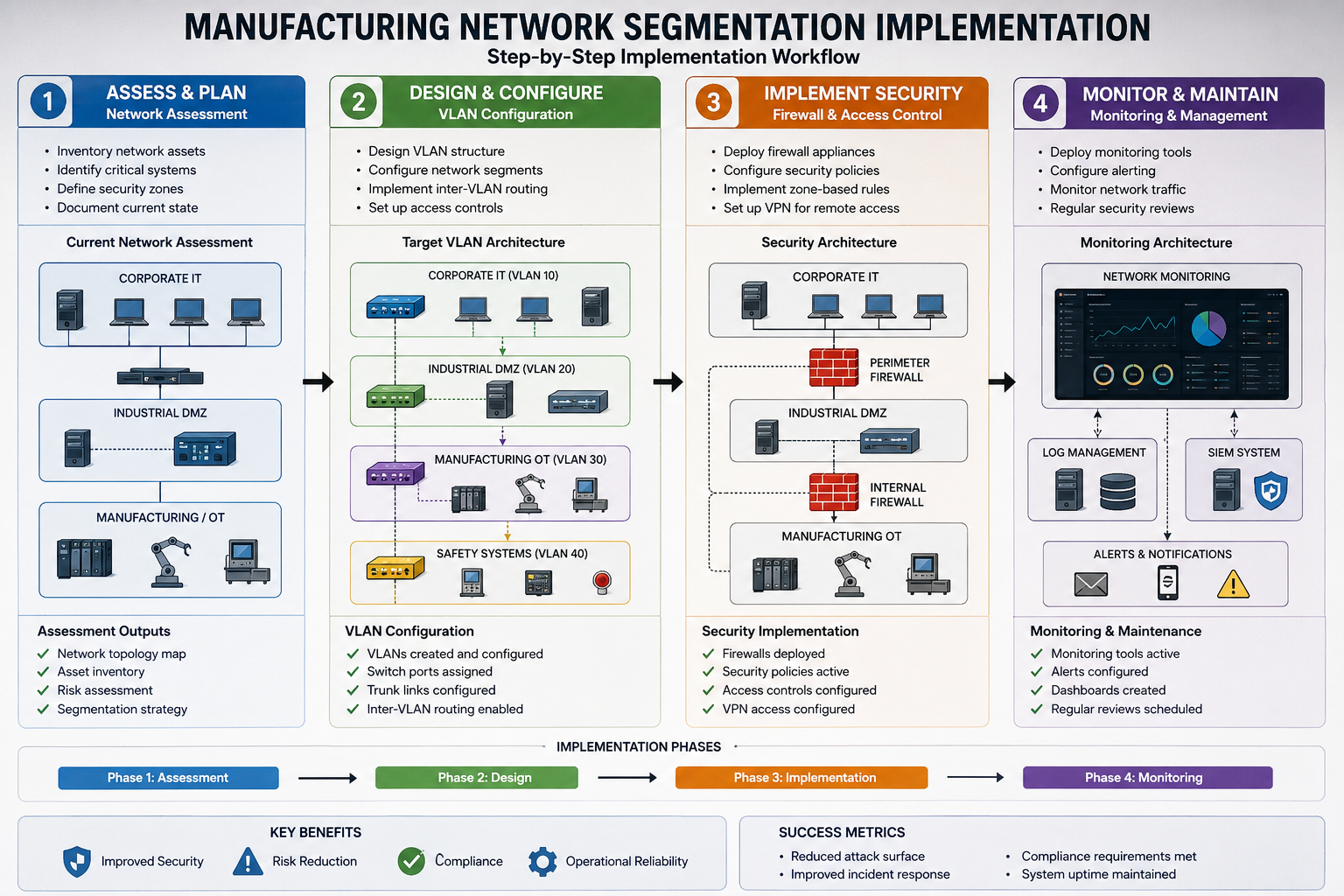
Implementing network segmentation for manufacturing requires a systematic approach that minimizes operational disruption while establishing strong security boundaries. The process typically takes 4-12 weeks, depending on facility complexity, and should always be performed by experienced professionals who understand both manufacturing operations and network security.
Step 1: Network Assessment and Planning (Week 1-2)
Inventory all connected systems: Document every device on your network, including office computers, production equipment, PLCs, HMIs, printers, and any IoT devices. Many facilities discover forgotten or unauthorized devices during this phase.
Map communication requirements: Identify which systems need to communicate with each other and what type of data they exchange. This prevents accidentally blocking critical production communications.
Define security zones: Based on your inventory and communication map, establish logical zones such as corporate, production, control systems, and external access areas.
Step 2: Infrastructure Preparation (Week 2-4)
Install network hardware: Deploy managed switches, firewalls, and other equipment needed to create and control network segments. This may require some brief production downtime for physical installations.
Configure VLANs: Set up Virtual Local Area Networks that logically separate different types of systems even when they share physical network infrastructure.
Establish firewall rules: Create access control policies that define which communications are allowed between network segments and which are blocked.
Step 3: Gradual Implementation (Weeks 4-8)
Start with non-critical systems: Begin by segmenting office networks and other systems that won’t impact production if something goes wrong during implementation.
Implement production segmentation during planned downtime: Move manufacturing systems to their dedicated segments during scheduled maintenance windows to minimize operational impact.
Test connectivity thoroughly: Verify that all necessary communications still work properly after each phase of implementation.
Step 4: Monitoring and Optimization (Weeks 8-12)
Deploy network monitoring tools: Install systems that can detect unusual traffic patterns and potential security threats crossing segment boundaries.
Fine-tune access rules: Adjust firewall policies based on observed traffic patterns and operational requirements that may not have been apparent during planning.
Train staff: Ensure that your team understands the new network architecture and knows how to troubleshoot common connectivity issues.
Critical success factors:
- Maintain detailed documentation of all changes and configurations
- Have rollback plans ready in case any step causes unexpected problems
- Communicate with all stakeholders about timing and potential impacts
- Work during planned maintenance windows whenever possible to minimize disruption
Never attempt to implement manufacturing network segmentation without experienced guidance. The combination of security requirements and operational continuity demands makes this a task for professionals who understand both domains.
Network Segmentation Best Practices for Industrial Control Systems
Industrial control systems require specialized segmentation approaches that account for their unique communication patterns, real-time requirements, and legacy equipment limitations. Standard IT security practices often don’t translate directly to manufacturing environments where availability and deterministic performance are critical.
Zone Architecture for Industrial Controls:
Level 0-1 (Field Devices): PLCs, sensors, actuators, and field instruments should be isolated in dedicated segments with minimal external connectivity. These systems often use specialized protocols like Modbus or EtherNet/IP that weren’t designed for internet connectivity.
Level 2 (Supervisory Control): HMIs, SCADA systems, and local control servers need controlled connectivity to both field devices and higher-level systems. This zone acts as a bridge between operational and business networks.
Level 3 (Manufacturing Operations): Manufacturing execution systems (MES), historians, and production databases require access to control data while maintaining separation from corporate networks.
Level 4 (Business Systems): ERP, inventory management, and other business applications should have limited, controlled access to manufacturing data through secure interfaces.
Critical implementation principles:
Preserve Real-Time Communications: Industrial control systems often require deterministic, low-latency communications that cannot tolerate the delays that poorly configured security devices might introduce. Segment boundaries should not interrupt time-critical control loops.
Account for Legacy Protocols: Many manufacturing systems use older communication protocols that lack built-in security features. Network-level security must compensate for these limitations without breaking functionality.
Maintain Operational Visibility: Operators need access to production data and control capabilities across multiple zones. Segmentation should enable secure access rather than create operational barriers.
Plan for Emergency Access: During emergencies, maintenance teams may need broader access to troubleshoot problems quickly. Have procedures for temporary access expansion that don’t compromise overall security.
Specific technical considerations:
- Use industrial-grade network equipment designed for manufacturing environments
- Implement time synchronization across segments to maintain coordinated operations
- Configure redundant paths for critical communications that can’t tolerate single points of failure
- Monitor protocol-specific traffic to detect anomalies in industrial communications
- Maintain air gaps for safety-critical systems that cannot risk any network-based interference
Common mistakes to avoid:
- Blocking multicast traffic that many industrial protocols require for normal operation
- Over-filtering communications between systems that need frequent data exchange
- Ignoring wireless connections that may provide unauthorized access to control systems
- Failing to segment older systems that may seem “too difficult” to isolate properly
Industrial control system segmentation requires a deep understanding of both manufacturing operations and cybersecurity principles. The goal is to protect critical systems while preserving the operational capabilities that keep production running smoothly.
Common Mistakes When Setting Up Manufacturing Network Segmentation
Manufacturing network segmentation failures often stem from treating industrial environments like standard office networks or rushing implementation without adequate planning. These mistakes can create security gaps, operational disruptions, or both, undermining the entire purpose of segmentation.
Critical planning mistakes:
Insufficient Discovery: Many facilities fail to identify all connected devices before implementing segmentation. Hidden systems like building automation, security cameras, or forgotten maintenance laptops can create unexpected connectivity issues or security gaps.
Ignoring Legacy Systems: Older PLCs and HMIs often have unique communication requirements that standard IT security practices don’t accommodate. Attempting to force these systems into inappropriate security models can break critical functionality.
Over-Segmentation: Creating too many small segments that require constant inter-zone communication can actually reduce security by necessitating overly permissive firewall rules to maintain operations.
Implementation errors:
Inadequate Testing: Rushing to implement segmentation without thorough testing in non-production environments often leads to unexpected outages when systems can’t communicate as expected.
Poor Timing: Implementing major network changes during peak production periods or without adequate maintenance windows can cause unnecessary operational disruptions.
Insufficient Documentation: Failing to document network changes and access rules makes troubleshooting problems extremely difficult and can lead to security gaps when staff make unauthorized modifications.
Operational oversights:
Blocking Necessary Communications: Overly restrictive firewall rules that prevent legitimate system communications can cause production delays or equipment malfunctions.
Ignoring Wireless Networks: Many facilities focus on wired network segmentation while leaving wireless access points unsecured, creating backdoors that bypass all segmentation efforts.
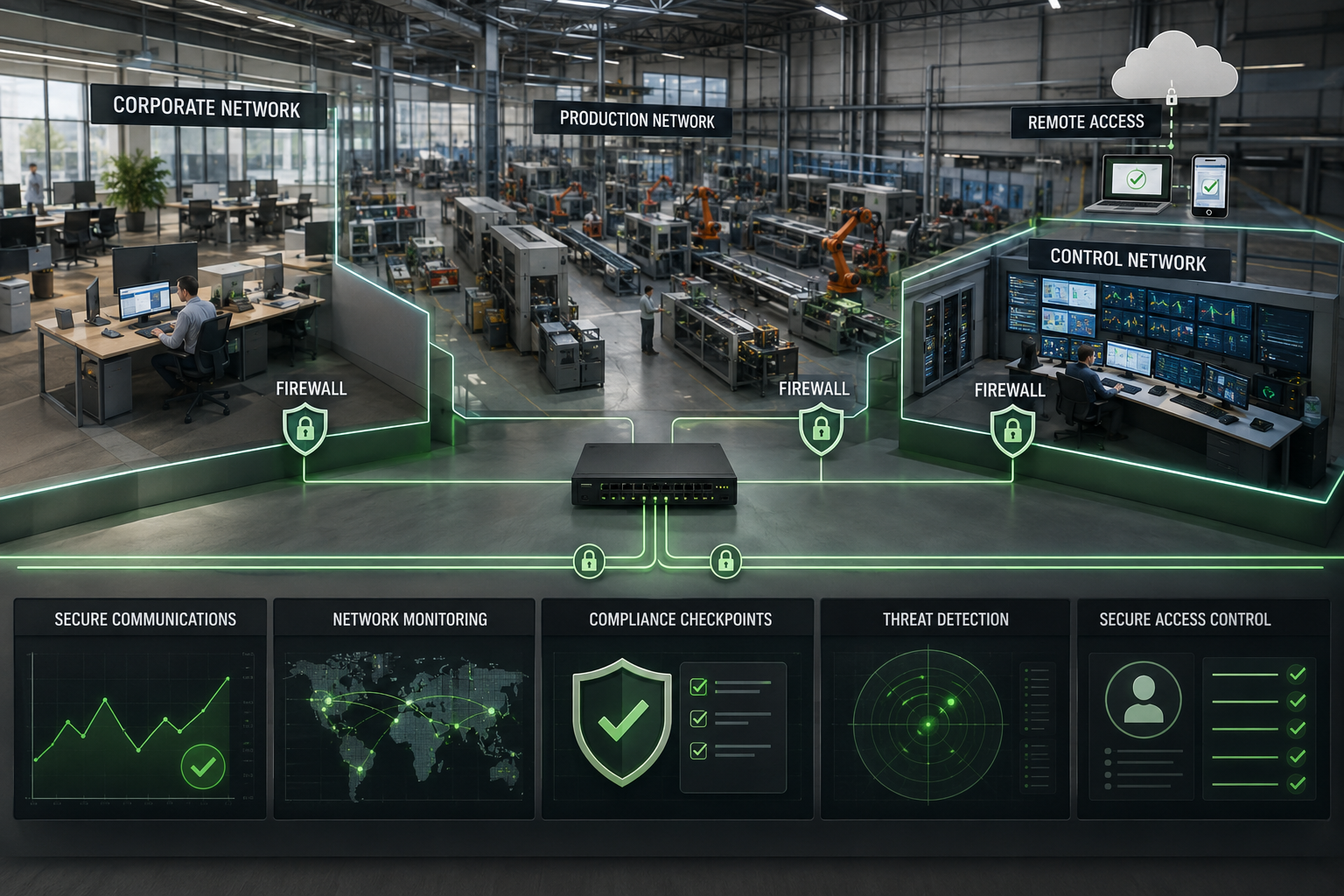
Inadequate Monitoring: Implementing segmentation without proper monitoring tools makes it impossible to detect when security boundaries are compromised or when legitimate systems are having connectivity problems.
Long-term maintenance failures:
Configuration Drift: Network configurations that aren’t properly maintained tend to accumulate unauthorized changes over time, gradually weakening segmentation effectiveness.
Outdated Access Rules: Firewall policies that aren’t regularly reviewed and updated can become overly permissive or block legitimate new system communications.
Staff Training Gaps: Teams that don’t understand segmented network architecture may inadvertently create security gaps when troubleshooting connectivity issues.
How to avoid these mistakes:
- Conduct comprehensive network discovery using both automated tools and manual verification
- Engage manufacturing operations staff throughout the planning and implementation process
- Test all changes in isolated environments before production deployment
- Implement gradually with rollback plans for each phase
- Document everything and maintain current network diagrams and access policies
- Monitor continuously with tools designed for segmented manufacturing networks
The most successful segmentation projects involve close collaboration between IT security professionals and manufacturing operations teams who understand both the security requirements and operational realities of industrial environments.
Network Segmentation for Legacy Manufacturing Equipment
Legacy manufacturing equipment presents unique segmentation challenges because older PLCs, HMIs, and control systems were designed for reliability and functionality rather than cybersecurity. These systems often lack modern security features but are too expensive to replace and too critical to leave unprotected.
Common legacy equipment vulnerabilities:
Unencrypted Communications: Older systems transmit data in plain text using protocols like Modbus RTU or older Ethernet/IP implementations that can be easily intercepted or manipulated.
Default Credentials: Many legacy systems ship with unchangeable default usernames and passwords that are widely known and published online.
No Authentication: Some older equipment accepts commands from any device that can communicate using the correct protocol, with no verification of authorization.
Unpatched Software: Legacy systems often run on operating systems or firmware that no longer receive security updates, leaving known vulnerabilities permanently exposed.
Network-level protection strategies:
Micro-Segmentation: Create very small network segments that isolate individual pieces of legacy equipment or small groups of related systems. This limits the impact if any single device is compromised.
Protocol Filtering: Use industrial firewalls that understand manufacturing protocols to filter communications and block unauthorized commands while allowing legitimate operations.
Network Access Control (NAC): Implement systems that verify device identity and authorization before allowing network access, even for legacy equipment that can’t authenticate itself.
Traffic Monitoring: Deploy specialized monitoring tools that understand industrial protocols and can detect unusual communications patterns that might indicate compromise or malfunction.
Practical implementation approaches:
Wrapper Security: Place legacy equipment behind modern security devices that provide authentication, encryption, and access control without requiring changes to the legacy systems themselves.
Jump Boxes: Require all access to legacy equipment to go through secure intermediary systems that can provide logging, authentication, and session control.
Physical Isolation: For the most critical legacy systems, consider physical network separation with manual or highly controlled data transfer processes.
Scheduled Replacement Planning: While protecting legacy equipment, develop long-term plans to replace the most vulnerable systems during normal equipment refresh cycles.
Balancing protection with functionality:
Legacy equipment segmentation must maintain operational requirements while adding security. This often means:
- Preserving real-time communications that production processes depend on
- Maintaining operator access to systems they need for normal operations
- Supporting maintenance activities that keep equipment running properly
- Enabling data collection for production reporting and analysis
Cost-effective solutions:
Many facilities find that network-level protection for legacy equipment costs significantly less than equipment replacement while providing substantial security improvements. Industrial network security appliances designed specifically for manufacturing environments can protect multiple legacy devices for a fraction of the replacement cost.
The key is implementing layered security that compensates for legacy equipment limitations without disrupting the production operations these systems support.
Who Should Handle Network Segmentation Implementation at a Factory
Network segmentation implementation requires specialized expertise that combines a deep understanding of manufacturing operations with advanced cybersecurity knowledge. Most facilities achieve the best results by partnering with experienced IT service providers who specialize in manufacturing environments rather than attempting implementation with internal resources alone.
Why specialized expertise matters:
Manufacturing network segmentation differs significantly from standard business IT security. The combination of legacy industrial equipment, real-time operational requirements, and high availability demands creates unique challenges that general IT professionals may not fully understand.
Internal team requirements:
If handling implementation internally, your team needs:
Manufacturing Operations Knowledge: Deep understanding of production processes, equipment communication requirements, and operational constraints that cannot be disrupted.
Industrial Networking Expertise: Experience with manufacturing protocols like Modbus, EtherNet/IP, PROFINET, and other specialized communications that differ from standard business networking.
Cybersecurity Skills: Advanced knowledge of network security, firewall configuration, and threat detection specifically applied to industrial environments.
Project Management Capabilities: Ability to coordinate complex implementations across multiple systems while minimizing production disruption.
External partner advantages:
Specialized Experience: Partners who focus on manufacturing cybersecurity have implemented segmentation across dozens or hundreds of facilities, bringing proven methodologies and lessons learned from similar projects.
Comprehensive Resources: Professional implementation teams include specialists in different areas rather than requiring your staff to master every aspect of segmentation.
Objective Perspective: External partners can identify security gaps and operational inefficiencies that internal teams might overlook due to familiarity with existing systems.
Ongoing Support: Experienced partners provide 24/7 monitoring and support capabilities that most internal teams cannot match.
Hybrid approach benefits:
Many successful implementations combine internal knowledge with external expertise:
- Internal teams provide operational knowledge and coordinate with production schedules
- External partners handle technical implementation and provide specialized security expertise
- Joint planning ensures that security measures support rather than hinder manufacturing operations
- Knowledge transfer builds internal capabilities while leveraging external experience
Selecting the right partner:
Look for providers with:
- Manufacturing-specific experience rather than a general IT security background
- Industry certifications in both cybersecurity and industrial automation
- Local presence for hands-on support when needed
- 24/7 monitoring capabilities to detect and respond to security incidents
- Straightforward pricing that makes budgeting predictable
Red flags to avoid:
- Providers who treat manufacturing networks like standard office environments
- Teams without hands-on experience with industrial control systems
- Partners who cannot provide local, same-day support when problems occur
- Proposals that seem significantly cheaper than market rates (often indicating inexperience)
The investment in experienced implementation partners typically pays for itself through faster deployment, fewer operational disruptions, and more effective long-term security outcomes.
Network Segmentation Compliance Requirements for Manufacturing
Manufacturing facilities face increasing compliance requirements for network segmentation from cyber insurance providers, industry standards, and regulatory bodies. These requirements have evolved rapidly as cyberattacks on manufacturing facilities have demonstrated the critical importance of properly segmented networks.
Cyber insurance requirements:
Most cyber insurance policies now require or strongly incentivize network segmentation for manufacturing facilities. Insurance providers have recognized that segmented networks significantly reduce claim severity and frequency.
Common insurance requirements:
- Separation of IT and OT networks with controlled connectivity between zones
- Multi-factor authentication for access between network segments
- Network monitoring and logging capabilities to detect and document security incidents
- Regular security assessments to verify segmentation effectiveness
- Incident response procedures that account for segmented network architecture
Industry-specific standards:
NIST Cybersecurity Framework recommends network segmentation as a core protective measure, particularly for critical infrastructure and manufacturing facilities.
IEC 62443 (Industrial Cybersecurity) provides detailed guidance on network segmentation for industrial control systems, including zone and conduit models that many facilities use as implementation blueprints.
ISO 27001 includes network segmentation requirements as part of a comprehensive information security management system.
Regulatory considerations:
While most manufacturing facilities don’t face direct regulatory mandates for network segmentation, several trends are increasing compliance pressure:
Critical Infrastructure Protection: Facilities that support critical infrastructure may face increasing regulatory requirements for cybersecurity measures, including network segmentation.
Data Protection Regulations: Manufacturers that handle customer data or personal information may need segmentation to comply with privacy regulations like GDPR or state privacy laws.
Supply Chain Security: Government contractors and suppliers to critical industries face increasing cybersecurity requirements that often include network segmentation mandates.
Documentation and audit requirements:
Compliance typically requires:
Network Architecture Documentation: Current diagrams showing all network segments, security controls, and connectivity between zones.
Access Control Policies: Written procedures that define who can access which network segments and under what circumstances.
Monitoring and Logging: Systems that track and record network traffic between segments to support incident investigation and compliance auditing.
Regular Testing: Periodic assessments that verify segmentation controls are working effectively and haven’t been compromised by configuration changes.
Benefits beyond compliance:
While compliance drives many segmentation projects, the operational benefits often exceed the regulatory requirements:
- Reduced cyber insurance premiums through demonstrated risk reduction
- Improved incident response capabilities when security events occur
- Better operational visibility through enhanced network monitoring
- Competitive advantages when bidding on contracts that require cybersecurity certifications
Staying ahead of requirements:
Compliance requirements continue to evolve as cyber threats against manufacturing facilities increase. Facilities that implement comprehensive segmentation now position themselves well for future requirements while gaining immediate security and operational benefits.
Working with partners who understand both current compliance requirements and emerging trends helps ensure that segmentation investments meet both today’s needs and tomorrow’s requirements.
How Often Should Manufacturing Networks Be Resegmented
Manufacturing networks should undergo comprehensive segmentation reviews annually, with continuous monitoring and incremental adjustments throughout the year as operational requirements and threat landscapes evolve. However, the frequency of actual resegmentation depends on facility changes, security incidents, and compliance requirements rather than on a rigid schedule.
Annual comprehensive reviews:
Network architecture assessment: Evaluate whether current segmentation still matches operational reality, including new equipment, changed processes, and evolving communication requirements.
Security effectiveness analysis: Review monitoring data to identify whether segmentation is successfully containing threats and preventing unauthorized lateral movement.
Compliance verification: Ensure segmentation continues to meet insurance, regulatory, and industry standard requirements that may have changed during the year.
Performance optimization: Assess whether network segments are properly sized and configured to support current production demands without creating unnecessary bottlenecks.
Triggers for immediate resegmentation:
Major equipment additions: New production lines, control systems, or significant equipment upgrades often require network architecture changes to maintain proper isolation.
Security incidents: Successful attacks or near-misses may reveal segmentation gaps that need immediate correction rather than waiting for scheduled reviews.
Operational changes: Facility expansions, process modifications, or organizational changes can alter communication requirements and necessitate segmentation updates.
Compliance mandate changes: New insurance requirements, regulatory standards, or industry guidelines may require segmentation modifications to maintain compliance.
Continuous monitoring and minor adjustments:
Traffic pattern analysis: Monthly reviews of network communications can identify unauthorized connections or unusual patterns that require firewall rule adjustments.
Access control updates: Quarterly reviews of who has access to which network segments, removing unnecessary permissions and adding access for new roles as needed.
Threat intelligence integration: Ongoing incorporation of new threat information that might require additional protective measures or segment isolation.
Performance tuning: Regular optimization of network rules and configurations to maintain security while supporting operational efficiency.
Signs that resegmentation is needed:
- Unusual network traffic patterns that suggest unauthorized communications between segments
- Operational inefficiencies caused by overly restrictive or poorly designed segment boundaries
- New regulatory requirements that current segmentation doesn’t address
- Significant changes in production processes or facility layout
- Security assessment findings that identify gaps in current segmentation
Best practices for ongoing segmentation management:
Maintain current documentation: Keep network diagrams and access policies updated as changes occur rather than waiting for major reviews.
Monitor continuously: Use automated tools to detect changes in network communication patterns that might indicate segmentation problems.
Plan changes carefully: Test all segmentation modifications in non-production environments before implementing changes that could affect operations.
Coordinate with operations: Ensure that network changes align with production schedules and don’t create unexpected operational disruptions.
Regular maintenance prevents major disruptions:
Facilities that perform ongoing segmentation maintenance typically avoid the need for major resegmentation projects that can be disruptive and expensive. Small, incremental improvements maintain security effectiveness while supporting operational continuity.
The key is balancing security requirements with operational stability through planned, measured changes rather than reactive emergency modifications.