

Why Your Business Needs an Annual Cybersecurity Review
Your cybersecurity systems are like the locks on your building; they need regular inspection to make sure they’re still working properly. An annual cybersecurity review acts as a comprehensive business risk checkup, examining every security control that protects your operations, data, and reputation.
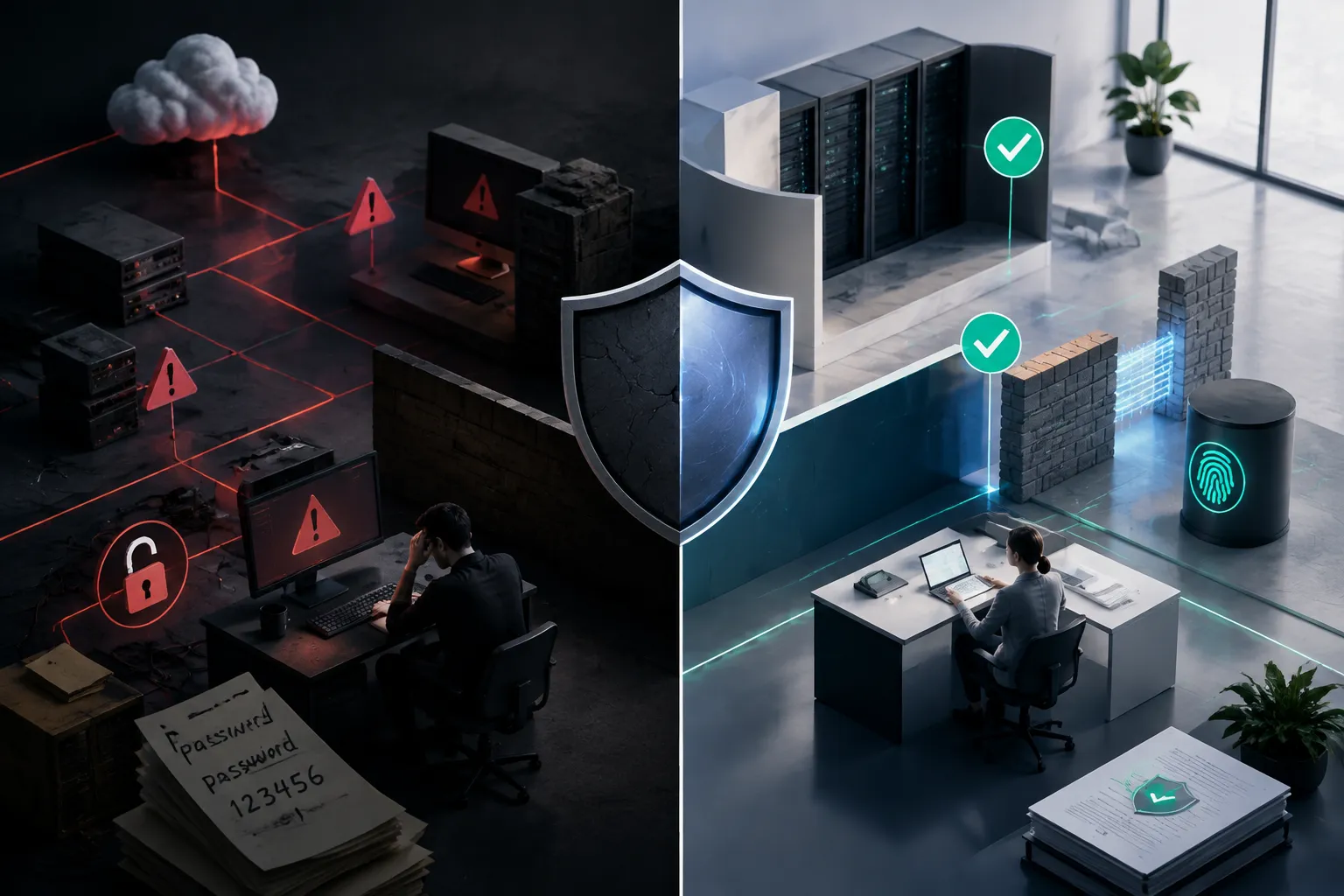
Most businesses configure their security systems once and then forget about them. This approach leaves dangerous gaps as technology evolves, employees change, and new threats emerge. Without regular reviews, you might discover too late that your backup system hasn’t worked for months, your firewall rules are blocking legitimate business traffic, or former employees still have access to sensitive systems.
The financial impact of security incidents extends far beyond immediate costs. When a dental practice loses patient records due to ransomware, they face regulatory fines, patient notification costs, system rebuilding expenses, and lost revenue from cancelled appointments. An accounting firm that suffers a data breach during tax season might lose clients permanently and face professional liability claims.
An annual security assessment creates a documented baseline of your security posture and identifies vulnerabilities before attackers exploit them. This proactive approach provides peace of mind and demonstrates due diligence to clients, insurance providers, and regulatory bodies.
What Should Be Included in Your Cybersecurity Assessment Checklist
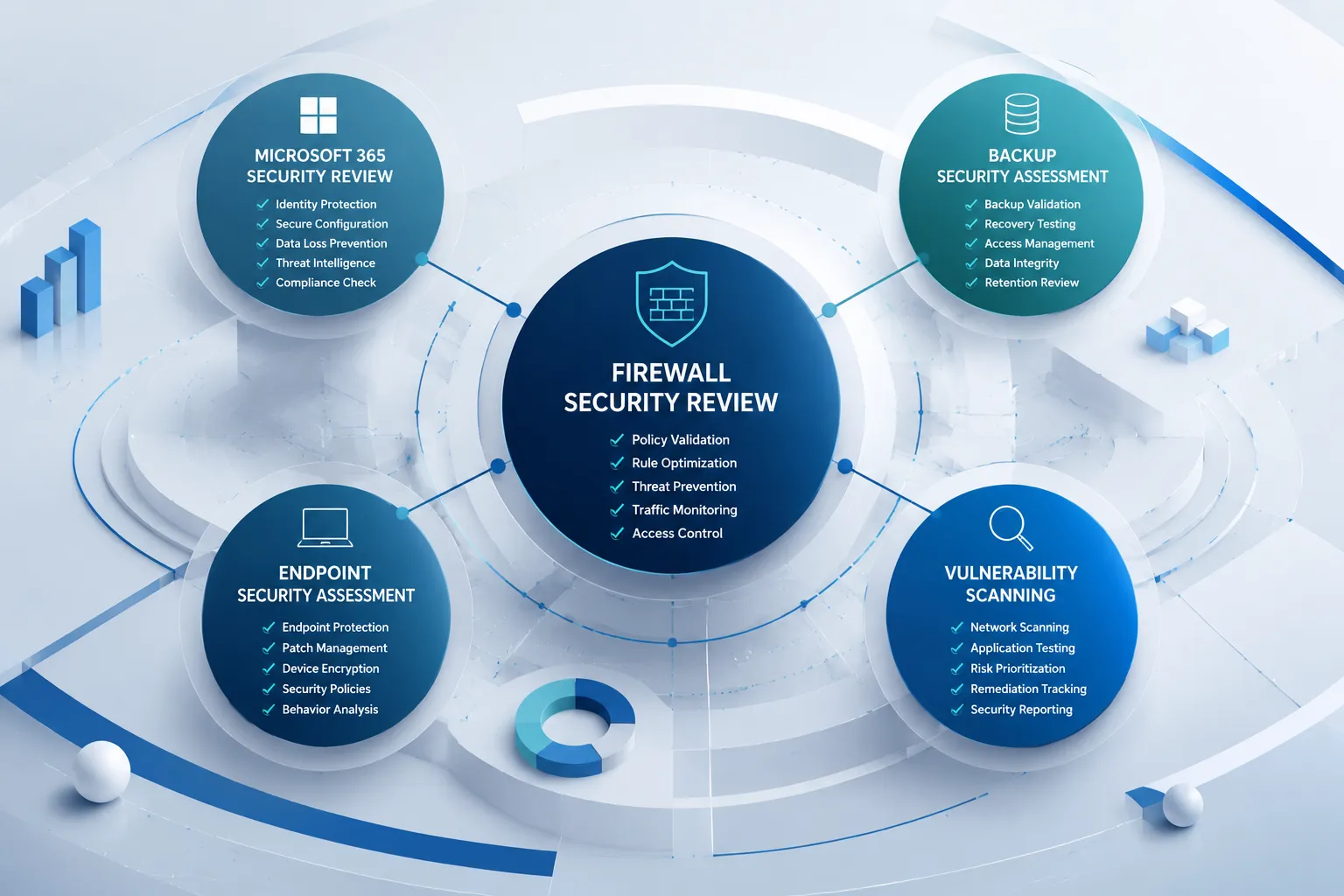
A comprehensive annual security assessment covers nine critical areas that protect your business operations. Each component addresses specific risks that could disrupt your business or compromise sensitive data.
Your cybersecurity assessment checklist should systematically evaluate technical controls, human factors, and business processes. This holistic approach ensures no security gaps slip through the cracks while maintaining focus on practical business outcomes like uptime, compliance, and cost control.
The most effective assessments connect each security control to real business impacts. Instead of simply checking whether antivirus software is installed, examine whether endpoint protection prevents malware from encrypting your accounting files or customer databases.
Firewall Security Review and Network Protection Assessment
Your firewall serves as the first line of defense against external threats, but misconfigured rules can either block legitimate business traffic or allow dangerous connections. A thorough firewall security review examines rule configurations, traffic patterns, and access controls to ensure optimal protection without operational disruption.
Start by documenting all firewall rules and identifying their business purposes. Many organizations accumulate outdated rules over years of changes, creating security holes or performance problems. Remove rules for discontinued services, former employees, or obsolete business processes.
Review remote access configurations carefully. The shift to remote work has created new attack vectors through VPN connections, remote desktop protocols, and cloud access points. Ensure that remote access requires multi-factor authentication and restricts access to necessary systems only.
Network segmentation assessment reveals whether sensitive systems are properly isolated from general business networks. Your accounting software, customer databases, and backup systems should operate on separate network segments with controlled access points.
Monitor for unusual traffic patterns that might indicate compromised systems or data exfiltration attempts. Establish baseline network behavior to identify anomalies quickly and respond to potential security incidents before they escalate.
Microsoft 365 Security Review and Configuration Assessment
Microsoft 365 environments often contain security misconfigurations that expose business data to unauthorized access or accidental deletion. A comprehensive Microsoft 365 security review evaluates user permissions, data protection settings, and security policies to ensure proper protection of email, documents, and business applications.
Examine user access permissions across all Microsoft 365 services, including SharePoint, OneDrive, Teams, and Exchange. Former employees should have no remaining access, and current employees should only access systems necessary for their roles. Global administrator privileges should be limited to essential personnel and protected with strong authentication.
Review data loss prevention policies and sensitivity labels to ensure confidential information receives appropriate protection. Business documents containing customer data, financial information, or proprietary details need classification and access controls that prevent unauthorized sharing or accidental exposure.
Evaluate email security settings, including anti-phishing policies, safe attachments scanning, and external sender warnings. Email remains a primary attack vector, and proper configuration significantly reduces successful phishing attempts and malware infections.
Assess backup and retention policies for Microsoft 365 data. While Microsoft provides some data protection, additional backup solutions often prove necessary for comprehensive business continuity and compliance with industry regulations.
Backup Security Assessment and Disaster Recovery Verification
Many businesses assume their backup systems work properly until they need to restore critical data during an emergency. A backup security assessment goes beyond checking whether backups run successfully; it verifies that your data can actually be restored quickly and completely when business operations depend on it.
Test restore procedures for different scenarios, including individual file recovery, complete system restoration, and point-in-time recovery for specific dates. Document restoration timeframes and identify any gaps in backup coverage that could result in permanent data loss.
Examine backup security measures including encryption, access controls, and offsite storage. Ransomware attacks increasingly target backup systems, making proper protection essential for business continuity. Ensure that backup systems operate on separate networks and require independent authentication.
Review backup retention policies and compliance requirements. Different types of business data may require specific retention periods, and your backup strategy should accommodate legal, regulatory, and operational needs without excessive storage costs.
Verify disaster recovery procedures through tabletop exercises or limited testing scenarios. Knowing how to restore individual files differs significantly from rebuilding entire business systems after a major incident. Document step-by-step procedures and assign specific responsibilities to team members.
Endpoint Security Assessment and Device Protection Review
Every computer, mobile device, and IoT device connected to your business network represents a potential entry point for cyberattacks. An endpoint security assessment evaluates protection software, device configurations, and management policies to ensure comprehensive coverage across all business devices.
Inventory all devices that access business systems, including employee computers, mobile phones, tablets, printers, security cameras, and smart devices. Each device needs appropriate security controls based on the sensitivity of data it can access and its exposure to external threats.
Review antivirus and anti-malware protection across all endpoints. Ensure that security software receives regular updates, performs scheduled scans, and reports threats to centralized management systems. Outdated or misconfigured endpoint protection provides false confidence while leaving devices vulnerable.

Evaluate mobile device management policies for smartphones and tablets that access business email or applications. Personal devices used for business purposes need security controls that protect company data without compromising employee privacy or device functionality.
Assess patch management procedures for operating systems and business applications. Unpatched vulnerabilities provide easy targets for attackers, but poorly managed updates can disrupt business operations. Establish testing procedures and rollback plans for critical system updates.
Employee Security Awareness and Phishing Simulation Testing
Human error remains one of the most significant cybersecurity risks facing small businesses. Employees who fall victim to phishing emails, use weak passwords, or mishandle sensitive data can compromise even the strongest technical security controls.
Conduct phishing simulation exercises to identify employees who need additional security training. These controlled tests reveal real vulnerabilities in your human firewall without the risks of actual phishing attacks. Focus on common attack scenarios relevant to your industry and business operations.
Review security awareness training programs and employee understanding of security policies. Training should cover password management, email security, social engineering recognition, incident reporting procedures, and safe handling of sensitive business data.
Evaluate physical security practices including device locking, clean desk policies, and visitor access controls. Social engineering attacks often combine digital and physical tactics to gain unauthorized access to business systems and information.
Assess incident reporting procedures and employee comfort with reporting potential security issues. Employees should know how to report suspicious emails, unusual system behavior, or potential security incidents without fear of blame or punishment.
Password and Authentication Policy Assessment
Weak authentication remains a primary cause of successful cyberattacks against small businesses. A comprehensive authentication assessment evaluates password policies, multi-factor authentication implementation, and account management procedures to ensure strong access controls across all business systems.
Review password requirements and user compliance across all business applications. Strong passwords should be required for all accounts, but overly complex requirements often lead to poor user practices like password reuse or predictable patterns.
Evaluate multi-factor authentication deployment for critical business systems, including email, accounting software, banking applications, and administrative access. Multi-factor authentication prevents most account takeover attacks even when passwords become compromised.
Assess privileged account management, including administrative credentials, service accounts, and shared accounts. These high-value targets need additional protection measures, including regular password changes, access monitoring, and usage restrictions.
Review account lifecycle management procedures for new employees, role changes, and departures. Prompt account provisioning ensures new employees can work effectively, while timely deprovisioning prevents former employees from retaining inappropriate access.
Vulnerability Scanning and Patch Management Review
Unpatched software vulnerabilities provide attackers with well-documented methods for compromising business systems. Regular vulnerability scanning identifies security weaknesses before they can be exploited, while effective patch management ensures timely remediation without operational disruption.
Conduct comprehensive vulnerability scans of all internet-facing systems, internal networks, and business applications. Prioritize findings based on exploitability, business impact, and available patches or workarounds.
Review patch management procedures for operating systems, business applications, and security software. Critical security patches need rapid deployment, but testing procedures should prevent updates from disrupting essential business operations.
Evaluate third-party software inventory and update procedures. Business applications from various vendors may have different update mechanisms and support lifecycles that require coordinated management approaches.
Assess vulnerability disclosure and remediation timelines. Document how quickly different types of vulnerabilities can be addressed and establish escalation procedures for critical security issues that require immediate attention.
How Often Should You Conduct a Cybersecurity Assessment
Most businesses should conduct comprehensive cybersecurity assessments annually, with quarterly reviews of critical security controls and monthly monitoring of key security metrics. However, assessment frequency depends on your industry, regulatory requirements, business growth rate, and risk tolerance.
Businesses in regulated industries like healthcare, finance, or legal services may require more frequent assessments to maintain compliance with industry standards. Rapidly growing companies need more frequent reviews as new employees, systems, and business processes create additional security considerations.
Trigger additional assessments after significant business changes, including mergers, major system implementations, office relocations, or security incidents. These events often introduce new risks that warrant immediate evaluation rather than waiting for the next scheduled assessment.
Continuous monitoring complements annual assessments by providing ongoing visibility into security posture changes. Automated tools can track security metrics, system configurations, and threat indicators to identify issues that require immediate attention between formal assessment cycles.
Cybersecurity Review Checklist for Small Business Operations
Small businesses need practical cybersecurity assessment approaches that provide comprehensive protection without overwhelming limited IT resources. Focus on high-impact security controls that address the most common threats facing businesses in your industry and size category.
Prioritize assessments of internet-facing systems, email security, backup systems, and employee access controls. These areas typically provide the highest security return on investment for small businesses while addressing the most frequent attack vectors.
Leverage automated tools and managed security services to extend your assessment capabilities without hiring additional IT staff. Many security vendors offer assessment services specifically designed for small business needs and budgets.
Document assessment findings and remediation plans in business terms that non-technical stakeholders can understand. Connect security recommendations to business outcomes like reduced downtime, improved compliance, or lower insurance costs.
What’s the Difference Between a Security Audit and Security Assessment
Security assessments and security audits serve different purposes in your overall cybersecurity program. A security assessment evaluates your current security posture and identifies improvement opportunities, while a security audit verifies compliance with specific standards or regulations.
Security assessments focus on risk identification and practical remediation recommendations. They examine whether your security controls effectively protect against real-world threats and business risks. Assessment results typically include prioritized action items and implementation guidance.
Security audits verify compliance with predetermined criteria such as industry standards, regulatory requirements, or contractual obligations. Audits result in pass/fail determinations and formal compliance reports rather than improvement recommendations.
Many businesses benefit from both assessment and audit activities. Assessments help improve overall security effectiveness, while audits demonstrate compliance to customers, regulators, or business partners who require formal verification.
How Much Does a Cybersecurity Review Cost for Small Businesses
Cybersecurity review costs vary significantly based on business size, assessment scope, and service provider selection. Small businesses typically spend between $3,000 and $15,000 for comprehensive annual assessments, though costs can range higher for complex environments or specialized compliance requirements.
Internal assessment costs include employee time, assessment tools, and remediation activities. External assessment costs include consultant fees, specialized testing services, and compliance reporting. Many businesses find that combining internal and external resources provides the best balance of thoroughness and cost-effectiveness.
Consider assessment costs in the context of potential incident costs, including downtime, data recovery, regulatory fines, and reputation damage. A comprehensive assessment that prevents a single ransomware incident typically pays for itself many times over.
Managed security service providers often include regular assessments as part of ongoing service contracts, spreading costs over time while providing continuous protection improvements and expert guidance.
How to Conduct Your Own Internal Cybersecurity Assessment
Small businesses can perform many assessment activities internally using structured checklists, automated tools, and employee training programs. Internal assessments provide ongoing security awareness while reducing dependence on external consultants for routine security evaluations.
Start with asset inventory and risk identification activities that document your business systems, data types, and potential threat scenarios. Understanding what you’re protecting and what could go wrong provides the foundation for effective security assessments.
Use free and low-cost security tools to scan for common vulnerabilities, test backup procedures, and evaluate security configurations. Many vendors offer assessment tools specifically designed for small business use without requiring extensive technical expertise.
Combine internal assessments with periodic external reviews to validate findings and identify blind spots. Internal teams may miss issues that outside experts readily identify, while external assessments provide independent verification of security improvements.
What Happens If You Skip Annual Cybersecurity Reviews
Businesses that skip regular cybersecurity reviews often discover security problems during actual incidents when remediation costs are highest, and business disruption is most severe. Unaddressed security gaps tend to worsen over time as systems age, configurations drift, and new threats emerge.
Common consequences include undetected malware infections, failed backup systems, outdated security software, excessive user privileges, and policy violations. These issues compound until they result in successful attacks, compliance failures, or operational disruptions.
Insurance claims may be denied if businesses cannot demonstrate reasonable cybersecurity practices, including regular assessments and timely remediation of known vulnerabilities. Many cyber insurance policies now require documented security programs as coverage prerequisites.
Regulatory penalties increasingly target businesses that fail to implement reasonable cybersecurity measures. Regular assessments demonstrate due diligence and good faith efforts to protect sensitive data and business operations.
Free vs Paid Cybersecurity Assessment Tools and Services
Free assessment tools provide valuable starting points for small businesses with limited security budgets. Open-source vulnerability scanners, configuration assessment scripts, and security checklists can identify many common security issues without significant investment.
Paid assessment tools typically offer more comprehensive coverage, automated reporting, and ongoing support. Commercial tools may integrate with existing business systems and provide remediation guidance tailored to specific environments and compliance requirements.
Professional assessment services provide expertise and objectivity that internal teams may lack. External assessors often identify issues that internal staff overlook while providing industry benchmarking and best practice recommendations.
The most effective approach often combines free tools for routine monitoring, paid tools for comprehensive assessment capabilities, and professional services for complex evaluations or compliance requirements.
Who Should Be Involved in Your Cybersecurity Review Process
Effective cybersecurity reviews require participation from both technical and business stakeholders to ensure comprehensive coverage and practical remediation planning. Include representatives from IT, operations, finance, human resources, and executive leadership in assessment planning and results review.
Technical staff provide system knowledge and implementation capabilities, while business stakeholders contribute risk context and resource allocation decisions. This collaboration ensures that security recommendations align with business priorities and operational constraints.
External consultants or managed service providers can supplement internal expertise and provide independent perspectives on security posture. Choose providers with relevant industry experience and demonstrated expertise in small business cybersecurity challenges.
Document roles and responsibilities for assessment activities, remediation tasks, and ongoing security maintenance. Clear accountability ensures that assessment findings translate into actual security improvements rather than forgotten recommendations.
Common Mistakes in Small Business Cybersecurity Assessments
Many businesses focus exclusively on technical vulnerabilities while ignoring process gaps, policy weaknesses, and human factors that often contribute to successful attacks. Comprehensive assessments address people, processes, and technology in balanced proportions.
Treating assessments as compliance checkboxes rather than risk management activities reduces their effectiveness in preventing actual security incidents. Focus on practical risk reduction rather than superficial compliance with generic security frameworks.
Failing to test backup and recovery procedures during assessments leads to unpleasant surprises during actual incidents. Assume that backup systems don’t work until you’ve successfully tested restoration procedures under realistic conditions.
Neglecting to involve business stakeholders in assessment planning and results review reduces support for necessary security investments and process changes. Security improvements require business buy-in to succeed in practical implementation.
How Long Does an Annual Cybersecurity Review Take to Complete
Comprehensive cybersecurity assessments typically require 2-6 weeks for small businesses, depending on environment complexity, assessment scope, and resource availability. Simple assessments focusing on basic security controls may be completed in days, while detailed compliance assessments can extend for months.
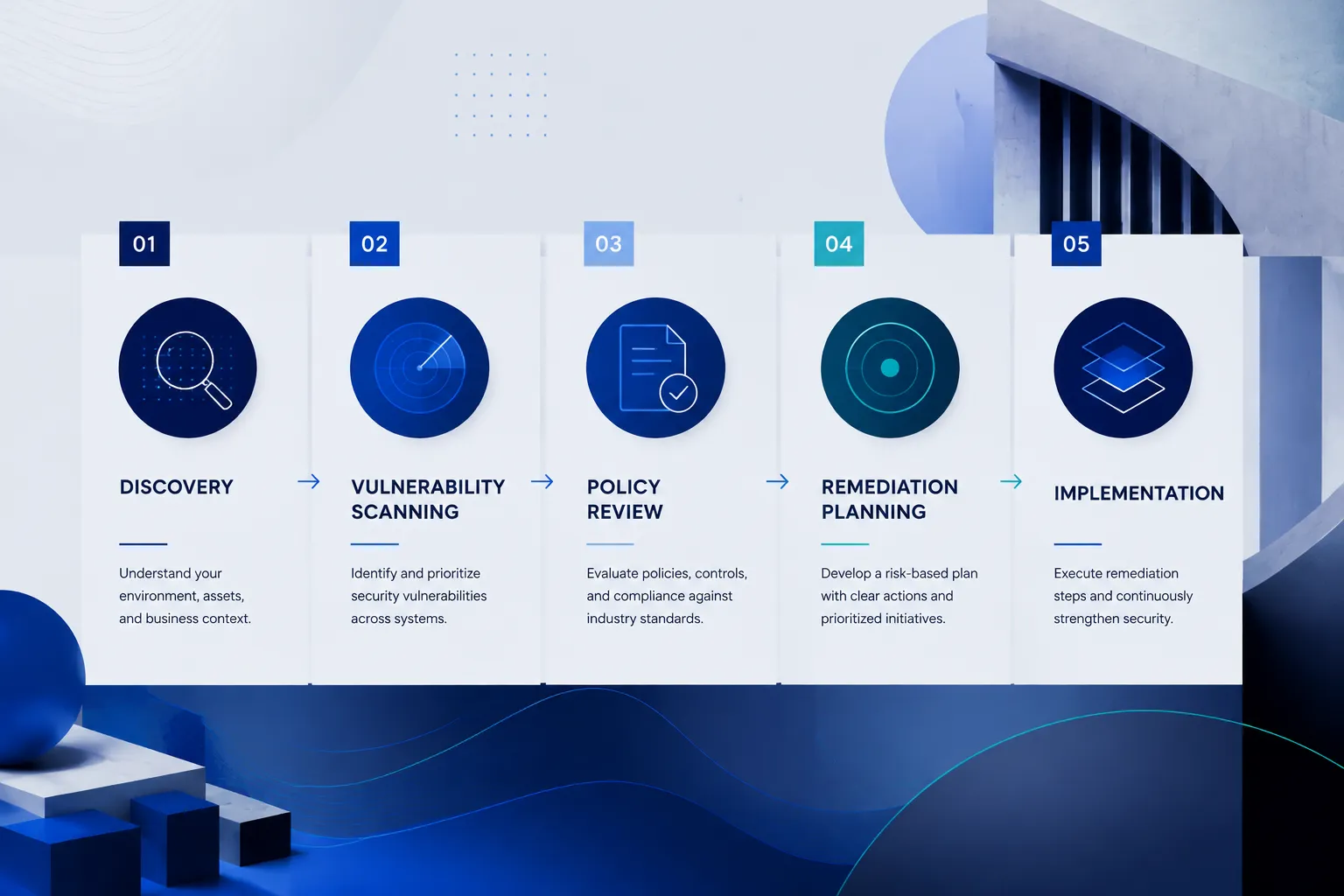
Assessment timelines include initial planning, data gathering, technical testing, analysis, reporting, and results presentation phases. Concurrent activities and good preparation can significantly reduce overall timeline requirements.
Internal resource availability often determines assessment pace more than technical complexity. Businesses with dedicated IT staff can typically complete assessments faster than those relying on part-time resources or external consultants.
Plan assessment timing to avoid busy business periods and allow adequate time for remediation activities. Rushed assessments often miss important issues, while delayed remediation reduces assessment value.
What to Do After Finding Vulnerabilities in Your Security Assessment
Assessment findings require systematic prioritization based on business risk, exploitability, and remediation complexity. Address critical vulnerabilities that could result in immediate business disruption before tackling lower-priority issues that pose theoretical risks.
Develop detailed remediation plans with specific timelines, resource requirements, and success metrics. Assign clear responsibility for each remediation task and establish regular progress reviews to ensure timely completion.
Communicate assessment results and remediation plans to relevant stakeholders in business terms that emphasize operational impacts and benefits. Technical vulnerability descriptions mean little to business leaders who need to understand risk implications and resource requirements.
Track remediation progress and verify that implemented solutions actually address identified vulnerabilities. Follow-up testing ensures that security improvements work as intended and don’t introduce new problems.
Is a Cybersecurity Review Required by Law for Your Business
Legal requirements for cybersecurity reviews vary by industry, business size, and geographic location. Healthcare organizations must comply with HIPAA security requirements, financial services face various federal and state regulations, and government contractors must meet specific cybersecurity standards.
Many states have enacted data breach notification laws that imply reasonable cybersecurity practices, including regular security assessments. While these laws rarely mandate specific assessment frequencies, they create legal expectations for proactive security management.
Contractual obligations often require cybersecurity assessments even when legal requirements don’t exist. Customer contracts, vendor agreements, and insurance policies frequently include security assessment requirements as business relationship conditions.
Consult with legal counsel and industry associations to understand specific requirements affecting your business. Compliance requirements continue evolving as legislators and regulators respond to increasing cybersecurity threats.
How to Prioritize Security Assessment Findings for Maximum Business Impact
Prioritize vulnerabilities based on potential business impact rather than technical severity scores alone. A minor configuration issue that could disrupt daily operations may deserve higher priority than a theoretical vulnerability with no practical exploitation path.
Consider remediation complexity and resource requirements when establishing priorities. Quick wins that significantly improve security posture with minimal effort should typically receive immediate attention, while complex projects may require longer-term planning.
Focus on vulnerabilities that affect multiple systems or business processes simultaneously. Addressing systemic issues often provides better security return on investment than fixing isolated problems with limited scope.
Balance short-term risk reduction with long-term security program development. Some findings may indicate broader security program gaps that require strategic planning rather than tactical fixes.