

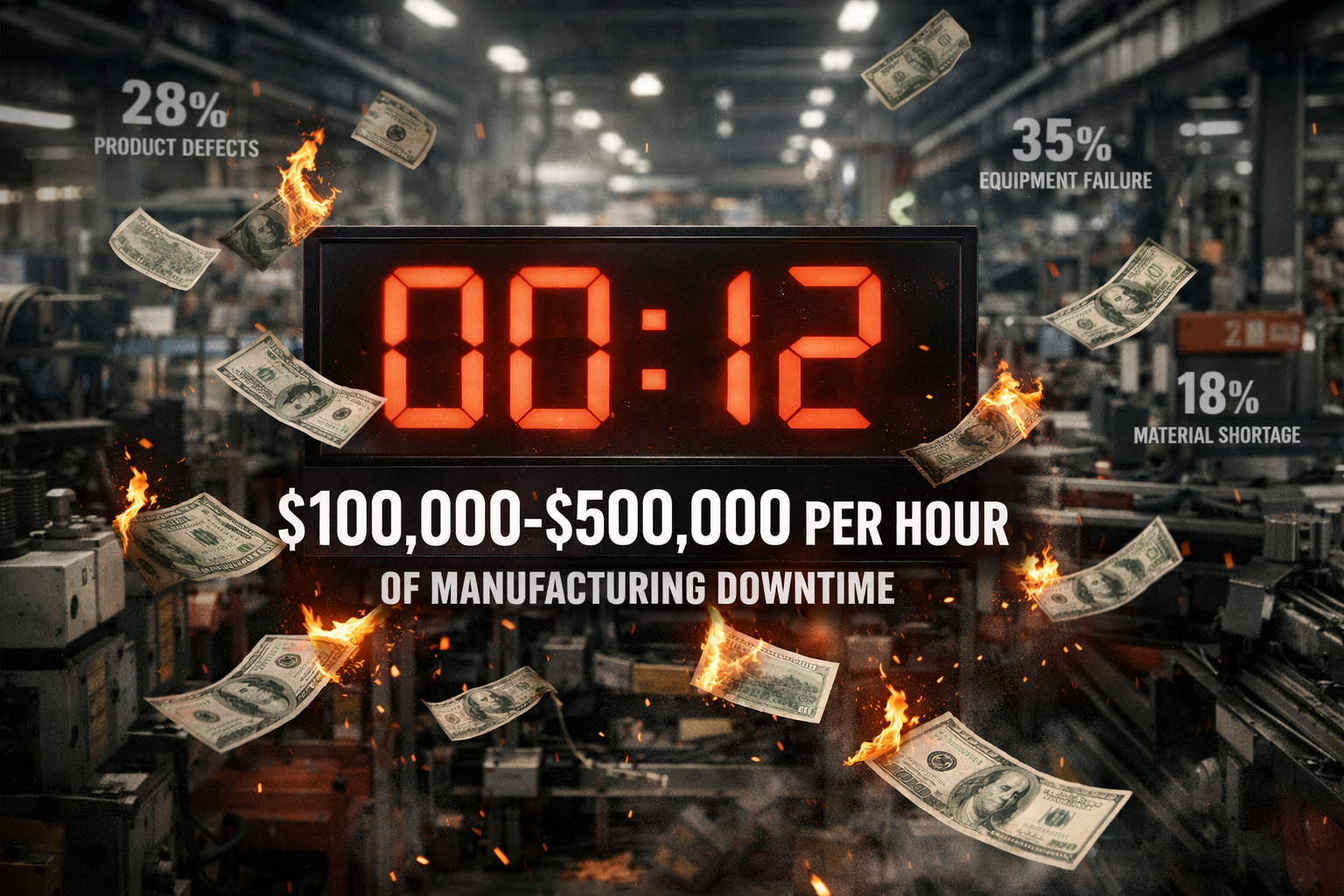
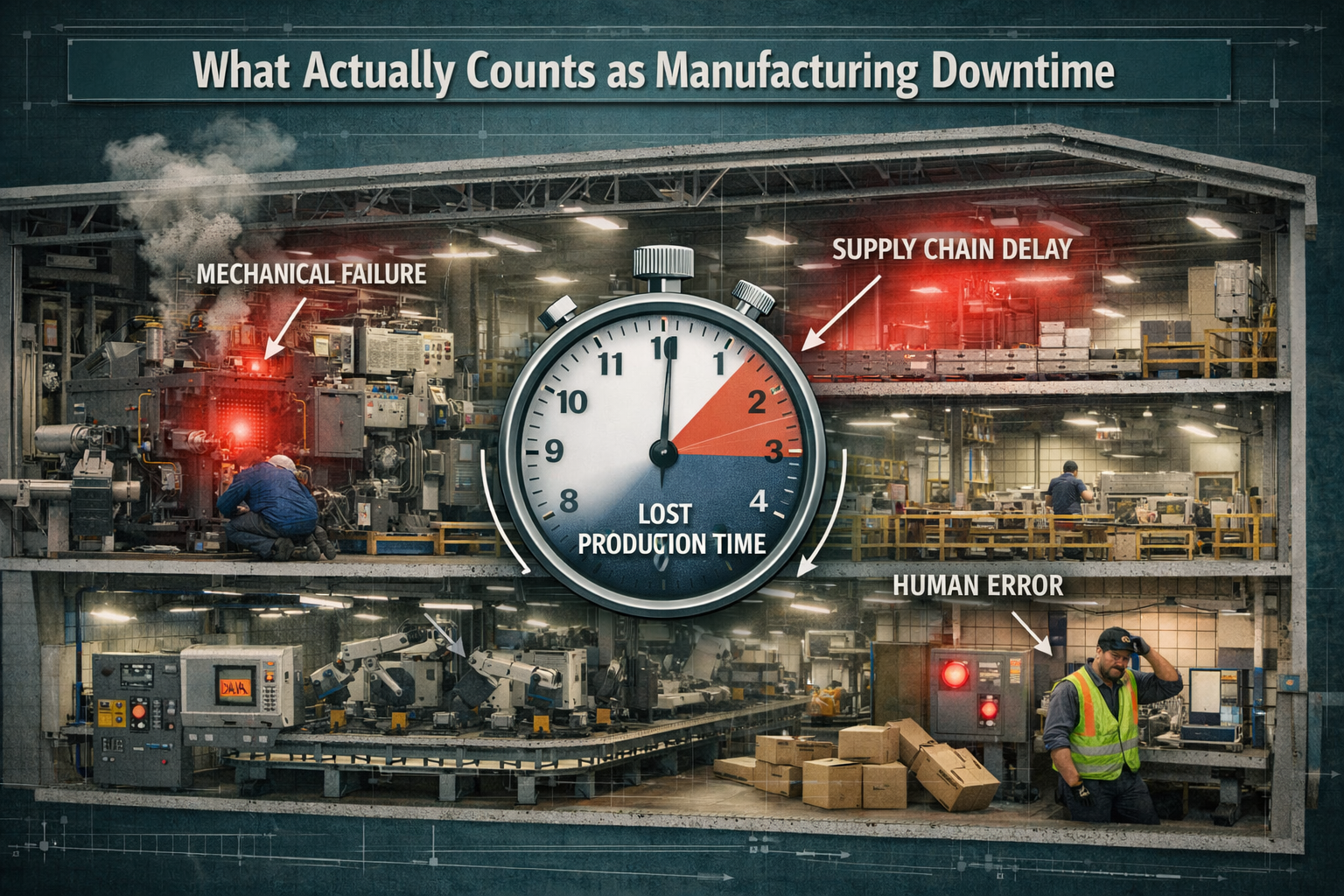
What Actually Counts as Manufacturing Downtime?
Manufacturing downtime includes any period when production equipment stops running as planned. This covers equipment breakdowns, system failures, power outages, cybersecurity incidents, and even planned maintenance that runs longer than scheduled.
Planned vs. Unplanned Downtime:
- Planned downtime: Scheduled maintenance, equipment upgrades, changeovers between product runs
- Unplanned downtime: Equipment failures, IT system crashes, supply chain disruptions, security breaches
The Hidden Truth: Most executives only track major equipment failures, missing smaller but frequent disruptions. A conveyor belt stopping for 15 minutes here, a quality control system freezing for 30 minutes there, these “minor” incidents add up to significant annual losses.
Common Blind Spots:
- Network connectivity issues affecting production systems
- Software crashes requiring system restarts
- Sensor malfunctions are causing safety shutdowns
- Cybersecurity incidents are forcing system isolation
The key insight? Every minute your production line isn’t running at full capacity represents measurable financial loss. Even partial slowdowns count as downtime when calculating the true cost of downtime in manufacturing per hour.
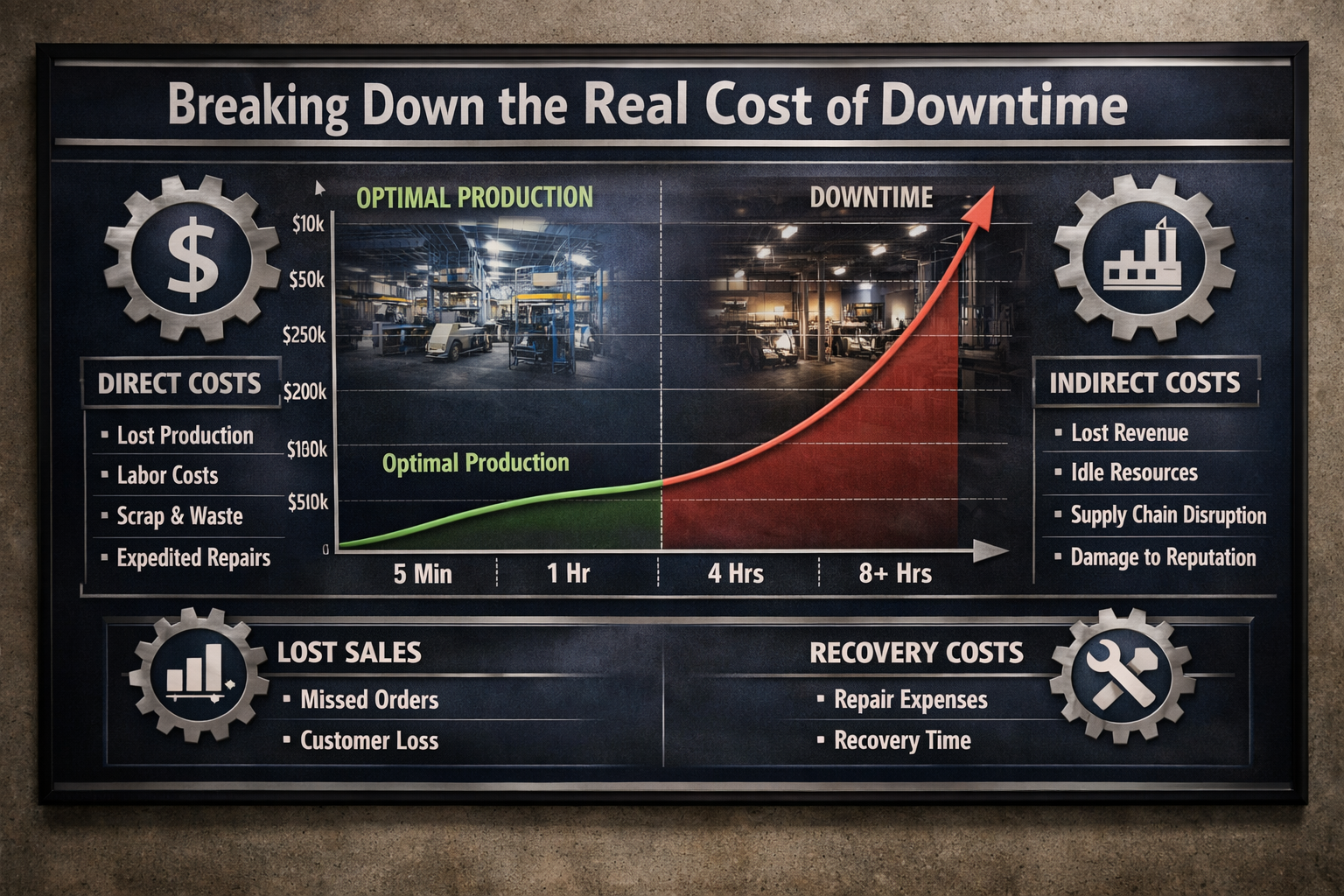
Breaking Down the Real Cost of Downtime in Manufacturing Per Hour
The actual cost extends far beyond stopped production. Here’s what accumulates during every hour of downtime:
Lost Production Output
This represents your biggest immediate loss: the products you can’t make and sell. For a facility producing $2 million worth of goods daily across 16 operating hours, each hour of downtime costs $125,000 in lost production value alone.
Quick Calculation:
- Daily production value: $2,000,000
- Operating hours per day: 16
- Hourly production loss: $125,000
Labor Costs Continue
Your workforce doesn’t disappear during equipment failures. Production workers, supervisors, quality control staff, and maintenance teams all remain on payroll while machines sit idle.
Typical hourly labor costs during downtime:
- Production workers: $3,000-$5,000
- Supervisors and technicians: $1,500-$2,500
- Support staff: $1,000-$1,500
- Total labor cost per hour: $5,500-$9,000
Overhead Expenses Keep Running
Facility costs don’t pause for equipment problems. Utilities, insurance, facility maintenance, and administrative expenses continue accumulating at roughly $2,000-$4,000 per hour for mid-sized manufacturing operations.
Restart and Recovery Costs
Getting production back online isn’t instantaneous. Most manufacturing processes require:
- System diagnostics and safety checks: 15-45 minutes
- Equipment warm-up and calibration: 30-90 minutes
- Quality testing of initial output: 30-60 minutes
- Additional cost: $8,000-$15,000 per incident
This means a “one-hour” equipment failure actually impacts 2-4 hours of normal operations.
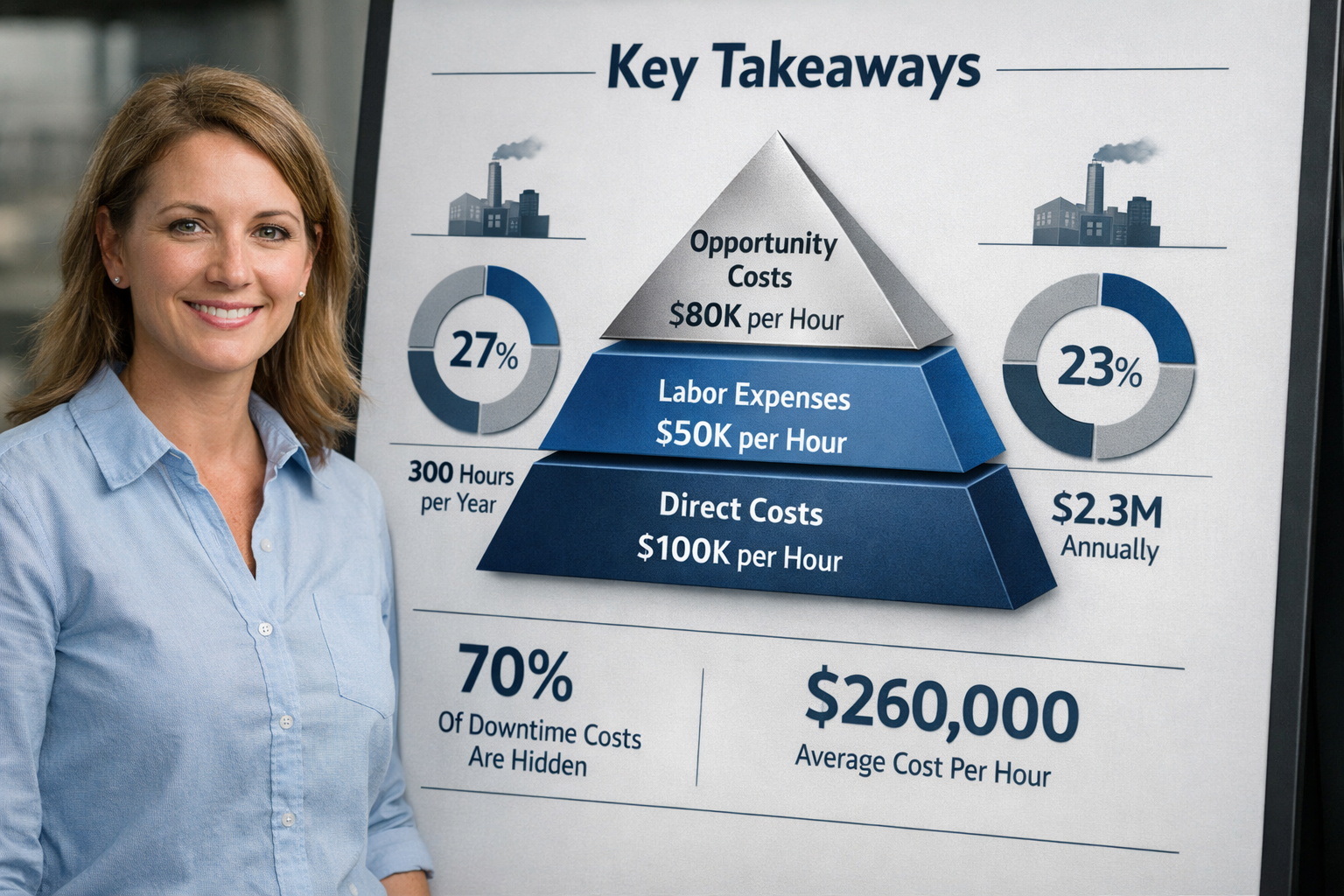
Industry-Specific Examples: Cost of Downtime in Manufacturing Per Hour
Automotive Manufacturing
Automotive assembly lines represent some of the highest downtime costs in manufacturing. Major automakers report losses of $22,000 per minute – that’s $1.3 million per hour – when main assembly lines stop.
Why are automotive costs so high?
- High-value finished products ($25,000-$80,000 per vehicle)
- Just-in-time delivery commitments with severe penalties
- Complex supply chain dependencies
- Large workforce (200-500 people per shift affected)
Real example: A major automotive plant producing 1,000 vehicles daily faces these hourly costs:
- Lost vehicle production: $1,250,000
- Labor costs: $45,000
- Supplier penalties: $25,000
- Total: $1,320,000 per hour
Food and Beverage Production
Food manufacturing faces unique challenges with perishable materials and strict safety requirements. Downtime costs range from $10,000-$25,000 per hour, but spoilage can double these losses.
Additional food industry factors:
- Product spoilage during temperature-sensitive processes
- Regulatory compliance issues requiring batch disposal
- Cleaning and sanitization requirements before restart
- Seasonal demand pressures
Electronics and Semiconductor Manufacturing
Clean room environments and precision equipment make electronics manufacturing particularly vulnerable. Downtime costs reach $50,000-$100,000 per hour, with contamination incidents potentially destroying entire production runs worth millions.
Semiconductor-specific risks:
- Clean room breaches requiring extensive decontamination
- Precision equipment recalibration takes 4-8 hours
- Work-in-progress inventory losses from process interruption
Simple Formula to Calculate Your Downtime Cost
Here’s a straightforward approach any manufacturing executive can use to estimate their cost of downtime in manufacturing per hour:
Basic Calculation
Hourly Downtime Cost = (A + B + C + D) where:
- A = Lost Production Value: Annual revenue ÷ annual operating hours
- B = Labor Costs: Hourly wages for all affected staff
- C = Overhead Allocation: Annual facility costs ÷ annual operating hours
- D = Recovery Costs: Average restart time × hourly operational cost
Practical Example
Mid-sized electronics manufacturer:
- Annual revenue: $50 million
- Operating hours: 6,000 per year (250 days × 24 hours)
- Affected workforce: 45 people at $35/hour average
- Annual overhead: $12 million
Calculation:
- A (Lost Production): $50M ÷ 6,000 = $8,333/hour
- B (Labor): 45 × $35 = $1,575/hour
- C (Overhead): $12M ÷ 6,000 = $2,000/hour
- D (Recovery): 2 hours × $11,908 = $23,816
Total downtime cost: $35,724 per hour
This manufacturer loses nearly $36,000 for every hour of unplanned downtime – making the business case for reliable IT infrastructure and proactive monitoring crystal clear.
Hidden Costs Most Manufacturing Leaders Ignore
Beyond the obvious expenses, several hidden costs can double your actual downtime impact:
Customer Relationship Damage
Late deliveries don’t just trigger penalty fees; they erode customer trust. A single missed delivery can cost future contracts worth 10-20 times the immediate penalty amount.
Long-term impacts:
- Reduced customer loyalty and repeat orders
- Negative word-of-mouth in industry networks
- Increased competition from more reliable suppliers
- Higher sales costs to win back lost accounts
Quality Issues During Restart
Production restart often means substandard output for the first 30-90 minutes as systems stabilize. This “ramp-up waste” typically costs $5,000-$15,000 per incident through:
- Defective products requiring rework or disposal
- Additional quality testing and inspection time
- Delayed shipments while quality is verified
Supply Chain Disruption Costs
Your downtime creates ripple effects throughout your supply chain:
- Supplier penalties for changed delivery schedules
- Expedited shipping costs to catch up on orders
- Inventory carrying costs from delayed shipments
- Customer stockout costs at the retail level
Regulatory and Compliance Issues
Certain industries face additional costs when downtime affects compliance systems:
- FDA documentation requirements for food/pharmaceutical
- Environmental reporting for chemical processes
- Safety system recertification costs
- Potential fines for missed regulatory deadlines
Conservative estimate: Hidden costs add 40-60% to your calculated downtime expenses.
How to Reduce Manufacturing Downtime and Protect Your Bottom Line
Reducing the cost of downtime in manufacturing per hour requires a comprehensive approach focusing on prevention, rapid response, and system redundancy.
Implement Comprehensive Monitoring Systems
Modern manufacturing facilities need 24/7 monitoring of both operational technology (OT) and information technology (IT) systems. Real-time monitoring catches problems before they cause full production stops.
Essential monitoring components:
- Equipment performance and predictive maintenance alerts
- Network connectivity and system health monitoring
- Cybersecurity threat detection and response
- Environmental controls (temperature, humidity, power quality)
ROI reality: Facilities with comprehensive monitoring reduce unplanned downtime by 35-50%, typically paying for monitoring systems within 6-12 months through avoided losses.
Built-in System Redundancy
Single points of failure create unnecessary risk. Smart manufacturers invest in backup systems for critical infrastructure:
High-impact redundancy investments:
- Backup power systems (generators, UPS systems)
- Redundant network connections and IT infrastructure
- Spare critical equipment components and rapid-swap capabilities
- Alternative production line configurations
Partner with Experienced IT Support
Manufacturing IT systems require specialized expertise. Many facilities benefit from partnering with managed IT providers who understand industrial environments and can provide same-day support when issues arise.
Key capabilities to look for:
- 24/7 monitoring and rapid response times
- Industry expertise in manufacturing environments
- Proactive security measures and compliance support
- Straightforward pricing that fits your budget
Peace of mind factor: Having a reliable partner eliminates IT headaches and lets you focus on core manufacturing operations instead of troubleshooting network problems.
Strengthen Cybersecurity Defenses
Cybersecurity incidents now cause 15% of manufacturing downtime, with ransomware attacks potentially stopping production for days or weeks. Secure and compliant IT systems are no longer optional.
Essential security measures:
- Network segmentation, separating OT and IT systems
- Regular security assessments and vulnerability testing
- Employee training on phishing and social engineering
- Incident response plans are tested quarterly
The investment in cybersecurity pays for itself by preventing even one major security incident that could cost hundreds of thousands in downtime and recovery expenses.
Taking Action: Your Next Steps to Minimize Downtime Costs
Understanding your cost of downtime in manufacturing per hour is just the first step. Here’s how to turn this knowledge into measurable results:
Conduct a Downtime Cost Assessment
Start by calculating your specific hourly downtime cost using the formula provided earlier. Document both obvious costs and hidden expenses to build a complete picture of your financial exposure.
Assessment checklist:
- Calculate lost production value per hour
- Document all affected labor costs during downtime
- Identify overhead expenses that continue during outages
- Estimate the restart and recovery time for different scenarios
- Research customer penalty clauses and relationship costs
Evaluate Your Current IT Infrastructure
Most manufacturing downtime now involves IT systems in some way. Assess whether your current technology setup provides adequate reliability and security for your operations.
Key questions to answer:
- How quickly can you detect and respond to system failures?
- Do you have adequate backup systems and redundancy?
- Are your cybersecurity defenses appropriate for your risk level?
- Can you get expert help quickly when problems occur?
Consider Professional IT Partnership
Many manufacturing companies find that partnering with experienced managed IT providers delivers better uptime at lower total cost than trying to handle everything internally.
Benefits of the right IT partner:
- Proactive solutions that prevent problems before they impact production
- 24/7 monitoring and rapid response capabilities
- Industry expertise specific to manufacturing environments
- Personalized service that understands your unique operational needs
The goal is finding a reliable partner who can eliminate IT headaches while providing the peace of mind that comes from knowing your systems are properly monitored and protected.