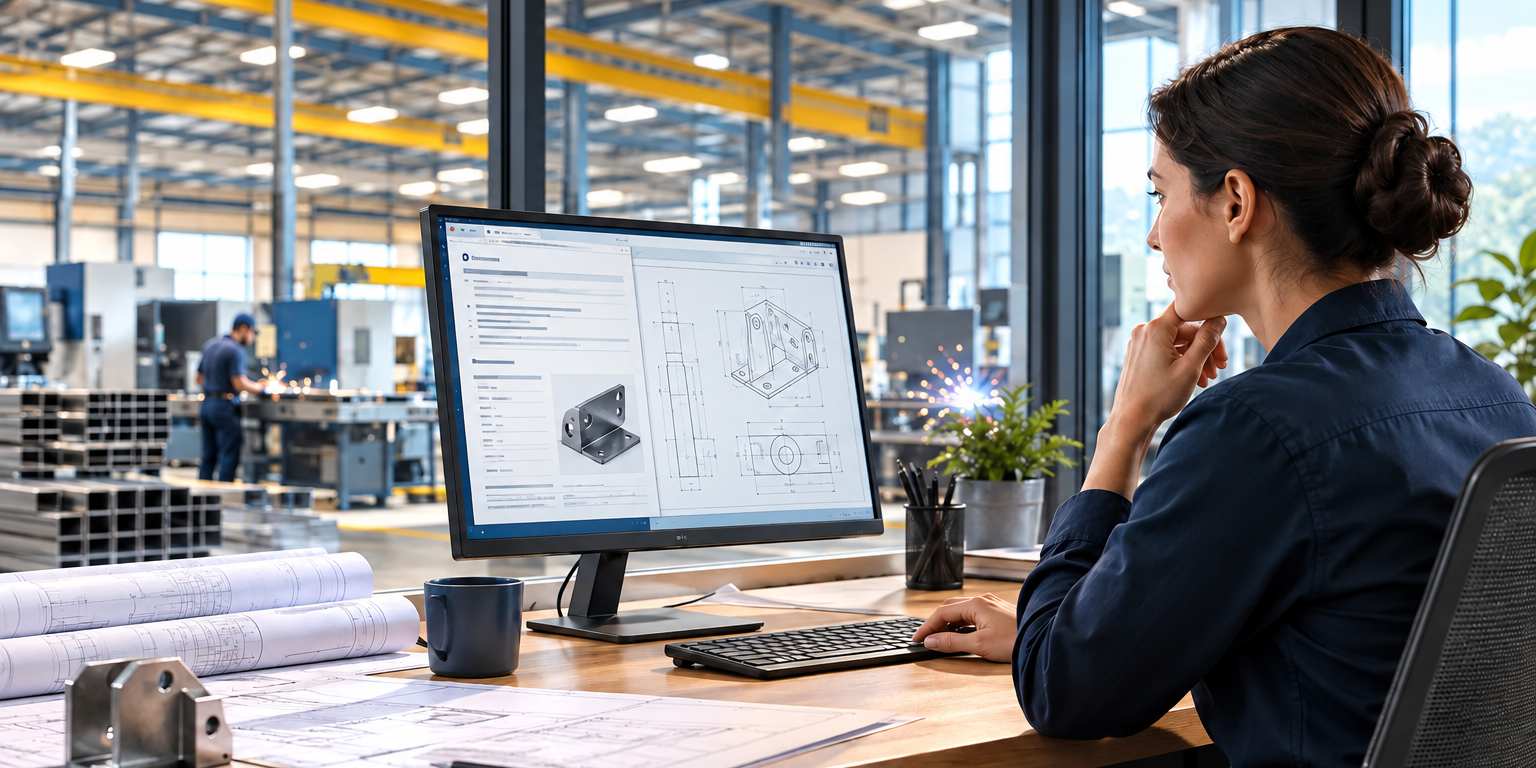

Manufacturing companies lose an average of $50,000 per hour during unplanned downtime, yet many still treat IT spending as a necessary evil rather than a strategic investment. The reality is that effective manufacturing IT budget planning isn’t just about keeping the lights on; it’s about creating a foundation that protects your operations while driving measurable business value.

Key Takeaways
• Balance is critical: Successful manufacturing IT budget planning requires equal attention to operational needs and cybersecurity investments
• Proactive beats reactive: Companies that invest upfront in monitoring and preventive measures save 3-5x more than those who wait for problems
• Security isn’t optional: OT cybersecurity investment should represent 15-20% of your total IT budget in 2026
• ROI is measurable: Proper IT investments deliver quantifiable returns through reduced downtime, improved efficiency, and risk mitigation
• Managed services optimize costs: Partnering with the right provider can reduce IT spending by 20-40% while improving security posture
• Legacy systems are expensive: Maintaining unsupported systems costs more long-term than strategic modernization
• Budget allocation matters: Following proven frameworks prevents both under-investment in critical areas and waste on unnecessary solutions
Why Manufacturing IT Budget Planning Demands a Strategic Approach
Manufacturing IT budget planning has become exponentially more complex as operational technology (OT) and information technology (IT) converge on factory floors. Unlike traditional office environments, manufacturing facilities face unique challenges that require specialized budget considerations.
Your production lines depend on seamless integration between legacy industrial systems and modern digital infrastructure. When budgeting decisions go wrong, the consequences extend far beyond IT; they impact production schedules, quality control, regulatory compliance, and ultimately, your bottom line.
The manufacturing industry faces a perfect storm of challenges in 2026. Cyber threats specifically targeting industrial systems have increased by over 200% in recent years. Meanwhile, skilled IT professionals who understand both manufacturing processes and cybersecurity remain scarce and expensive.
The cost of getting it wrong is substantial. I’ve seen manufacturing companies spend six figures on emergency cybersecurity remediation after a ransomware attack, when a fraction of that investment in proactive security would have prevented the incident entirely. The key is shifting from reactive spending to strategic investment.
Smart manufacturing IT cost optimization starts with understanding that every dollar spent on IT should serve a dual purpose: supporting current operations while building resilience for future challenges. This means your budget must account for both keeping existing systems running and preparing for evolving threats.
Common Manufacturing IT Budgeting Mistakes That Cost You Money
The biggest mistake I see in manufacturing IT budget planning is treating cybersecurity as an afterthought. Many plant managers allocate 80% of their IT budget to maintaining existing systems, leaving insufficient resources for the security measures that protect those very systems.
Underinvesting in cybersecurity tops the list of costly errors. Manufacturing companies often assume their operational technology is “air-gapped” and therefore safe. This assumption proves dangerous and expensive when attackers find ways to bridge that gap. Your cybersecurity budget manufacturing allocation should reflect the reality that OT and IT systems are increasingly interconnected.
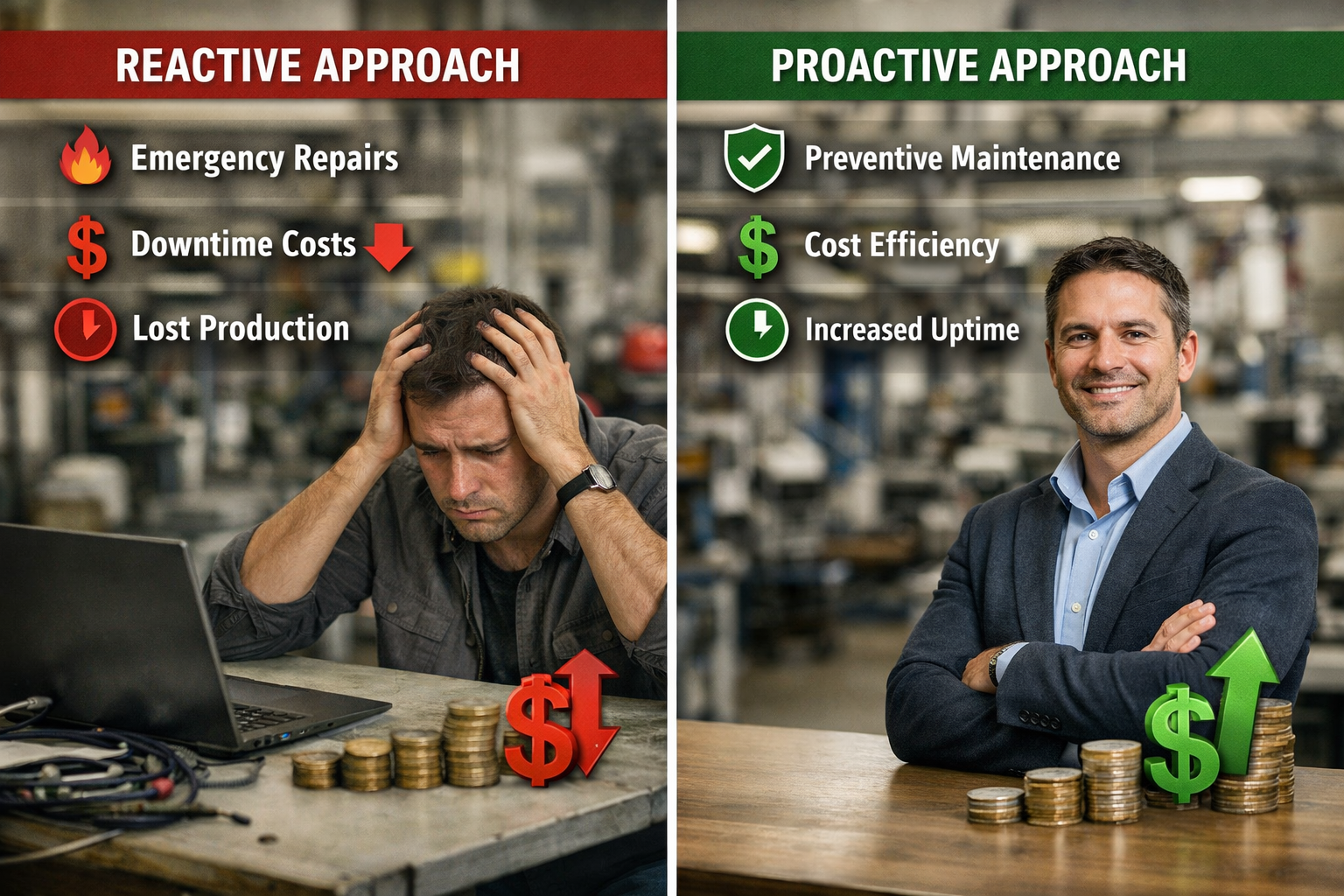
Overinvesting in reactive fixes represents another common trap. When you’re constantly putting out fires, replacing failed equipment, responding to security incidents, or dealing with unplanned downtime, you’re spending 3-5 times more than proactive solutions would cost.
Here’s what reactive budgeting looks like in practice:
- Emergency hardware replacements at premium prices
- Overtime costs for IT staff during crises
- Lost production time while systems are restored
- Rush shipping fees for replacement components
- Consultant fees for emergency problem-solving
Ignoring the total cost of ownership when making technology decisions creates budget surprises down the road. That “bargain” industrial computer might save money upfront, but if it requires specialized support or lacks security features, the long-term costs quickly exceed the initial savings.
Failing to plan for compliance requirements can derail your entire budget when regulatory audits reveal gaps. Whether it’s FDA validation, ISO standards, or industry-specific regulations, compliance isn’t optional, and retrofitting compliance into existing systems costs significantly more than building it in from the start.
The most successful manufacturing companies I work with avoid these mistakes by adopting a balanced approach that weighs immediate needs against long-term strategic goals. They understand that balancing IT cost and security isn’t about finding the cheapest solution; it’s about finding the most cost-effective one.
Building a Cost vs Risk Analysis Framework for Manufacturing IT
Effective manufacturing technology budget decisions require a systematic approach to evaluating costs against risks. The framework I recommend helps manufacturing executives make informed decisions by quantifying both the investment required and the potential impact of not investing.
Start by categorizing your IT risks into four buckets: operational disruption, cybersecurity threats, compliance violations, and competitive disadvantage. Each category carries different cost implications and requires different investment strategies.
Operational disruption risks include equipment failures, network outages, and system incompatibilities that halt production. Calculate the true cost by multiplying your average hourly production value by the typical duration of each type of outage. Don’t forget to include overtime costs, customer penalties, and reputation damage.
Cybersecurity threats require a more nuanced analysis. Consider both the probability of an incident and the potential impact. A ransomware attack might have a 15% annual probability, but could cost millions in downtime, remediation, and regulatory fines. Your OT cybersecurity investment should reflect this reality.
Here’s a practical risk assessment approach:
- Identify critical systems that would halt production if compromised
- Calculate downtime costs for each system (production loss + recovery expenses)
- Assess threat likelihood based on industry data and your current security posture
- Determine acceptable risk levels based on your company’s risk tolerance
- Compare mitigation costs against potential losses
Compliance violations carry both immediate costs (fines, remediation) and ongoing expenses (increased oversight, audit requirements). Factor in the cost of maintaining compliance over time, not just achieving it initially.
The goal isn’t to eliminate all risk; that’s neither possible nor cost-effective. Instead, you’re optimizing your industrial IT spending strategy to achieve the best balance between investment and protection. This means accepting some low-probability, low-impact risks while heavily investing in preventing high-probability, high-impact scenarios.
Essential Budget Areas for Manufacturing IT in 2026
Your manufacturing IT budget should allocate resources across five critical areas, each serving specific operational and security needs. Getting these allocations right determines whether your IT investment drives business value or becomes a constant source of headaches.
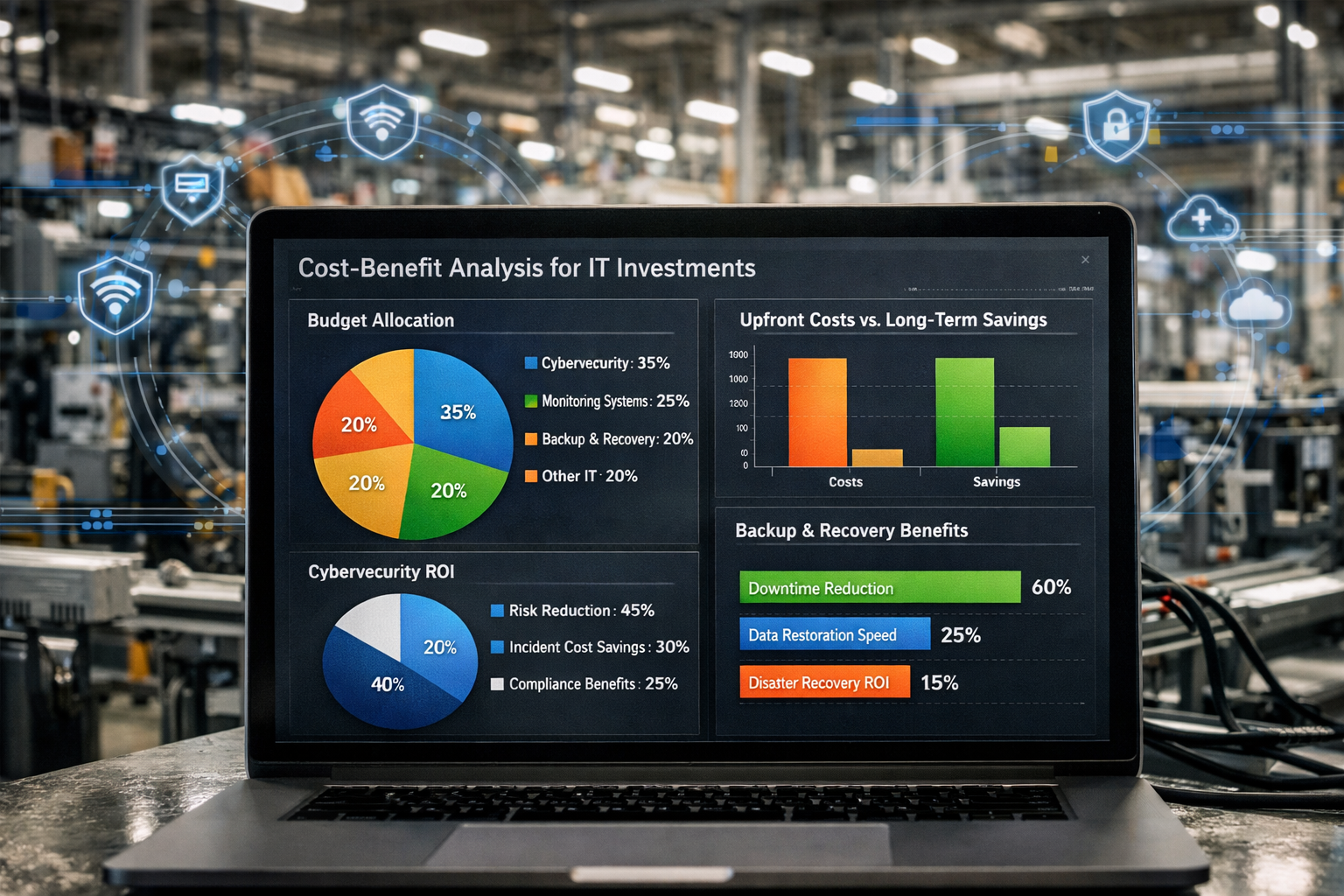
Cybersecurity and OT Protection (15-20% of IT budget)
This isn’t just about antivirus software anymore. Modern manufacturing cybersecurity requires specialized tools that understand industrial protocols, network segmentation to isolate critical systems, and monitoring solutions that can detect anomalous behavior in operational technology environments.
Your cybersecurity budget manufacturing allocation should include:
- Industrial firewall and network segmentation solutions
- OT-specific security monitoring and incident response capabilities
- Regular security assessments and penetration testing
- Employee training on manufacturing-specific cyber threats
- Backup and recovery solutions for both IT and OT systems
Monitoring and Maintenance (25-30% of IT budget)
Proactive monitoring prevents the expensive emergencies that blow up budgets. This includes both traditional IT monitoring and specialized OT monitoring that tracks the health of industrial systems without disrupting production processes.
Effective monitoring delivers peace of mind by catching problems before they impact operations. The right monitoring solution provides 24/7 oversight of your critical systems, alerting your team to potential issues while they’re still manageable.
Infrastructure and Modernization (30-35% of IT budget)
This covers the foundation that everything else runs on servers, networking equipment, industrial computers, and the gradual replacement of legacy systems that are becoming security liabilities.
Smart infrastructure investments focus on systems that improve both operational efficiency and security posture. When evaluating infrastructure upgrades, consider how each investment contributes to your overall resilience and competitive advantage.
Backup and Disaster Recovery (10-15% of IT budget)
Manufacturing environments require specialized backup strategies that account for both traditional data and the unique requirements of industrial systems. Your backup solution must be able to restore not just files, but entire operational environments quickly and reliably.
Training and Support (10-15% of IT budget)
Your team needs ongoing education about evolving threats and technologies. This includes both formal training programs and access to expert support when complex issues arise. Having access to industry expertise and personalized service can mean the difference between a minor hiccup and a major crisis.
Calculating Manufacturing IT ROI: Measuring What Matters
The challenge with manufacturing IT ROI isn’t just measuring returns; it’s identifying the right metrics that reflect the true business impact of your technology investments. Traditional ROI calculations often miss the indirect benefits that drive long-term value.
Direct ROI measurements include quantifiable savings from reduced downtime, improved efficiency, and lower maintenance costs. If your new monitoring system prevents just one major outage per year, the ROI calculation is straightforward: divide the cost of that prevented outage by your monitoring investment.
Indirect benefits often provide greater long-term value but require more sophisticated measurement approaches. These include improved regulatory compliance, enhanced competitive positioning, better decision-making through data visibility, and increased operational flexibility.
Here’s how to calculate comprehensive manufacturing IT ROI:
Step 1: Establish baseline costs
- Current annual IT spending
- Historical downtime costs and frequency
- Maintenance and support expenses
- Compliance and audit costs
- Security incident remediation expenses
Step 2: Project investment outcomes
- Reduced downtime frequency and duration
- Lower maintenance requirements through proactive monitoring
- Decreased security incident probability and impact
- Improved compliance audit results
- Enhanced operational efficiency metrics
Step 3: Calculate total value
- Direct cost savings (quantifiable reductions in expenses)
- Risk mitigation value (probability × impact of prevented incidents)
- Productivity improvements (measurable efficiency gains)
- Competitive advantages (market share, customer retention)
Step 4: Account for implementation costs
- Technology acquisition and deployment
- Training and change management
- Temporary productivity impacts during transition
- Ongoing support and maintenance requirements
The most successful manufacturing companies I work with track ROI over 3-5 year periods, recognizing that the biggest benefits often emerge after the initial implementation period. They also factor in the cost of not investing—what happens to their competitive position if they fall behind on technology adoption?
Risk-adjusted ROI provides the most accurate picture by incorporating the probability and cost of various scenarios. This approach helps justify investments in areas like cybersecurity, where the ROI might seem unclear until you factor in the cost of a major security incident.
Sample Manufacturing IT Budget Allocation Model
Based on my experience working with manufacturing companies of various sizes, here’s a practical budget allocation model that balances operational needs with security requirements. This model assumes a total annual IT budget and provides percentage guidelines for each category.
For a $100,000 annual manufacturing IT budget:
Cybersecurity & OT Protection – $18,000 (18%)
- Network security and segmentation: $8,000
- OT monitoring and threat detection: $6,000
- Security training and assessments: $4,000
Infrastructure & Modernization – $32,000 (32%)
- Server and networking equipment: $15,000
- Industrial computing hardware: $10,000
- Legacy system updates: $7,000
Monitoring & Maintenance – $28,000 (28%)
- Proactive system monitoring: $12,000
- Preventive maintenance programs: $10,000
- Performance optimization: $6,000
Backup & Recovery – $12,000 (12%)
- Backup system licensing and storage: $7,000
- Disaster recovery planning and testing: $5,000
Training & Support – $10,000 (10%)
- Staff training and certification: $4,000
- Expert support and consultation: $6,000
This allocation model prioritizes proactive solutions over reactive fixes, which typically reduces total IT costs by 20-40% compared to reactive approaches. The emphasis on monitoring and maintenance reflects the reality that preventing problems costs far less than fixing them after they occur.
Scaling considerations: Smaller budgets (under $50,000) might need to emphasize managed services to achieve comprehensive coverage. Larger budgets (over $250,000) can support more sophisticated in-house capabilities while still benefiting from specialized external expertise.
Industry variations: Food and beverage manufacturers might allocate more to compliance-related systems, while automotive suppliers might emphasize supply chain integration technologies. Adjust these percentages based on your specific regulatory and operational requirements.
The key is maintaining balance across all categories rather than heavily weighting any single area. I’ve seen companies spend 60% of their budget on new equipment while neglecting cybersecurity, only to face expensive security incidents that could have been prevented with proper investment allocation.
How Managed IT Services Optimize Manufacturing Costs
Partnering with the right managed IT provider can transform your manufacturing IT budget from a cost center into a strategic advantage. The key is finding a reliable partner who understands both manufacturing operations and the unique security challenges facing industrial environments.

Cost optimization through expertise: Managed IT providers bring specialized knowledge that’s expensive to develop in-house. Instead of hiring multiple full-time specialists for cybersecurity, networking, and industrial systems, you get access to an entire team of experts for a predictable monthly cost.
The math is compelling. A single experienced cybersecurity professional with manufacturing expertise might cost $120,000+ annually in salary and benefits. A comprehensive managed IT service that includes cybersecurity, monitoring, and support typically costs 30-50% less while providing broader expertise and 24/7 coverage.
Proactive solutions that prevent expensive problems: The best managed IT providers focus on preventing issues rather than just responding to them. This approach eliminates the budget-busting emergencies that plague reactive IT management.
Proactive managed services include:
- Continuous monitoring that catches problems before they impact production
- Regular security assessments that identify vulnerabilities before attackers do
- Preventive maintenance that extends equipment life and reduces replacement costs
- Strategic planning that aligns IT investments with business objectives
Predictable costs that simplify budgeting: Managed IT services replace unpredictable emergency expenses with fixed monthly costs. This makes budgeting easier and helps you avoid the feast-or-famine cycle where you’re either spending nothing on IT or facing massive unexpected bills.
Access to enterprise-grade security: Small and mid-sized manufacturers often can’t justify the cost of enterprise security solutions on their own. Managed IT providers can offer access to sophisticated security tools and expertise that would be prohibitively expensive for individual companies to implement independently.
Same-day support when you need it: Manufacturing operations can’t wait for IT problems to be resolved. The right managed IT partner provides same-day support for critical issues, minimizing production disruptions and their associated costs.
When evaluating managed IT providers, look for those who offer straightforward pricing without hidden fees, demonstrate genuine industry expertise, and can provide references from other manufacturing clients. The goal is to find a partner who eliminates IT headaches while improving your overall security and operational efficiency.
Strategic Planning for Long-Term Manufacturing IT Success
Successful manufacturing IT budget planning extends beyond annual allocations to encompass multi-year strategic planning that aligns technology investments with business growth objectives. This long-term perspective helps you avoid the costly stop-and-start approach that characterizes reactive IT management.
Three-year technology roadmaps provide the framework for making smart investment decisions. Your roadmap should identify which systems need replacement or upgrade, when compliance requirements might change, and how emerging technologies could impact your operations.
Start by assessing your current technology lifecycle. Most industrial computers and networking equipment have 5-7 year useful lives, while software systems might need updates every 2-3 years. Planning these replacements allows you to budget appropriately and avoid emergency purchases at premium prices.
Regulatory compliance planning requires looking ahead to understand how changing regulations might impact your IT requirements. New cybersecurity standards, data protection regulations, or industry-specific requirements can significantly impact your budget if you’re not prepared.
Scalability considerations become critical as your business grows. The IT infrastructure that supports a single facility might not scale efficiently to multiple locations. Planning for growth helps you make technology choices that will serve you well as your operations expand.
Technology convergence trends continue to reshape manufacturing IT requirements. The increasing integration of OT and IT systems, the adoption of Industrial Internet of Things (IIoT) devices, and the move toward cloud-based manufacturing systems all have budget implications that require planning.
Risk management evolution demands ongoing attention as threat landscapes change. The cybersecurity measures that protect you today might be insufficient against tomorrow’s threats. Your long-term planning should include regular security posture assessments and budget allocations for emerging security technologies.
The most successful approach involves annual budget reviews within a multi-year strategic framework. This allows you to respond to immediate needs while maintaining progress toward longer-term objectives. It also helps you take advantage of opportunities like technology refresh cycles or favorable vendor terms that might not align perfectly with your fiscal year.
Working with a reliable partner who understands both manufacturing operations and long-term technology trends can provide a valuable perspective during strategic planning. The right partner helps you balance immediate operational needs with future strategic objectives, ensuring your IT investments continue delivering value as your business evolves.
Conclusion
Manufacturing IT budget planning in 2026 requires a fundamental shift from viewing IT as a necessary expense to recognizing it as a strategic investment that drives operational excellence and competitive advantage. The companies that get this right will thrive, while those that continue treating IT reactively will face escalating costs and increasing risks.
The key to success lies in balancing immediate operational needs with long-term strategic objectives. This means allocating sufficient resources to cybersecurity and proactive monitoring while maintaining the infrastructure that keeps your operations running smoothly. It means choosing solutions that provide measurable ROI while building resilience against future challenges.
Remember that the most expensive IT strategy is having no strategy at all. Reactive approaches consistently cost 3-5 times more than proactive investments, while leaving your operations vulnerable to the kind of disruptions that can damage customer relationships and competitive positioning.
Your next steps should include:
- Conducting a comprehensive assessment of your current IT spending and security posture
- Developing a balanced budget allocation that addresses all critical areas
- Establishing metrics to measure the ROI of your IT investments
- Creating a multi-year technology roadmap aligned with business objectives
- Evaluating managed IT partnerships that could optimize costs while improving capabilities
The manufacturing landscape continues evolving rapidly, with new technologies, threats, and opportunities emerging regularly. Success requires staying ahead of these changes through strategic planning and smart investment decisions. By following the frameworks and principles outlined in this guide, you can build an IT foundation that supports both current operations and future growth while providing the peace of mind that comes from knowing your systems are secure and reliable.
Don’t let another year pass with reactive IT management that drains your budget and puts your operations at risk. Take action now to implement a strategic approach that delivers measurable value and positions your manufacturing operation for long-term success.