

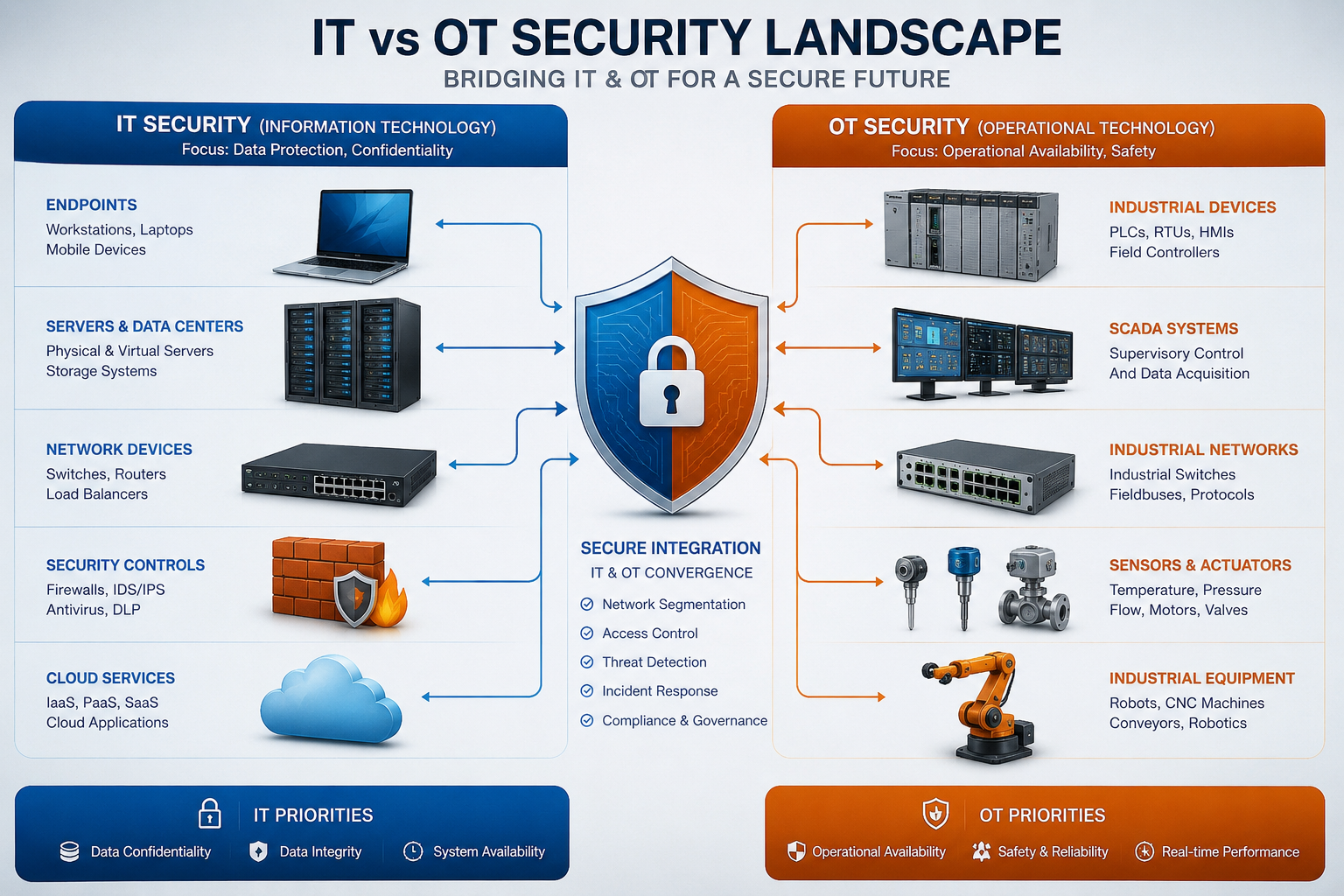
What IT Security Protects in Manufacturing
IT security in manufacturing environments focuses on protecting your business data, financial systems, and corporate networks. Your IT team works to secure everything from employee laptops and email servers to customer databases and accounting software.
The primary goal is to maintain the confidentiality, integrity, and availability of business-critical information. This includes protecting intellectual property, such as product designs, safeguarding customer data to meet compliance requirements, and ensuring financial systems remain accurate and accessible.
Common IT security measures include:
- Firewalls and antivirus software on computers
- Email security and spam filtering
- Data backup and recovery systems
- User access controls and password policies
- Network monitoring for suspicious activity
- Regular software updates and patches
Your IT security team typically operates on the principle that it’s better to shut down a system than risk a data breach temporarily. They can restart servers, restore from backups, or temporarily limit network access without directly impacting production lines.
What OT Security Protects in Manufacturing
OT (Operational Technology) security protects the industrial control systems that actually run your manufacturing processes. This includes programmable logic controllers (PLCs), supervisory control and data acquisition (SCADA) systems, human-machine interfaces (HMIs), and all the sensors and actuators that control your production equipment.
The primary focus is on maintaining continuous operation and worker safety. Your OT systems need to run 24/7 without interruption because even brief downtime can cost thousands of dollars per minute and potentially create safety hazards.
Key OT security considerations include:
- Industrial control system integrity
- Real-time process monitoring and control
- Safety instrumented systems (SIS)
- Physical security of control panels and equipment
- Reliable communication between production systems
- Predictable system performance and response times
Unlike IT systems, OT equipment often can’t be easily restarted or updated. Many industrial systems run on older operating systems or custom software that can’t handle modern security patches without extensive testing and planned maintenance windows.
Why IT vs OT Security Manufacturing Priorities Create Conflicts
The fundamental difference between IT and OT security creates natural tension in manufacturing environments. IT teams prioritize data protection and can accept temporary system downtime to address security threats. OT teams prioritize continuous operation and worker safety, often viewing security measures as potential disruptions to production.
IT security operates on these principles:
- Confidentiality first – protect sensitive data at all costs
- Regular updates and patches to address new threats
- Network monitoring and traffic analysis
- User authentication and access logging
- Incident response that may include system isolation
OT security operates on different principles:
- Availability first – keep production running safely
- Stability over updates – avoid changes that could disrupt operations
- Deterministic performance and predictable response times
- Physical safety systems that override cybersecurity measures
- Minimal network complexity to ensure reliability
These competing priorities often lead to security gaps. IT teams may implement network changes without fully understanding operational impacts, while OT teams may resist security measures that could affect production schedules or system performance.
The Dangerous IT vs OT Security Manufacturing Gap
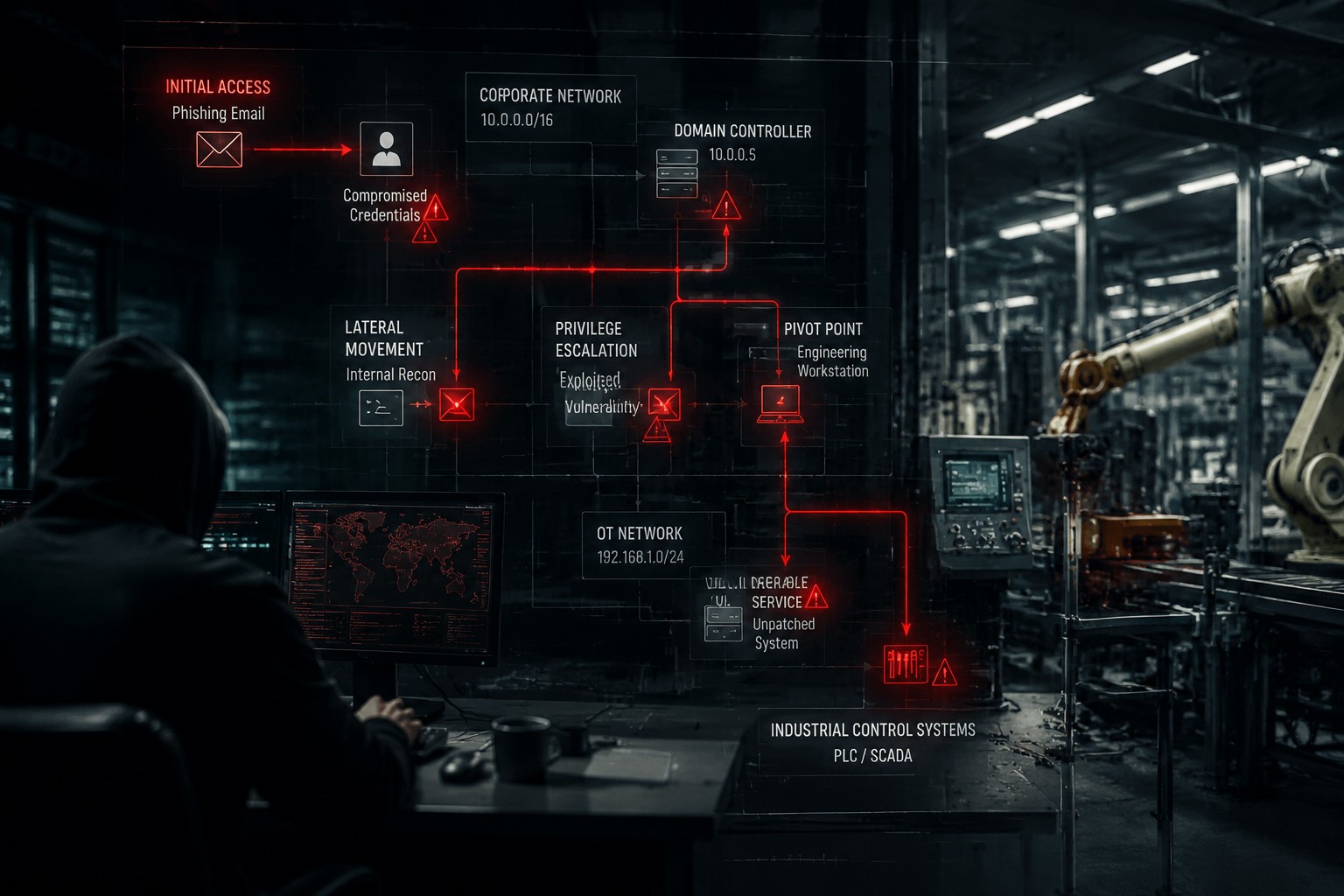
The security gap between IT and OT systems creates multiple vulnerabilities that attackers actively exploit. These gaps exist because many manufacturers built their networks when industrial systems were completely isolated from corporate networks.
Flat network architectures represent one of the biggest risks. Many facilities connect OT systems directly to corporate networks without proper segmentation. This means an attacker who compromises a single office computer can potentially access production control systems.
Weak network segmentation allows threats to move laterally between systems. Even when some separation exists, inadequate firewall rules or shared network infrastructure can provide pathways for attackers to escalate their access from IT systems to OT environments.
Shared credentials multiply security risks across both environments. When the same usernames and passwords work on both office computers and industrial control systems, a single compromised account can provide access to everything from email to production equipment.
Legacy industrial devices often lack basic security features like encryption, authentication, or logging capabilities. Many PLCs and SCADA systems were designed decades ago when cybersecurity wasn’t a primary concern, and they can’t be easily updated with modern security controls.
Poor visibility into OT networks means security teams don’t know what devices exist, how they communicate, or whether they’ve been compromised. Traditional IT security tools often can’t monitor industrial protocols or may disrupt OT operations if deployed incorrectly.
Real-World Manufacturing Attack Scenarios
Understanding how attackers exploit the IT/OT security gap helps illustrate why this issue demands immediate attention. These scenarios represent common attack patterns that security experts see across manufacturing environments.
The Email Gateway Attack: An employee receives a phishing email that installs malware on their workstation. The malware spreads through the corporate network until it reaches a poorly segmented connection to the production network. From there, attackers can monitor production data, steal intellectual property, or disrupt manufacturing processes.
The Remote Access Breach: Attackers compromise remote access credentials used by maintenance vendors or remote workers. Because these accounts often have elevated privileges across both IT and OT systems, attackers can move freely between corporate networks and production control systems.
The Supply Chain Compromise: Malware embedded in software updates or equipment firmware provides attackers with persistent access to industrial systems. Because OT teams trust updates from equipment vendors, these compromises can go undetected for months while attackers gather intelligence or prepare for disruption.
The Insider Threat: A disgruntled employee or contractor uses their legitimate access to both IT and OT systems to steal trade secrets, sabotage production, or sell access to external attackers. Poor access controls and monitoring make these threats difficult to detect until significant damage occurs.
Each scenario demonstrates how the lack of proper IT vs OT security manufacturing coordination creates opportunities for attackers to cause maximum business impact with minimal effort.
How Attackers Exploit the IT/OT Security Gap
Cybercriminals specifically target the seams between IT and OT environments because they know these areas receive less security attention. Understanding their methods helps manufacturers better defend against these sophisticated threats.
Reconnaissance and mapping represent the first phase of most attacks. Attackers scan networks to identify connections between corporate and industrial systems, catalog accessible devices, and map communication pathways. Poor network documentation and visibility tools make this reconnaissance easier and less likely to be detected.
Credential harvesting allows attackers to collect usernames and passwords that work across multiple systems. They target shared service accounts, default passwords on industrial equipment, and credentials stored in plain text on engineering workstations.
Lateral movement techniques help attackers spread from initial compromise points to high-value targets. They exploit trust relationships between systems, abuse legitimate administrative tools, and take advantage of overprivileged accounts to access both IT and OT environments.
Persistence mechanisms ensure attackers maintain access even after initial entry points are discovered and closed. They install backdoors on multiple systems, compromise firmware on industrial devices, and create new user accounts with administrative privileges.
Data exfiltration and disruption represent the final phases where attackers achieve their objectives. They may steal intellectual property through corporate networks while simultaneously disrupting production through OT system manipulation, maximizing both immediate impact and long-term competitive damage.
The most successful attacks combine multiple techniques and exploit both technical vulnerabilities and organizational gaps between IT and OT security teams.
Best Practices for IT vs OT Security Manufacturing Convergence
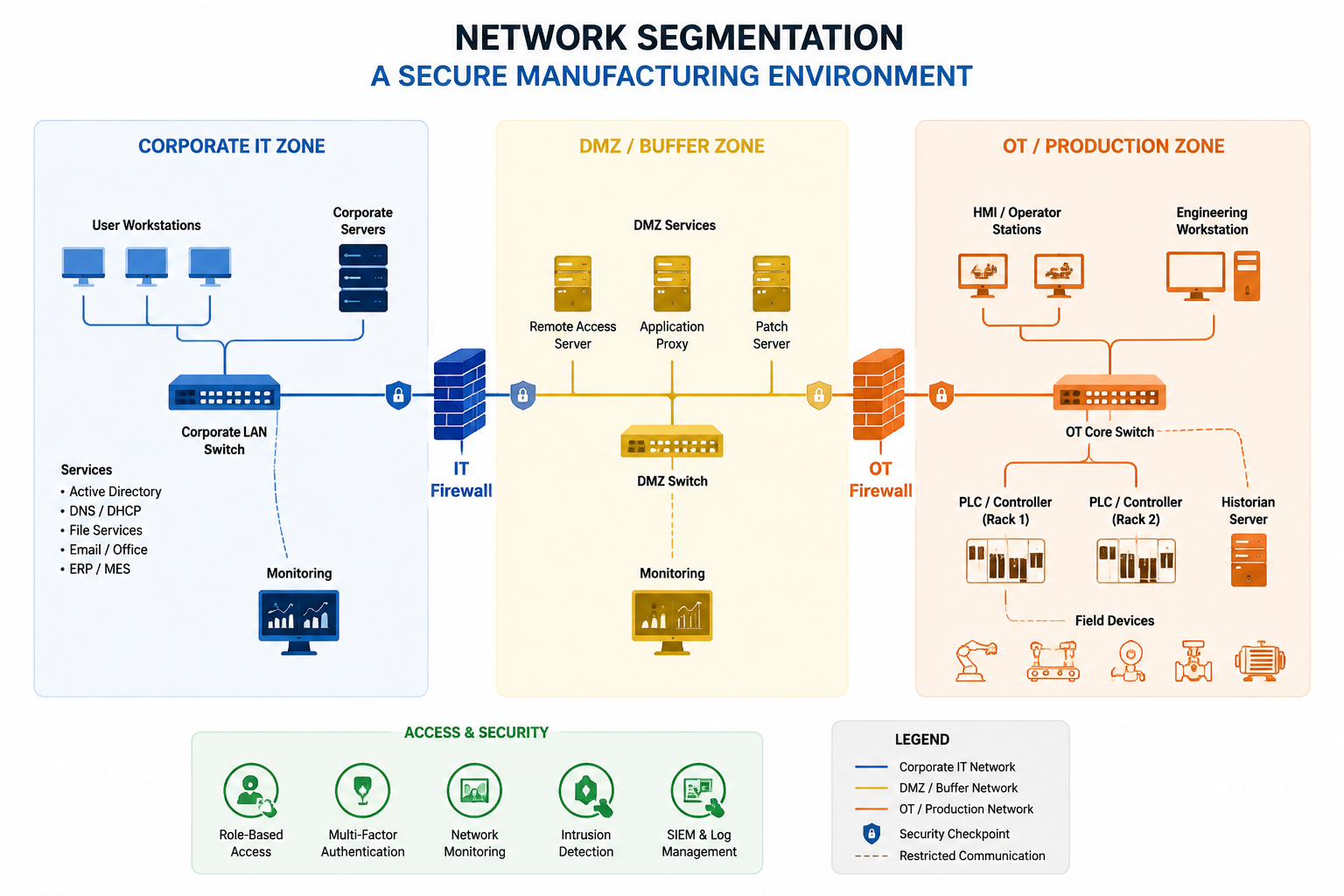
Building effective convergence between IT and OT security requires a systematic approach that addresses both technical controls and organizational challenges. The goal is to create unified protection without disrupting critical production operations.
Network segmentation provides the foundation for secure IT/OT convergence. Implement properly configured firewalls between corporate networks and production systems, with rules that only allow necessary communication. Use demilitarized zones (DMZs) to isolate systems that need connectivity to both environments, such as manufacturing execution systems (MES) or historian servers.
Continuous monitoring gives you visibility into both IT and OT network activity without disrupting operations. Deploy monitoring tools that understand industrial protocols and can detect unusual communication patterns, unauthorized device connections, or signs of lateral movement between network segments.
Access control management ensures that only authorized personnel can access critical systems with appropriate privileges. Implement role-based access controls that limit users to only the systems and functions they need for their jobs. Use multi-factor authentication for remote access and eliminate shared accounts wherever possible.
Asset inventory and management help you understand what devices exist on your networks and their security status. Maintain accurate documentation of all IT and OT assets, including their network connections, software versions, and security configurations. This inventory becomes critical for incident response and security planning.
Patch management coordination between IT and OT teams ensures security updates are applied safely without disrupting production. Establish testing procedures for industrial system updates and coordinate maintenance windows that allow for both security patches and operational requirements.
Building a Unified Security Strategy
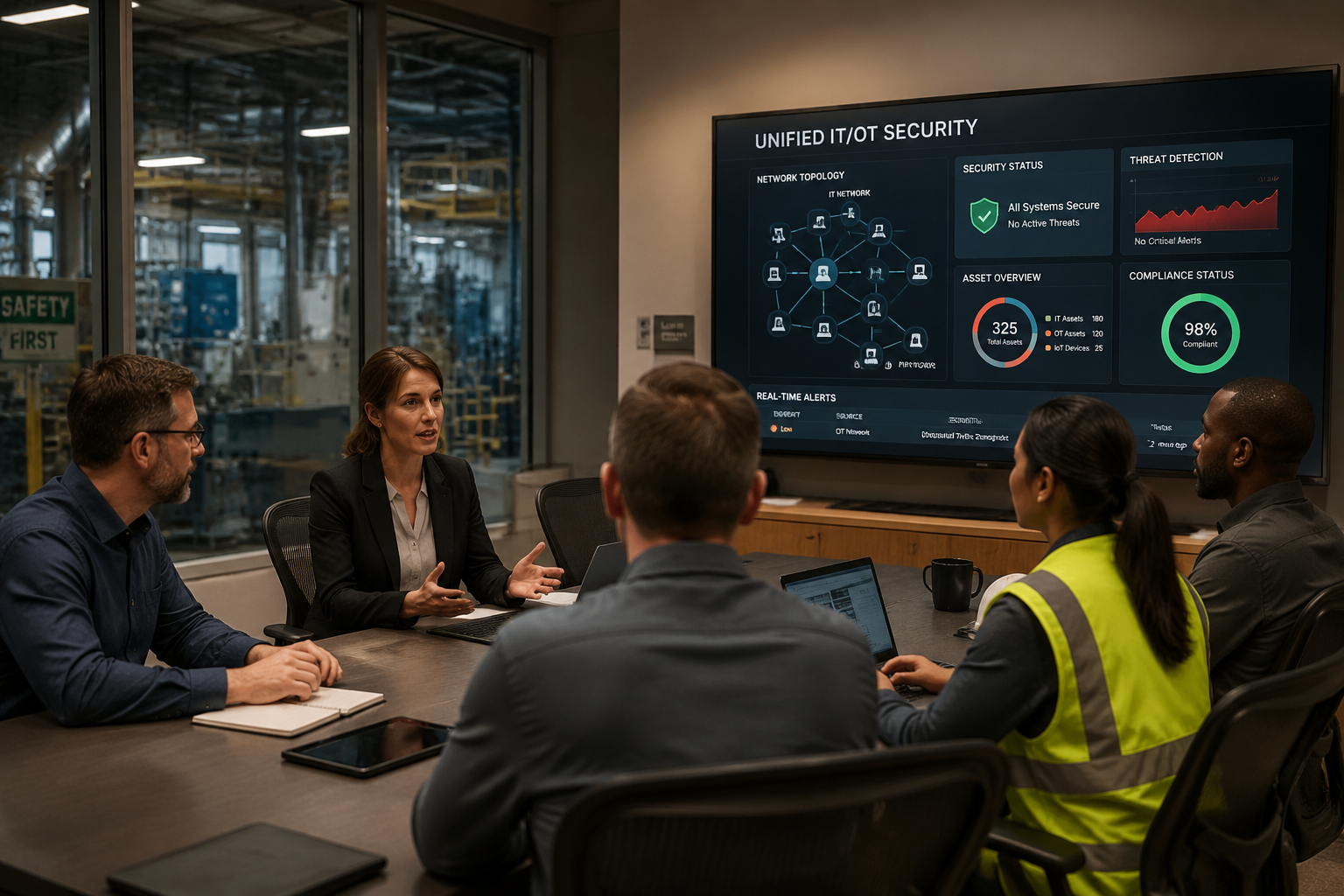
Creating a truly unified security strategy requires breaking down organizational silos and establishing processes that serve both IT and OT security objectives. This collaboration provides the peace of mind that comes from comprehensive protection across your entire manufacturing environment.
Cross-functional security teams bring together IT security professionals, OT engineers, and operations managers to make collaborative decisions about security controls and incident response. Regular meetings between these teams ensure security measures support both data protection and operational reliability.
Shared security policies establish consistent standards that apply across both IT and OT environments while acknowledging their different operational requirements. These policies should address access control, change management, incident response, and vendor management in ways that work for both corporate and industrial systems.
Integrated incident response procedures ensure your organization can respond effectively to security incidents that span both IT and OT environments. Response plans should include communication protocols between teams, decision-making authority for production shutdowns, and coordination with external partners like law enforcement or cybersecurity firms.
Regular security assessments evaluate the effectiveness of your converged security strategy and identify areas for improvement. These assessments should include both traditional IT security testing and OT-specific evaluations that consider the unique risks and constraints of industrial environments.
Training and awareness programs help all team members understand their role in maintaining security across both IT and OT systems. Operations staff need to recognize cybersecurity threats, while IT staff need to understand the operational impact of their security decisions.
The most successful manufacturers treat IT/OT security convergence as an ongoing process rather than a one-time project, continuously adapting their approach as threats evolve and operations change.
FAQ
What’s the main difference between IT and OT security in manufacturing?
IT security focuses on protecting business data and can accept temporary downtime for security measures, while OT security prioritizes keeping production systems running safely and continuously. This creates natural tension when implementing security controls.
Why can’t manufacturers just use the same security tools for both IT and OT systems?
Traditional IT security tools may not understand industrial communication protocols and could disrupt time-sensitive production processes. OT systems also often run on legacy platforms that can’t support modern security software without extensive testing and modification.
How do attackers typically move from IT systems to OT systems?
Attackers commonly exploit poor network segmentation, shared credentials, or remote access connections to move laterally from compromised office computers to industrial control systems. They target the trust relationships and communication pathways between these environments.
What’s the biggest risk of not addressing the IT/OT security gap?
The biggest risk is a cyberattack that combines data theft with production disruption, potentially causing millions in lost revenue, regulatory penalties, and competitive disadvantage. Attackers can steal intellectual property while simultaneously sabotaging manufacturing operations.
How long does it typically take to implement proper IT/OT security convergence?
Implementation timelines vary based on facility size and complexity, but most manufacturers need 6-12 months to establish proper network segmentation, monitoring, and coordinated security processes. The key is starting with risk assessments and building incrementally.
Can small manufacturers afford proper IT/OT security convergence?
Yes, many security improvements can be implemented cost-effectively through better network configuration, access controls, and team coordination. Working with experienced partners can provide industry expertise and 24/7 monitoring capabilities that would be expensive to build internally.
What happens during a security incident that affects both IT and OT systems?
Coordinated incident response procedures should define communication protocols, decision-making authority, and steps to contain threats while maintaining safe operations. This may include isolating affected systems, implementing manual processes, or coordinating with external cybersecurity experts.
How often should manufacturers assess their IT/OT security posture?
Annual comprehensive assessments provide a good baseline, with quarterly reviews of key security metrics and controls. However, assessments should also occur after major system changes, security incidents, or when new threats emerge that could impact manufacturing operations.
What role do equipment vendors play in IT/OT security?
Equipment vendors are critical partners for maintaining security on industrial systems through firmware updates, security patches, and configuration guidance. Manufacturers should establish clear security requirements in vendor contracts and coordinate update schedules with operational needs.
Is air-gapping OT systems still an effective security strategy?
Complete air-gapping is increasingly difficult to maintain due to business requirements for data integration and remote monitoring. When implemented properly with strict procedures for any network connections, air-gapping can provide strong security, but it may limit operational efficiency and visibility.
How do regulatory requirements affect IT/OT security in manufacturing?
Industry regulations often require specific security controls, documentation, and reporting that span both IT and OT environments. Manufacturers need coordinated compliance programs that address data protection, operational safety, and cybersecurity requirements across their entire technology infrastructure.
What’s the best first step for manufacturers concerned about their IT/OT security gap?
Start with a comprehensive risk assessment that maps network connections, identifies critical assets, and evaluates current security controls across both IT and OT environments. This assessment provides the foundation for prioritizing security improvements and building a coordinated strategy.
Conclusion
The gap between IT and OT security in manufacturing represents one of the most significant cybersecurity challenges facing industrial organizations in 2026. As we’ve explored throughout this article, the fundamental differences in priorities – data protection versus operational continuity – create natural tensions that cybercriminals actively exploit.
The business consequences of this security gap extend far beyond technical concerns. Manufacturers face the real possibility of simultaneous data breaches and production shutdowns, regulatory penalties, and competitive disadvantage from stolen intellectual property. The attacks on Colonial Pipeline, Norsk Hydro, and countless other manufacturers demonstrate that these threats are not theoretical – they’re happening right now to organizations just like yours.
However, the solution isn’t choosing between IT security and operational reliability. The most successful manufacturers are building unified security strategies that protect both their data and their production capabilities. This requires breaking down organizational silos, implementing proper network segmentation, and establishing monitoring and access controls that work across both environments.
The key is starting with a comprehensive understanding of your current security posture and building improvements incrementally. Focus on network segmentation, asset inventory, and cross-team collaboration as your foundation. Then layer on monitoring, access controls, and coordinated incident response capabilities that provide comprehensive protection without disrupting critical operations.
Remember, you don’t have to navigate this challenge alone. Working with experienced partners who understand both IT security and manufacturing operations can provide the industry expertise, 24/7 monitoring, and proactive solutions you need to eliminate IT headaches while maintaining operational excellence.
The manufacturers who address their IT/OT security gaps proactively will gain significant competitive advantages through improved uptime, better compliance posture, and the peace of mind that comes from comprehensive protection. Those who wait for a security incident to force action may find themselves dealing with much more expensive and disruptive consequences.
Ready to assess your IT/OT security posture? Contact our team for a comprehensive evaluation of your manufacturing environment’s security gaps and a personalized roadmap for building unified protection that supports both your operational and cybersecurity objectives.