

A cyberattack at a Georgia automotive parts manufacturer last year started with a simple phishing email. Within hours, hackers had moved from the office network into the production floor, shutting down three assembly lines for two weeks. The total cost? Over $2.3 million in lost production, emergency response, and customer penalties.
This isn’t an isolated incident. Manufacturing companies have become prime targets for cybercriminals because they operate critical infrastructure that can’t afford downtime. Yet many manufacturers make the same cybersecurity mistakes that leave their operations vulnerable to attack.
As someone who’s helped dozens of manufacturing companies recover from cyber incidents, I’ve seen firsthand how these mistakes can devastate operations. The good news? They’re all preventable when you understand how manufacturing cybersecurity differs from traditional business IT.
Why Manufacturing Companies Are Prime Cyber Targets
Manufacturing companies face a perfect storm of cybersecurity challenges. Unlike traditional businesses that primarily handle data, manufacturers control physical processes that directly impact safety, production, and revenue. Cybercriminals know that shutting down a production line creates immediate pressure to pay ransoms or meet demands.
The convergence of information technology (IT) and operational technology (OT) has created new attack surfaces. Modern factories connect everything from programmable logic controllers (PLCs) to enterprise resource planning (ERP) systems, often without proper security boundaries. This connectivity improves efficiency but also gives hackers multiple pathways into critical systems.
Manufacturing environments also present unique timing pressures. When production stops, every hour costs money. This urgency often leads to quick fixes that bypass security protocols, creating long-term vulnerabilities. Additionally, many manufacturing systems prioritize availability and real-time performance over security, making them attractive targets for attackers who understand these priorities.
What Are the Most Common Cybersecurity Vulnerabilities in Manufacturing
Manufacturing cybersecurity vulnerabilities typically fall into five categories that pose the greatest risks to production operations. Unpatched industrial control systems represent the most widespread vulnerability, as many OT systems run specialized software that receives infrequent security updates. These systems often operate for decades without patches, creating easy entry points for attackers.
Weak authentication controls plague manufacturing environments where shared passwords and default credentials are common. Production systems frequently use simple passwords like “admin” or “password” that haven’t been changed since installation. Remote access solutions often lack multi-factor authentication, allowing attackers to gain control through compromised credentials.
Network architecture vulnerabilities allow attackers to move freely between systems once they gain initial access. Many manufacturers connect office networks directly to production systems without proper segmentation or monitoring. This “flat” network design means a compromised email account can lead to control over critical manufacturing equipment.
Human factors create additional vulnerabilities as employees often lack awareness of manufacturing-specific cyber risks. Phishing attacks targeting industrial systems, USB-based malware designed for OT environments, and social engineering tactics focused on production schedules represent growing threats that traditional cybersecurity training doesn’t address.
How Much Does a Data Breach Cost a Manufacturing Company
Manufacturing data breaches cost significantly more than breaches in other industries due to the operational impact on production systems. The average cost of a manufacturing cyberattack reaches $4.2 million when including direct response costs, production downtime, and recovery expenses. However, this figure often underestimates the full impact on manufacturing operations.
Production downtime represents the largest cost component, averaging $50,000 per hour for mid-sized manufacturers. A typical ransomware attack shuts down operations for 22 days, resulting in over $26 million in lost production for a facility operating around the clock. These figures don’t include customer penalties, expedited shipping costs, or long-term contract losses.
Recovery costs extend beyond typical IT restoration because manufacturing systems require specialized expertise to rebuild safely. OT system recovery can take months as engineers verify the integrity of safety systems and production processes. Many manufacturers also face regulatory fines when attacks impact safety or environmental systems.
The hidden costs often exceed direct expenses. Customer confidence, supplier relationships, and market position can suffer permanent damage when production commitments can’t be met. Some manufacturers lose major contracts permanently after failing to deliver during cyber incidents.
Are Small Manufacturing Businesses at Higher Risk of Cyberattacks
Small and mid-sized manufacturing businesses face disproportionately higher cybersecurity risks compared to larger manufacturers with dedicated security teams. These companies typically lack the resources to implement comprehensive cybersecurity programs while operating the same types of vulnerable industrial systems that attract attackers.
Limited IT staff means cybersecurity often becomes a part-time responsibility for employees who primarily focus on production support. This divided attention creates gaps in security monitoring, patch management, and incident response capabilities. Small manufacturers also struggle to afford specialized OT security tools and expertise.
Cybercriminals specifically target smaller manufacturers because they’re less likely to have robust backup systems and incident response plans. Attackers know that smaller companies face greater pressure to pay ransoms quickly to restore operations. The average ransom payment for small manufacturers has increased 300% since 2020.
However, small manufacturers can achieve effective cybersecurity through focused strategies and partnerships with experienced providers. Working with a reliable partner who understands manufacturing operations can provide enterprise-level security without requiring internal expertise or massive budgets.
Manufacturing Cybersecurity Mistake #1: Treating OT Like Traditional IT
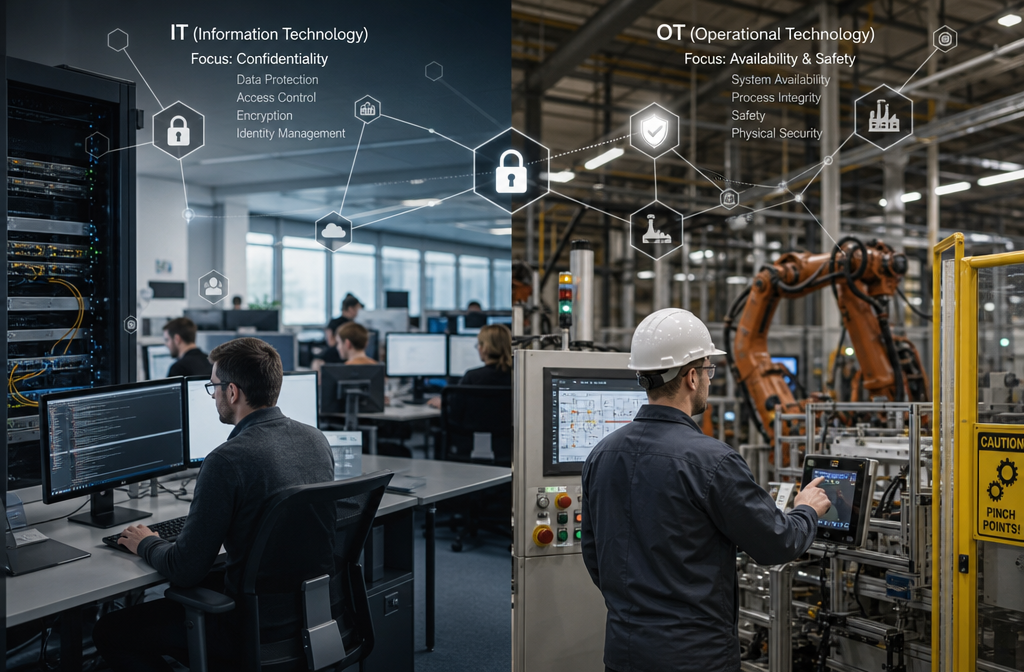
The biggest manufacturing cybersecurity mistake is applying traditional IT security approaches to operational technology without understanding the fundamental differences. OT systems prioritize availability, real-time performance, and safety over security, while IT systems can typically handle security measures like frequent reboots, patches, and access controls without operational impact.
Traditional IT security tools often disrupt OT operations by introducing network latency, requiring system restarts, or blocking legitimate industrial communications. Installing standard antivirus software on a PLC can cause production delays or safety system failures. Similarly, IT patch management schedules don’t account for production requirements that may prevent system updates for months.
OT systems also use different communication protocols, network architectures, and user access patterns than traditional IT environments. Industrial protocols like Modbus and DNP3 weren’t designed with security in mind, while IT security tools expect standard TCP/IP communications. This mismatch creates blind spots where security tools can’t properly monitor or protect OT systems.
The solution requires specialized OT security approaches that understand manufacturing operations. This includes passive monitoring tools that don’t interfere with production, OT-specific threat detection, and security policies that account for operational requirements. Successful manufacturers work with partners who have both cybersecurity expertise and a deep understanding of industrial operations.
What Equipment Is Most Likely to Get Hacked in a Factory
Human-machine interfaces (HMIs) represent the most frequently compromised equipment in manufacturing facilities because they often run standard Windows operating systems with known vulnerabilities. These systems provide direct control over production processes while typically lacking proper security hardening or network isolation.
Programmable logic controllers (PLCs) face increasing attack frequency as cybercriminals develop specialized tools for industrial systems. Many PLCs use default passwords, unencrypted communications, and lack authentication controls. Once compromised, PLCs give attackers direct control over manufacturing processes, safety systems, and production equipment.
Remote access devices create significant vulnerabilities when they provide unmonitored pathways into manufacturing networks. VPN concentrators, remote desktop servers, and cellular gateways often use weak authentication while connecting directly to critical systems. Attackers frequently target these devices to establish persistent access to manufacturing operations.
Engineering workstations present attractive targets because they typically have elevated privileges across multiple systems while running standard software that may contain vulnerabilities. These systems often connect to both IT and OT networks, making them ideal pivot points for attackers moving between environments.
Manufacturing Cybersecurity Mistake #2: Running Unsupported Systems
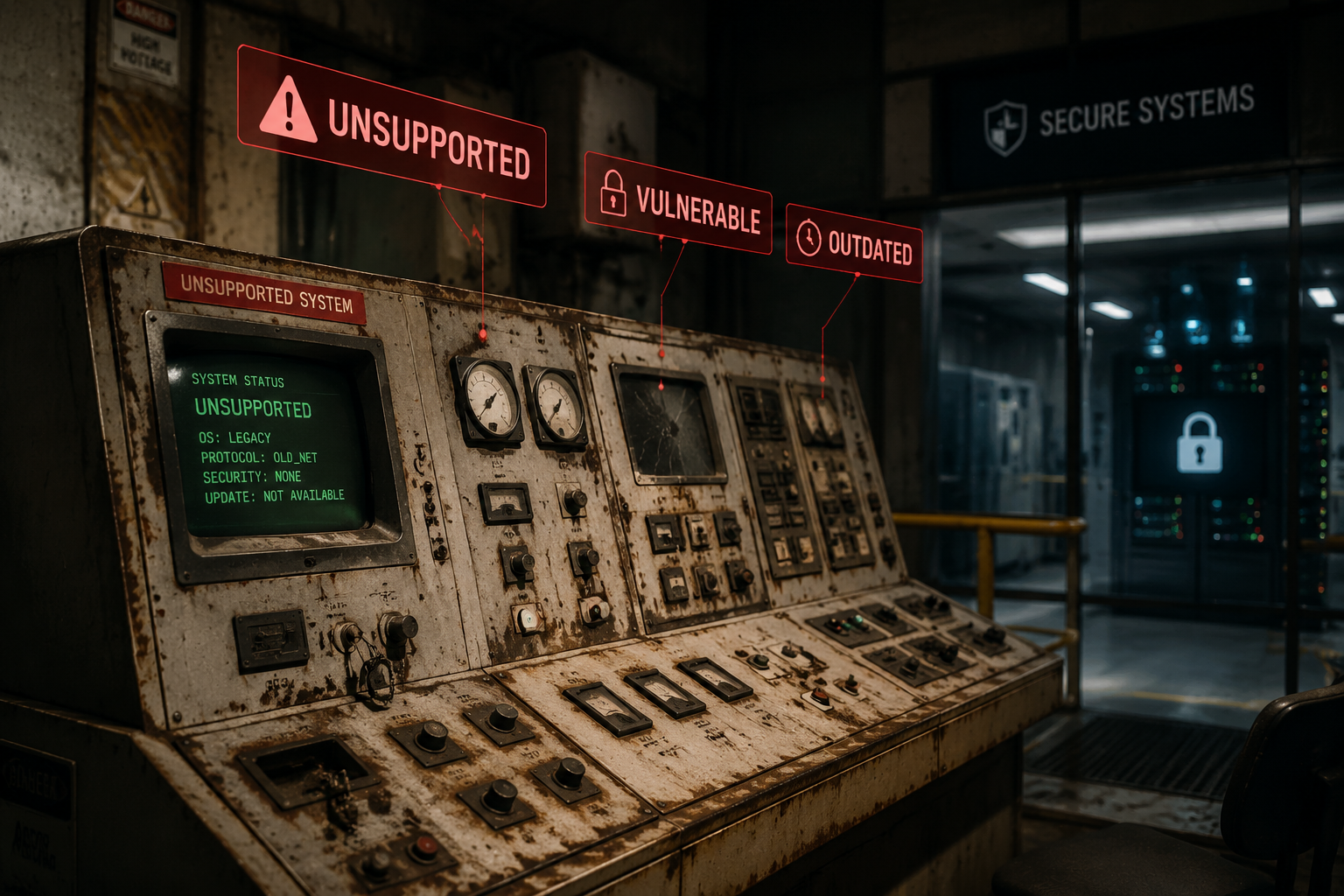
Running unsupported legacy systems represents a critical manufacturing cybersecurity mistake that creates permanent vulnerabilities in production environments. Many manufacturers operate industrial control systems that are 10-20 years old, running on Windows XP or other obsolete operating systems that no longer receive security updates.
The challenge stems from the long lifecycle of manufacturing equipment compared to IT systems. While computers typically get replaced every 3-5 years, industrial systems often operate for decades. This creates situations where critical production equipment runs on software platforms that have been unsupported for years, accumulating dozens of known security vulnerabilities.
Manufacturers often avoid upgrading legacy systems due to concerns about production disruption, validation requirements, or compatibility issues with existing equipment. However, these unsupported systems create permanent entry points that attackers can exploit with publicly available tools and techniques.
The solution involves developing systematic approaches to legacy system security that balance operational requirements with risk management. This includes network isolation for unsupported systems, compensating controls like application whitelisting, and planned migration strategies for critical legacy equipment. Some manufacturers successfully implement “security wrappers” that add protection around legacy systems without requiring software changes.
How Do Hackers Typically Target Manufacturing Networks
Cybercriminals typically begin manufacturing attacks through traditional IT systems before moving laterally into production environments. Email phishing remains the most common initial attack vector, targeting employees with access to both office and factory systems. These attacks often use manufacturing-specific lures like fake supplier communications or production schedule updates.
Once inside the network, attackers perform reconnaissance to map connections between IT and OT systems. They look for shared credentials, network pathways, and systems that bridge office and production environments. Engineering workstations and manufacturing execution systems often provide these pathways because they need access to multiple network zones.
Remote access systems represent another primary target as they often provide direct access to manufacturing networks with minimal monitoring. Attackers scan for exposed VPN servers, remote desktop services, and industrial remote access tools that may use default credentials or weak authentication.
Advanced attackers also target supply chain connections, compromising vendor systems that have trusted access to manufacturer networks. This approach allows them to bypass perimeter security by using legitimate business connections. Software updates, remote support sessions, and shared development environments create opportunities for these supply chain attacks.
Manufacturing Cybersecurity Mistake #3: Weak Network Segmentation
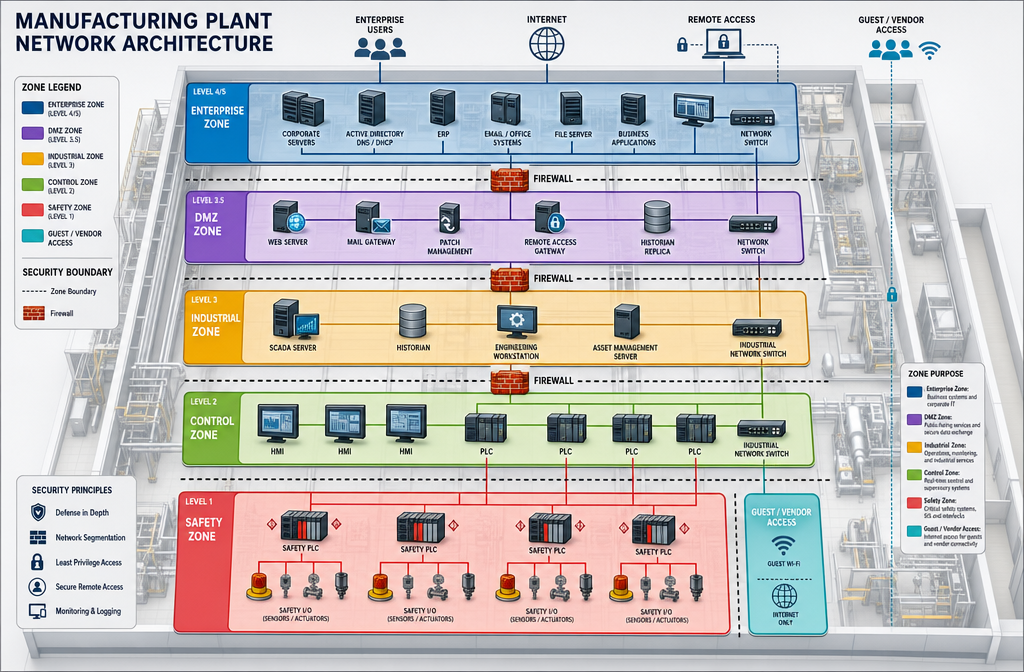
Weak network segmentation represents a critical manufacturing cybersecurity mistake that allows attackers to move freely between office systems and production equipment. Many manufacturers connect their corporate networks directly to manufacturing systems without proper security boundaries, creating “flat” networks where compromising any system provides access to critical operations.
Traditional network designs often prioritize convenience over security, allowing engineering workstations, manufacturing execution systems, and enterprise software to communicate directly with PLCs and safety systems. This approach eliminates the friction of managing multiple network zones but creates pathways for attackers to reach critical systems from any network entry point.
The consequences become severe when attackers gain initial access through common vectors like phishing emails or compromised credentials. Without proper segmentation, they can quickly escalate from accessing email systems to controlling production equipment. This lateral movement often goes undetected because many manufacturers lack monitoring tools that can identify unusual communications between network zones.
Effective network segmentation requires creating security zones based on operational requirements and risk levels. Corporate systems, manufacturing operations, and safety systems should operate in separate network segments with controlled communication pathways. Industrial firewalls, network access control, and micro-segmentation help enforce these boundaries while maintaining necessary business communications.
What Are the Warning Signs of an Industrial Cybersecurity Attack
Early warning signs of industrial cybersecurity attacks often appear in operational anomalies before traditional security alerts trigger. Unexpected changes in production parameters, unusual equipment behavior, or unexplained process variations can indicate that attackers have gained control of manufacturing systems. These operational indicators often precede network-based detection by hours or days.
Network traffic anomalies provide another early warning category, including unusual communication patterns between systems, unexpected data transfers during off-hours, or connections to external systems that don’t match normal operations. Manufacturing networks typically have predictable traffic patterns, making deviations easier to identify than in dynamic office environments.
System performance issues may signal the presence of malware or unauthorized access, particularly when multiple systems experience simultaneous problems. Slow response times, frequent disconnections, or systems that become unresponsive can indicate that attackers are interfering with normal operations or installing malicious software.
Authentication anomalies deserve immediate attention, including failed login attempts on industrial systems, successful logins from unusual locations or times, or accounts accessing systems they don’t normally use. Many manufacturing systems log authentication events that can provide early attack indicators when properly monitored.
Difference Between IT Security and Operational Technology Security
IT security and operational technology security differ fundamentally in their priorities, approaches, and risk models. IT security prioritizes data confidentiality and integrity, while OT security focuses on availability, safety, and real-time performance. This difference in priorities drives completely different security strategies and tool selections.
IT systems can typically handle security measures that require system restarts, performance overhead, or temporary service interruptions. OT systems often cannot tolerate these disruptions because they control physical processes with safety implications or production requirements that demand continuous operation. A security patch that requires rebooting an email server is routine; the same patch on a safety system controlling chemical processes requires extensive planning and coordination.
Network architectures also differ significantly between IT and OT environments. IT networks are designed for flexibility, remote access, and integration with internet services. OT networks traditionally operated as isolated systems focused on deterministic communication and real-time control. The convergence of these networks creates security challenges that neither traditional IT nor OT approaches fully address.
Security tools and techniques must account for these operational differences. OT security solutions use passive monitoring to avoid disrupting industrial communications, while IT security tools actively scan and interact with systems. OT incident response prioritizes maintaining safe operations over preserving forensic evidence, while IT incident response can typically shut down affected systems for investigation.
Manufacturing Cybersecurity Mistake #4: Unsecured Remote Access
Unsecured remote access represents a dangerous manufacturing cybersecurity mistake that provides cybercriminals with direct pathways into production systems. Many manufacturers implement remote access solutions for vendor support, engineering access, and system monitoring without applying proper security controls, creating permanent entry points that bypass perimeter security.
Traditional remote access approaches often prioritize convenience over security, using shared passwords, default credentials, or weak authentication methods. Vendor support accounts frequently use simple passwords that remain unchanged for years, while remote desktop services may lack multi-factor authentication or session monitoring. These weaknesses allow attackers to gain persistent access to manufacturing networks.
The challenge intensifies because remote access often connects directly to critical systems without intermediate security controls. Vendor support tools may provide administrative access to PLCs, HMIs, and safety systems to enable troubleshooting and maintenance. When these connections lack proper security, attackers can gain immediate control over production operations.
Many manufacturers also struggle with managing remote access across multiple vendors, contractors, and internal users. Without centralized control and monitoring, remote access connections proliferate without proper oversight. Some facilities have dozens of remote access pathways that IT teams don’t fully understand or monitor.
How Can Manufacturers Prevent Ransomware Without Spending Millions
Manufacturers can implement effective ransomware protection through focused strategies that don’t require massive security budgets. The key lies in understanding that ransomware attacks follow predictable patterns and can be disrupted at multiple stages with proper planning and basic security controls.
Network segmentation provides the highest-impact protection by limiting ransomware spread between systems. Isolating production networks from office systems prevents ransomware that enters through email from reaching manufacturing equipment. This approach costs significantly less than comprehensive security tools while providing substantial protection for critical operations.
Backup strategies specifically designed for manufacturing environments offer crucial protection without requiring expensive security infrastructure. Regular backups of PLC programs, HMI configurations, and system documentation enable rapid recovery from ransomware attacks. The key is ensuring backups remain isolated from production networks and can’t be encrypted by attackers.
Employee training focused on manufacturing-specific threats provides excellent return on investment because most ransomware attacks begin with human error. Training employees to recognize phishing emails targeting industrial systems, USB-based attacks, and social engineering tactics reduces successful attacks by over 70%, according to industry studies.
Working with a reliable partner who understands manufacturing operations can provide enterprise-level protection at small business budgets. Managed security services designed for manufacturers offer 24/7 monitoring, incident response, and specialized expertise without requiring internal security teams.
Manufacturing Cybersecurity Mistake #5: No Tested Incident Response Plan
Lacking a tested incident response plan represents a critical manufacturing cybersecurity mistake that can turn manageable incidents into operational disasters. Many manufacturers assume their general business continuity plans will handle cyber incidents, but cyberattacks on manufacturing systems require specialized response procedures that account for safety systems, production dependencies, and regulatory requirements.
Manufacturing incident response differs significantly from traditional IT incident response because production systems can’t simply be shut down for investigation. Safety systems must remain operational, environmental controls require continuous monitoring, and some production processes can’t be stopped without causing equipment damage or safety hazards.

Most manufacturers lack response procedures that address the unique challenges of OT incidents. Traditional incident response focuses on preserving evidence and containing threats, while manufacturing incidents require maintaining safe operations while investigating and recovering from attacks. This requires coordination between cybersecurity teams, operations staff, safety personnel, and potentially regulatory authorities.
Testing incident response plans reveals critical gaps that only become apparent during actual incidents. Many manufacturers discover that their backup systems don’t work as expected, communication procedures break down under pressure, or recovery procedures take much longer than anticipated. Regular tabletop exercises and simulated incidents help identify and address these issues before real attacks occur.
Which Cybersecurity Mistakes Lead to the Most Expensive Damages
Weak network segmentation leads to the most expensive manufacturing cybersecurity damages because it allows attackers to reach multiple critical systems from a single entry point. When ransomware spreads from office networks to production systems, the resulting downtime affects entire facilities rather than individual systems, multiplying recovery costs and production losses.
Running unsupported legacy systems creates the second most expensive category of damages because these vulnerabilities often remain undetected until attackers exploit them for major incidents. Legacy systems frequently lack logging and monitoring capabilities, allowing attackers to maintain persistent access for months while gathering intelligence and preparing large-scale attacks.
Inadequate backup strategies amplify the cost of any successful attack because they force manufacturers to choose between paying ransoms and accepting extended downtime for system rebuilding. Manufacturing systems often require specialized knowledge to restore properly, and inadequate documentation or backup procedures can extend recovery times from days to months.
Poor incident response preparation multiplies the cost of cybersecurity incidents by extending response times and complicating recovery efforts. Manufacturers without tested response plans often make critical mistakes during incidents that worsen the impact, such as shutting down safety systems unnecessarily or failing to isolate affected systems properly.
What Training Do Manufacturing Employees Need to Prevent Cyber Risks
Manufacturing employees need specialized cybersecurity training that addresses the unique risks and attack vectors targeting industrial environments. Traditional cybersecurity awareness training focuses on office-based threats but doesn’t cover the manufacturing-specific tactics that attackers use to target production systems.
Production floor employees should understand the risks of USB devices, removable media, and portable equipment that could introduce malware into manufacturing systems. Many attacks specifically target industrial environments through infected USB drives or compromised laptops that connect to both office and production networks. Training should cover proper procedures for handling external devices and reporting suspicious equipment.
Engineering and maintenance staff need training on secure remote access procedures, vendor management, and system administration practices. These employees often have elevated privileges across multiple systems and may work with external vendors who require network access. Training should cover password management, multi-factor authentication, and procedures for monitoring vendor activities.
Management personnel should understand the business impact of cybersecurity decisions and the importance of supporting security initiatives that may affect operational efficiency. Training should cover the true cost of cyber incidents, regulatory requirements, and the business case for cybersecurity investments in manufacturing environments.
Are Legacy Industrial Systems More Vulnerable to Hacking
Legacy industrial systems face significantly higher cybersecurity risks than modern equipment because they were designed during an era when manufacturing networks operated in isolation from external threats. These systems often lack basic security features like authentication controls, encrypted communications, or logging capabilities that are standard in modern equipment.
The age of legacy systems creates multiple vulnerability categories that compound over time. Operating systems and software platforms may have accumulated years of unpatched security vulnerabilities, while hardware components may use outdated communication protocols that expose sensitive information. Many legacy systems use default passwords or shared credentials that haven’t been changed since installation.
Legacy systems also lack the monitoring and detection capabilities needed to identify cybersecurity incidents. Without proper logging or network monitoring, attacks on legacy systems often go undetected for months while attackers gather intelligence or establish persistent access. This extended dwell time allows attackers to cause maximum damage when they choose to activate their attacks.
However, legacy systems can be protected through compensating controls that add security without requiring system replacement. Network isolation, application whitelisting, and specialized monitoring tools can significantly reduce the risk of legacy system compromise while allowing continued operation of critical equipment.
How Quickly Can a Cyberattack Shut Down a Manufacturing Plant
Cyberattacks can shut down manufacturing plants within hours once attackers gain access to production systems, but the timeline varies significantly based on the attack type and target systems. Ransomware attacks typically move quickly once deployed, encrypting critical systems and halting operations within 2-4 hours of activation.
Targeted attacks on safety systems or process control equipment can cause immediate shutdowns if attackers interfere with safety interlocks or critical process parameters. These attacks may trigger automatic safety responses that shut down production to prevent equipment damage or safety incidents. Recovery from safety system attacks often takes weeks as engineers verify system integrity before restarting operations.
More sophisticated attacks may operate slowly to avoid detection while gathering intelligence about production processes and system dependencies. These attacks can remain dormant for months before activating, but when triggered, they can cause coordinated shutdowns across multiple systems simultaneously.
The speed of attack propagation depends heavily on network architecture and segmentation. Well-segmented networks may contain attacks to specific systems or production lines, while flat networks allow rapid spread across entire facilities. Proper network design can limit attack impact and provide time for response teams to contain threats before they reach critical systems.
What Regulations Require Manufacturers to Have Cybersecurity Protocols
Several regulatory frameworks require manufacturers to implement cybersecurity protocols, with requirements varying based on industry sector and geographic location. The NIST Cybersecurity Framework provides voluntary guidelines that many manufacturers use as a baseline for cybersecurity programs, while sector-specific regulations impose mandatory requirements for certain industries.
Chemical manufacturers must comply with the Chemical Facility Anti-Terrorism Standards (CFATS), which include cybersecurity requirements for high-risk facilities. These regulations require risk assessments, security plans, and cybersecurity measures proportional to the facility’s risk level. Food and beverage manufacturers face FDA regulations that include cybersecurity requirements for food safety systems.
Defense contractors must comply with DFARS cybersecurity requirements and NIST 800-171 standards when handling controlled unclassified information. These regulations impose specific technical requirements for network security, access controls, and incident response procedures. Non-compliance can result in contract termination and exclusion from future government work.
State and local regulations increasingly address cybersecurity for critical infrastructure, including manufacturing facilities that support essential services. Some states require incident reporting, risk assessments, or specific security measures for manufacturers in critical sectors. International manufacturers must also consider regulations like the EU’s NIS2 Directive, which imposes cybersecurity requirements on essential and important entities.
How Manufacturers Can Improve Security Maturity
Improving manufacturing security maturity requires a systematic approach that balances operational requirements with cybersecurity best practices. The journey typically begins with understanding current vulnerabilities through comprehensive risk assessments that evaluate both IT and OT environments using manufacturing-specific frameworks.
Network architecture improvements provide the foundation for enhanced security by creating proper segmentation between corporate and production systems. This includes implementing industrial firewalls, network access controls, and monitoring solutions designed for manufacturing environments. Proper segmentation limits attack spread while maintaining necessary business communications.
Asset management and inventory control help manufacturers understand what systems they need to protect and prioritize security investments. Many manufacturers lack complete inventories of their industrial systems, making it impossible to implement comprehensive security programs. Asset discovery tools designed for OT environments can identify systems that traditional IT tools miss.
Partnership with experienced providers offers manufacturers access to specialized expertise without requiring internal security teams. Working with a reliable partner who understands manufacturing operations can accelerate security improvements while avoiding costly mistakes that could disrupt production operations.