

Quick Answer
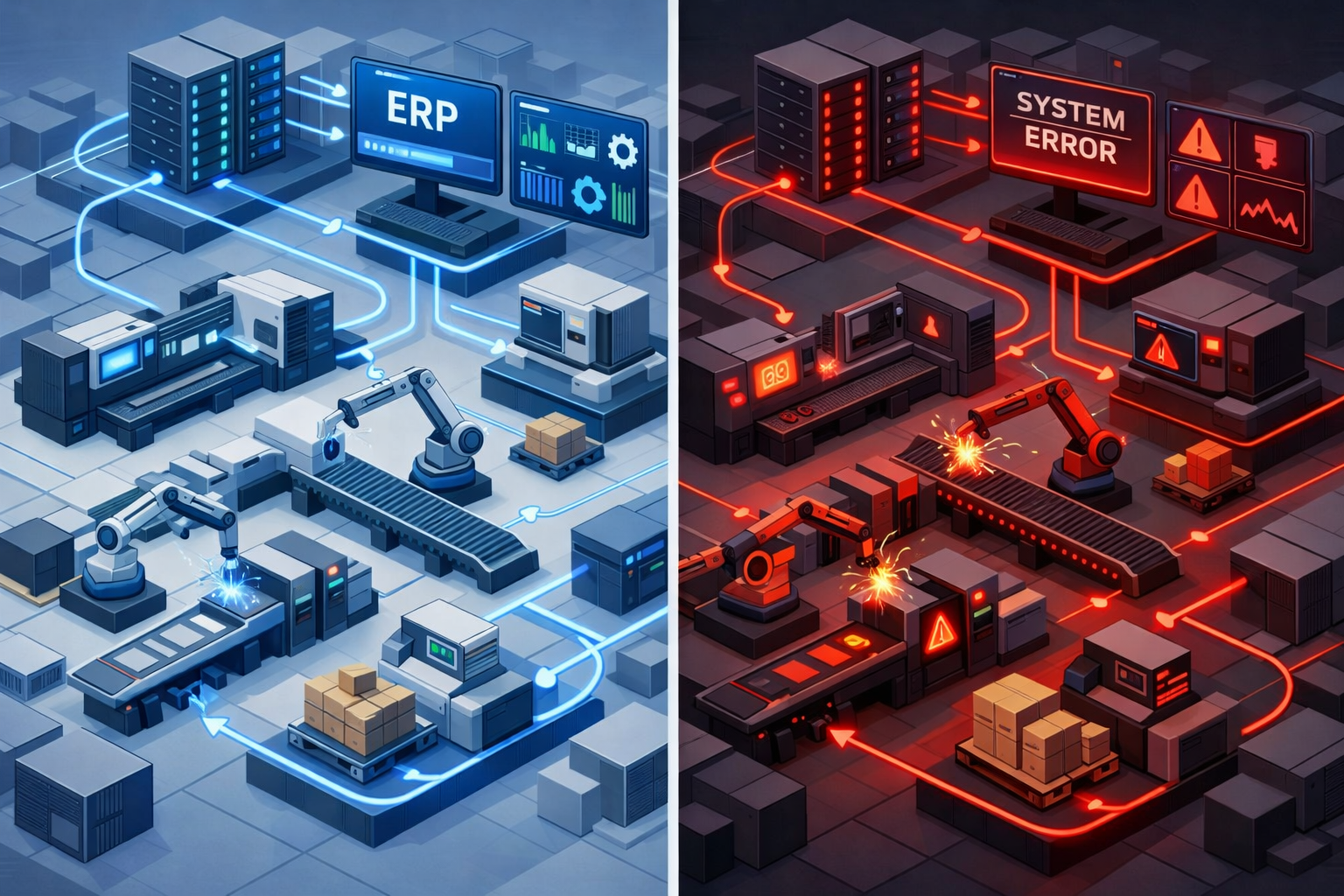
IT downtime impact on manufacturing extends far beyond simple computer problems – it can completely halt production lines, disrupt supply chains, and cost manufacturers hundreds of thousands of dollars per hour. Modern factories depend on interconnected systems for everything from inventory management to quality control, making IT reliability critical for operational success.
Picture this: It’s Monday at 7 AM, and your production floor should be humming with activity. Instead, machines sit silent, workers stand idle, and your plant manager is frantically calling the IT department. A simple network failure has brought your entire operation to a standstill.
If you’re a manufacturing executive, this scenario probably makes your stomach drop. And it should. In 2026, the IT downtime impact on manufacturing has never been more severe or more costly. What used to be a minor inconvenience has become a business-critical threat that can derail production schedules, damage customer relationships, and devastate your bottom line.
The reality is that today’s manufacturing operations are more connected and technology-dependent than ever before. Your production lines don’t just rely on mechanical systems anymore – they’re powered by complex networks of IT infrastructure that control everything from inventory management to quality assurance.
What Qualifies as IT Downtime in Manufacturing?
IT downtime in manufacturing occurs whenever technology systems fail to support normal production operations, regardless of whether machines are physically operational. This includes everything from complete network outages to partial system failures that slow or compromise production quality.
Understanding what constitutes IT downtime helps you recognize threats before they escalate into major production disruptions.
Complete System Failures
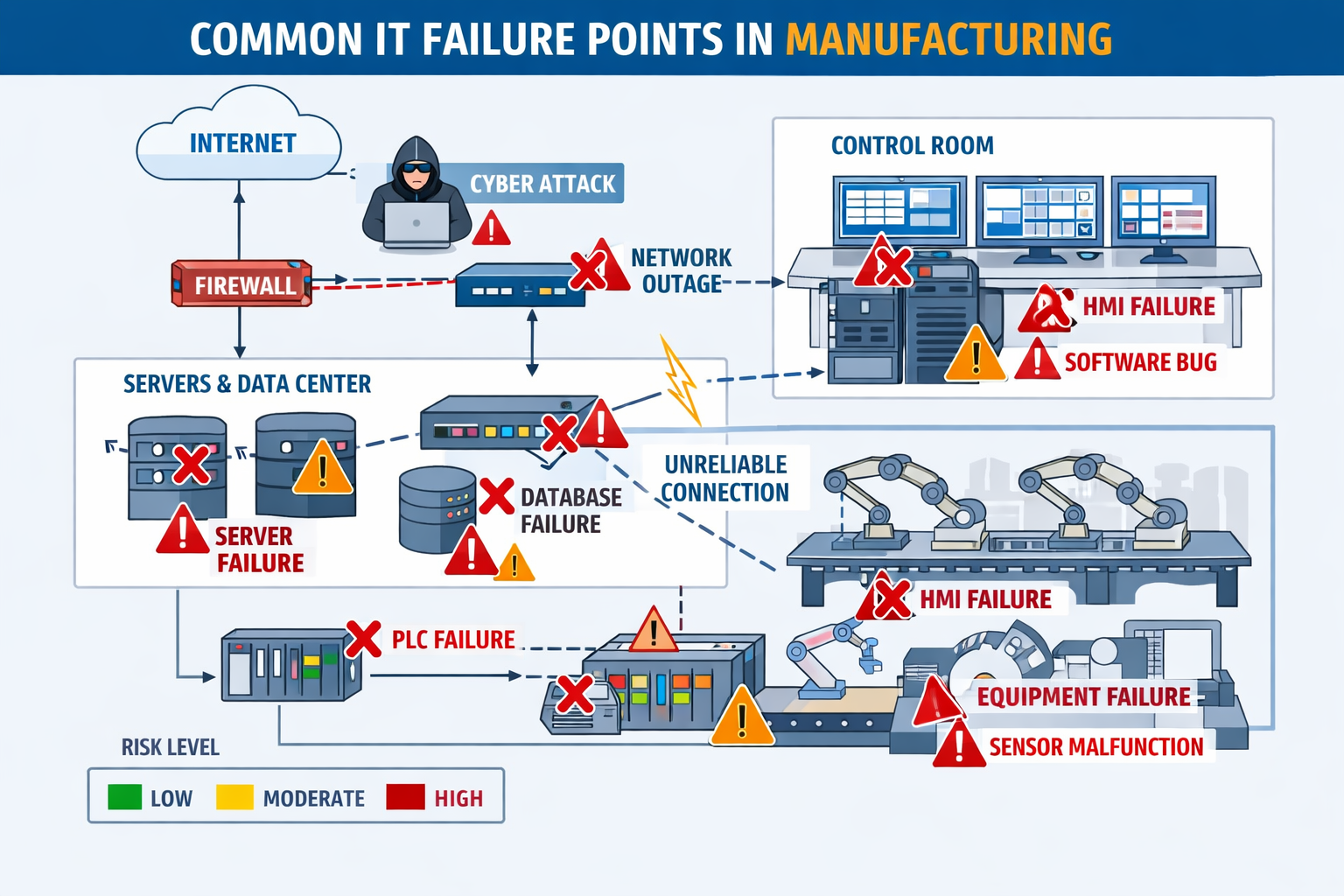
The most obvious form of downtime happens when core systems go completely offline. This includes:
- ERP system crashes that prevent access to production schedules, inventory data, and work orders
- Network outages that disconnect production equipment from central control systems
- Server failures that take down manufacturing execution systems (MES) or quality management platforms
- Power grid issues affecting data centers and IT infrastructure
Partial System Degradation
Sometimes systems stay online but perform poorly enough to disrupt operations:
- Slow network performance that delays data synchronization between production stages
- Database connectivity issues are causing intermittent access to critical production data
- Software glitches in control systems leading to equipment malfunctions or safety shutdowns
- Communication failures between automated systems and human operators
Cybersecurity Incidents
Security breaches often force manufacturing companies to shut down systems as a precautionary measure:
- Ransomware attacks that encrypt critical production data and control systems
- Malware infections requiring immediate isolation of affected networks
- Data breaches are prompting temporary shutdowns while security teams assess the damage
Choose immediate containment if: You detect any signs of unauthorized access to production control systems, even if operations seem normal.
How Production Lines Depend on IT Systems
Modern manufacturing operations integrate IT systems into every aspect of production, from initial planning through final quality control. When these systems fail, the entire production ecosystem can collapse within minutes.
Your production floor might look like it runs on mechanical equipment, but dig deeper and you’ll find layers of IT infrastructure that make everything possible.
Enterprise Resource Planning (ERP) Integration
Your ERP system serves as the central nervous system for manufacturing operations:
- Production scheduling relies on real-time inventory data and customer demand forecasts
- Material requirements planning automatically generates purchase orders and work instructions
- Quality control processes track defects and trigger corrective actions across multiple production lines
- Shipping and logistics coordinate finished goods movement with customer delivery schedules
When ERP systems go down, plant managers lose visibility into what should be produced, when, and with which materials.
Manufacturing Execution Systems (MES)
MES platforms bridge the gap between planning and actual production:
- Work order management guides operators through specific production steps
- Real-time monitoring tracks production rates, equipment performance, and quality metrics
- Batch tracking ensures traceability for regulatory compliance and quality assurance
- Equipment integration connects automated machinery with human oversight systems
Industrial Control Systems
Modern equipment relies heavily on digital control and monitoring:
- Programmable Logic Controllers (PLCs) manage automated production sequences
- Human Machine Interfaces (HMIs) provide operators with real-time equipment status
- Supervisory Control and Data Acquisition (SCADA) systems monitor facility-wide operations
- Safety systems automatically shut down equipment when problems are detected
Common mistake: Assuming that older “dumb” equipment is immune to IT failures. Even basic machinery often depends on network connectivity for scheduling, monitoring, and safety systems.
The Real Cost of IT Downtime Impact on Manufacturing
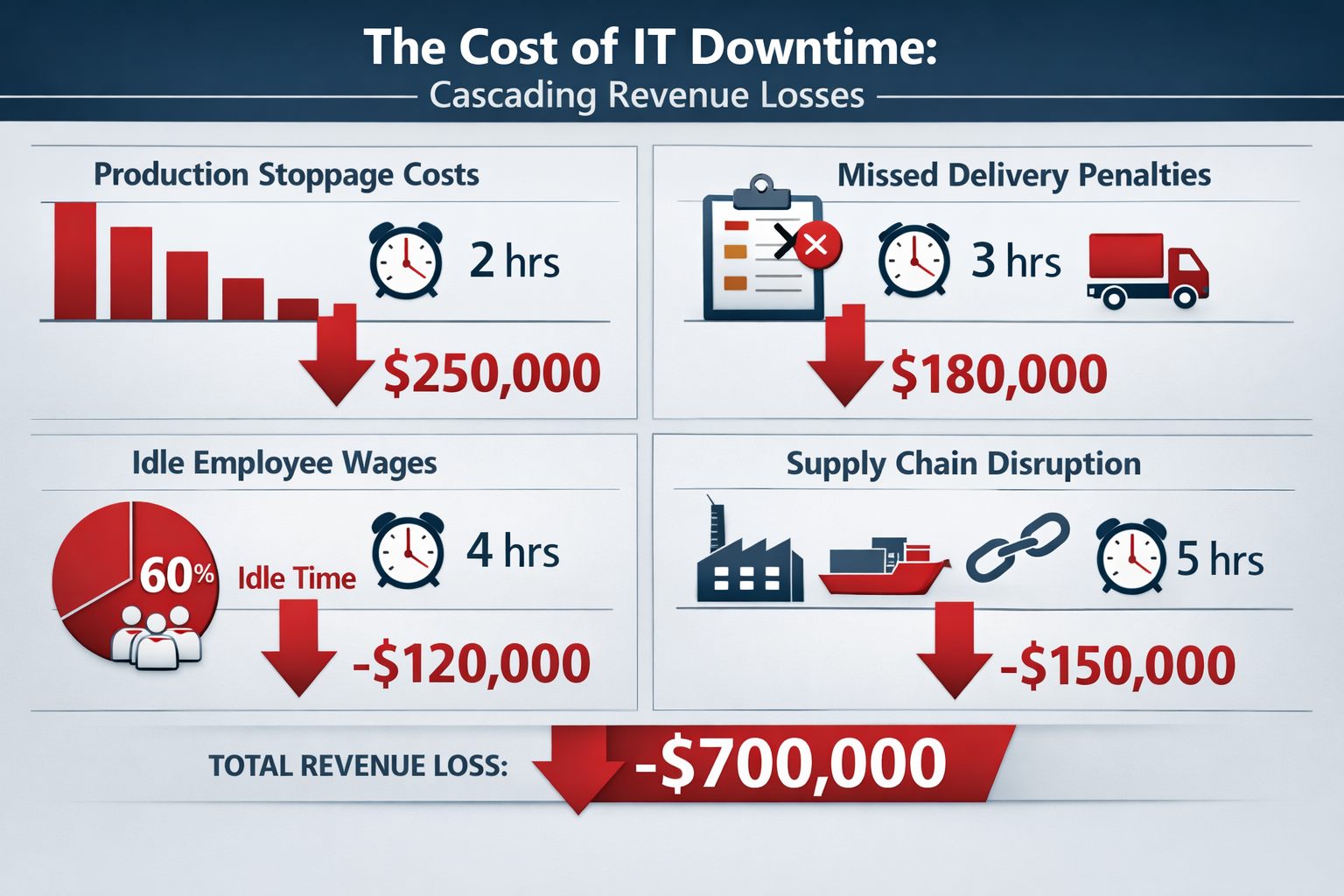
Calculating the true cost of IT downtime requires looking beyond immediate production losses to include hidden expenses like overtime wages, expedited shipping, and long-term customer relationship damage. Most manufacturers underestimate total downtime costs by 40-60%.
Let me walk you through how these costs add up faster than you might expect.
Direct Production Losses
The most visible costs hit immediately when production stops:
- Lost production output based on your hourly production capacity and profit margins
- Fixed cost absorption continues even when no products are being manufactured
- Raw material waste from interrupted processes that can’t be resumed
- Energy costs for restarting complex production sequences
For example, a mid-size automotive parts manufacturer producing $500,000 worth of components daily would lose approximately $21,000 for every hour of complete downtime.
Labor-Related Expenses
Your workforce becomes a cost center instead of a profit driver during downtime:
- Idle employee wages for production workers who can’t perform their normal duties
- Overtime premiums to make up for lost production once systems are restored
- Supervisor and management time spent coordinating recovery efforts instead of normal operations
- Maintenance team costs for emergency repairs and system restoration
Supply Chain Disruption Costs
Downtime creates ripple effects throughout your supply network:
- Expedited shipping charges to meet customer delivery commitments
- Supplier penalties for last-minute order changes or cancellations
- Customer penalty fees for missed delivery deadlines
- Rush order premiums for replacement materials or components
Quality and Compliance Issues
System failures often compromise product quality and regulatory compliance:
- Increased defect rates when manual processes replace automated quality controls
- Rework and scrap costs for products that don’t meet specifications
- Regulatory fines if downtime affects compliance documentation or traceability
- Product recall expenses if quality issues reach customers
Edge case consideration: Some industries face exponentially higher costs. Pharmaceutical manufacturers, for example, may need to discard entire batches worth hundreds of thousands of dollars if IT systems can’t verify proper environmental controls during production.
Hidden Costs That Multiply Your Losses
The indirect costs of IT downtime often exceed direct production losses by 200-300%, creating financial impacts that compound for weeks or months after systems are restored. These hidden expenses frequently catch manufacturing executives off guard.
Customer Relationship Damage
Missing delivery commitments creates long-term business risks:
- Lost customer confidence, leading to reduced future order volumes
- Penalty clauses in customer contracts that trigger automatic fee assessments
- Emergency sourcing costs when customers find alternative suppliers during your downtime
- Sales team time spent rebuilding relationships and explaining service failures
I’ve seen manufacturers lose major contracts because a single downtime incident convinced customers they couldn’t rely on consistent delivery performance.
Insurance and Legal Expenses
Downtime incidents often trigger additional professional service costs:
- Business interruption claims require detailed documentation and professional assessment
- Legal fees if downtime causes contract breaches or customer disputes
- Forensic IT analysis to determine root causes and prevent recurrence
- Regulatory reporting costs if downtime affects compliance obligations
Competitive Disadvantage
Extended downtime can permanently damage your market position:
- Market share erosion when competitors capture your displaced customers
- Pricing pressure from customers who demand discounts after service failures
- Reputation damage affecting your ability to win new business
- Talent retention issues arise if employees lose confidence in the company’s stability
Recovery and Prevention Investments
Getting back to normal operations requires significant additional spending:
- Emergency IT services at premium rates for immediate problem resolution
- Accelerated equipment replacement to prevent similar failures
- Enhanced backup systems and redundancy investments
- Staff overtime during the recovery period to catch up on lost production
Decision rule: If your total downtime costs (including hidden expenses) exceed $100,000 annually, invest in proactive monitoring and redundancy systems. The prevention costs will typically be 10-20% of your total risk exposure.
Common Causes of Manufacturing IT Downtime
Network infrastructure failures, cybersecurity incidents, and aging hardware account for approximately 75% of manufacturing IT downtime events. Understanding these common causes helps you prioritize prevention efforts where they’ll have the greatest impact.
Network and Connectivity Issues
Your production floor depends on reliable network connectivity for real-time operations:
- Switch and router failures that disconnect production equipment from control systems
- Internet service provider outages are affecting cloud-based applications and remote monitoring
- Wireless network interference is disrupting mobile devices and automated guided vehicles
- Bandwidth saturation during peak data transfer periods is slowing critical communications
Quick fix: Implement network redundancy with automatic failover capabilities. A backup internet connection costs a fraction of what you’ll lose during a single extended outage.
Cybersecurity Threats
Manufacturing companies face increasing cyber risks as they digitize operations:
- Ransomware attacks targeting industrial control systems and production data
- Phishing campaigns that compromise employee credentials and provide network access
- Supply chain attacks through compromised vendor software or equipment
- Insider threats from disgruntled employees or inadequate access controls
Hardware and Infrastructure Failures
Physical equipment eventually fails, often at the worst possible times:
- Server hardware failures affecting ERP, MES, or database systems
- Storage system crashes, causing data loss or corruption
- Power supply issues affecting data centers and network equipment
- Environmental controls, like cooling system failures that force equipment shutdowns
Software and Application Problems
Even well-maintained systems can experience software-related downtime:
- Operating system crashes requiring server reboots and application restarts
- Database corruption is preventing access to critical production data
- Software bugs in manufacturing applications are causing system instability
- Failed software updates that introduce new problems or compatibility issues
Common mistake: Applying software updates during production hours without proper testing. Always test updates in a development environment and schedule implementations during planned maintenance windows.
Human Error
People-related incidents cause a surprising percentage of downtime events:
- Accidental configuration changes that disrupt network connectivity or system performance
- Improper maintenance procedures that damage equipment or corrupt data
- Security policy violations that expose systems to cyber threats
- Inadequate training leading to operator errors that cascade into system failures
Real-World Manufacturing Downtime Scenarios
Learning from actual downtime incidents helps manufacturing leaders understand how quickly problems escalate and why comprehensive prevention strategies matter more than quick fixes. Here are three scenarios I’ve witnessed that illustrate different aspects of IT downtime impact on manufacturing.
Scenario 1: ERP System Crash During Peak Production
A plastic injection molding company experienced a complete ERP system failure during their busiest production shift. The server hosting their manufacturing software crashed due to a failed hard drive, and their last backup was three days old.
Immediate impacts:
- Production supervisors couldn’t access work orders or material specifications
- Quality control couldn’t record inspection results or track batch numbers
- Shipping department couldn’t generate bills of lading or update delivery schedules
- Customer service couldn’t provide order status updates to anxious customers
Cascading effects:
- 12 hours of lost production are worth $85,000 in revenue
- $23,000 in overtime wages to make up lost production over the following week
- $8,500 in expedited shipping charges to meet customer commitments
- Loss of a major customer contract worth $300,000 annually due to delivery failures
Total cost: $416,500 for a problem that could have been prevented with proper backup systems and redundant hardware.
Scenario 2: Ransomware Attack on Control Systems
A food processing facility fell victim to a targeted ransomware attack that encrypted its production control systems. The attackers specifically targeted industrial systems, knowing that food safety regulations would prevent the company from operating without proper monitoring and documentation.
Immediate response:
- Complete production shutdown to prevent contamination and ensure worker safety
- Isolation of all network systems to prevent further malware spread
- Emergency notification to regulatory agencies about potential food safety impacts
- Activation of the incident response team, including legal counsel and cybersecurity experts
Extended impacts:
- 72-hour production shutdown while systems were rebuilt from clean backups
- $180,000 in lost production during the shutdown period
- $45,000 in cybersecurity consulting fees for incident response and system hardening
- $25,000 in regulatory compliance costs for additional inspections and documentation
- Six months of customer audits and enhanced security requirements
Total cost: $250,000 plus ongoing compliance burdens that added $50,000 annually to operating costs.
Scenario 3: Network Failure During Supply Chain Integration
An electronics manufacturer experienced a network switch failure that disconnected their production systems from supplier integration platforms. While production could continue manually, the company lost real-time visibility into component availability and delivery schedules.
Hidden complexity:
- Just-in-time manufacturing meant only 4-6 hours of component inventory on hand
- Automated reordering systems couldn’t function without network connectivity
- Production planning software couldn’t adjust schedules based on supplier delays
- Quality systems couldn’t access supplier certification data for incoming materials
Escalating problems:
- Initial 2-hour network outage seemed manageable with manual workarounds
- Component shortages began affecting production lines after 6 hours
- Quality holds on incoming materials without proper documentation
- Customer delivery commitments at risk due to production delays
Resolution costs:
- $15,000 for emergency network equipment replacement
- $35,000 in expedited component deliveries to prevent line shutdowns
- $12,000 in additional quality testing for materials received during the outage
- $28,000 in customer penalty fees for delayed shipments
Lesson learned: Even “minor” IT failures can create major operational disruptions when manufacturing processes are highly integrated and optimized for efficiency.
Prevention Strategies That Actually Work
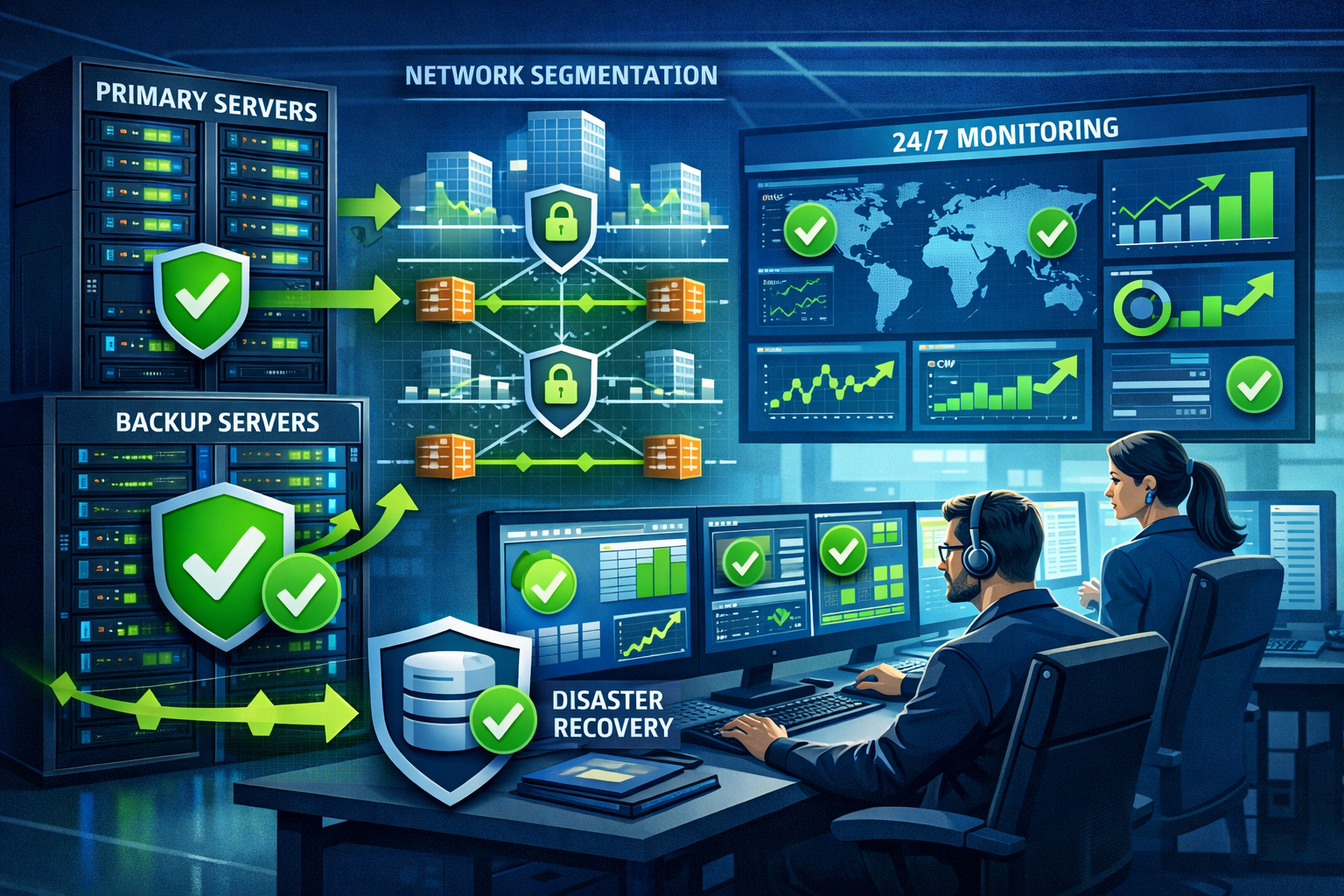
Effective IT downtime prevention requires a layered approach combining proactive monitoring, system redundancy, and network segmentation tailored specifically for manufacturing environments. Generic IT solutions often miss the unique requirements of production operations.
Implement Comprehensive 24/7 Monitoring
Real-time monitoring helps you catch problems before they cause production disruptions:
- Network performance monitoring tracks bandwidth utilization, latency, and packet loss across production networks
- Server health monitoring watches CPU usage, memory consumption, disk space, and application responsiveness
- Database monitoring identifies slow queries, connection issues, and storage problems before they affect operations
- Security monitoring detects unusual network activity, failed login attempts, and potential cyber threats
The key is setting up alerts that notify your IT team about developing problems while there’s still time to take corrective action. A reliable partner with industry expertise can configure monitoring systems that understand the difference between normal manufacturing operations and actual problems.
Built-in System Redundancy
Redundant systems ensure that single points of failure don’t shut down your entire operation:
- Backup servers that can automatically take over if primary systems fail
- Network redundancy with multiple internet connections and backup communication paths
- Power protection, including uninterruptible power supplies and backup generators
- Data replication that maintains current copies of critical information in multiple locations
Choose active redundancy if: Your production lines generate more than $50,000 per hour in revenue. The cost of redundant systems will be recovered quickly during your first avoided downtime incident.
Implement Network Segmentation
Separating your production networks from office systems limits the impact of failures and security incidents:
- Production network isolation prevents office IT problems from affecting manufacturing systems
- Equipment-specific subnets contain problems within specific production areas
- Guest network separation keeps visitor devices away from critical systems
- Administrative network controls restrict access to sensitive configuration interfaces
Establish Proactive Maintenance Schedules
Regular maintenance prevents many common causes of IT downtime:
- Software updates are applied during planned maintenance windows with proper testing
- Hardware replacement based on manufacturer recommendations and performance monitoring
- Security patches are deployed systematically to prevent vulnerability exploitation
- Performance optimization to prevent gradual degradation that leads to system failures
Create Detailed Incident Response Procedures
When problems do occur, having clear procedures minimizes downtime duration:
- Escalation protocols that quickly engage the right technical resources
- Communication plans keep stakeholders informed about the status and expected resolution times
- Recovery checklists ensuring systematic restoration of systems and services
- Documentation requirements for post-incident analysis and prevention improvements
Common mistake: Creating incident response plans but never testing them. Regular drills help identify gaps and ensure your team can execute procedures under pressure.
Business Continuity Planning for Manufacturing
Effective business continuity planning goes beyond IT disaster recovery to address how your entire manufacturing operation will continue functioning during various types of disruptions. This comprehensive approach protects both immediate operations and long-term business relationships.
Develop Tiered Response Plans
Different types of incidents require different response strategies:
Tier 1: Minor disruptions (1-4 hours)
- Single system failures that don’t affect core production
- Network performance issues that slow but don’t stop operations
- Planned maintenance activities during production hours
- Response: Manual workarounds and accelerated repair procedures
Tier 2: Major disruptions (4-24 hours)
- Multiple system failures affecting production capacity
- Cybersecurity incidents requiring system isolation
- Infrastructure failures affecting facility operations
- Response: Alternative production methods and customer communication
Tier 3: Extended disruptions (24+ hours)
- Facility damage is preventing normal operations
- Complete IT infrastructure failures
- Supply chain disruptions affecting material availability
- Response: Alternative production locations and comprehensive customer management
Establish Alternative Production Capabilities
Maintaining some production capacity during IT outages protects critical customer relationships:
- Manual production procedures for essential products that can be manufactured without full IT support
- Partner manufacturing agreements with other facilities that can handle overflow production
- Inventory buffers for critical products that provide time to restore normal operations
- Mobile production units that can operate independently of facility IT infrastructure
Maintain Customer Communication Protocols
Keeping customers informed during disruptions often prevents relationship damage:
- Automated notification systems that don’t depend on your primary IT infrastructure
- Customer priority classifications ensure your most important relationships get immediate attention
- Alternative communication channels, including phone trees and mobile messaging systems
- Regular status updates with realistic timelines for resolution and delivery recovery
Plan for Financial Continuity
Downtime incidents often create immediate cash flow pressures that compound operational problems:
- Emergency funding arrangements providing quick access to capital for recovery efforts
- Insurance claim procedures that accelerate business interruption payments
- Supplier payment modifications preventing supply chain disruptions during recovery
- Customer billing adjustments, maintaining goodwill while protecting cash flow
Decision rule: If your business would face serious financial stress after 48 hours of complete downtime, establish emergency credit facilities and expedited insurance claim procedures before you need them.
Test and Update Plans Regularly
Business continuity plans become obsolete quickly without regular maintenance:
- Quarterly plan reviews ensure procedures reflect current operations and technology
- Annual full-scale exercises testing all aspects of your continuity capabilities
- Supplier and partner coordination, verifying that external resources remain available
- Employee training updates, ensuring staff can execute procedures effectively
The goal isn’t just surviving IT disruptions, it’s maintaining enough operational capability to protect your customer relationships and market position while you restore full functionality.
Conclusion
The IT downtime impact on manufacturing has evolved from a minor inconvenience to a business-critical threat that can devastate production schedules, damage customer relationships, and cost hundreds of thousands of dollars per incident. As manufacturing operations become increasingly dependent on interconnected IT systems, the stakes continue to rise.
The good news is that most downtime incidents are preventable with the right combination of proactive monitoring, system redundancy, and comprehensive business continuity planning. The key is taking action before problems occur rather than scrambling to respond after production has already stopped.
Your next steps should include:
- Conduct a comprehensive IT risk assessment to identify your specific vulnerabilities and calculate potential downtime costs
- Implement 24/7 monitoring systems that can detect and alert you to problems before they disrupt production
- Establish system redundancy for your most critical manufacturing applications and infrastructure
- Develop and test business continuity plans that address both immediate response and extended recovery scenarios
- Partner with an experienced IT provider who understands manufacturing operations and can provide same-day support when you need it most
Don’t wait for a downtime incident to reveal your vulnerabilities. The cost of prevention is always lower than the cost of recovery, and the peace of mind that comes with a reliable IT infrastructure lets you focus on what you do best, running efficient, profitable manufacturing operations.
Remember, in today’s competitive manufacturing environment, IT reliability isn’t just about technology; it’s about protecting your ability to serve customers, maintain quality standards, and grow your business. Invest in proper IT infrastructure and support before downtime decides for you.