
Quick Answer
The average cost of an IT outage per hour for small businesses ranges from $5,600 to $22,000, depending on your industry, with hidden costs often doubling the total impact. Most small businesses underestimate these costs by 300-400% because they only count obvious revenue losses while ignoring productivity, reputation, and recovery expenses. The good news? Downtime prevention strategies cost significantly less than dealing with outages after they happen.
Picture this: It’s Monday morning, and your team arrives to find every computer screen black. Your phones aren’t working. Your point-of-sale system is down. Your customer database is inaccessible. Sounds like a nightmare? For many small business owners, this scenario becomes reality more often than they’d like to admit.
The cost of IT downtime for small businesses extends far beyond the obvious revenue losses. While you’re scrambling to get systems back online, your competitors are serving your customers, your team is sitting idle, and your reputation takes a hit with every passing hour.
What Exactly Is IT Downtime?
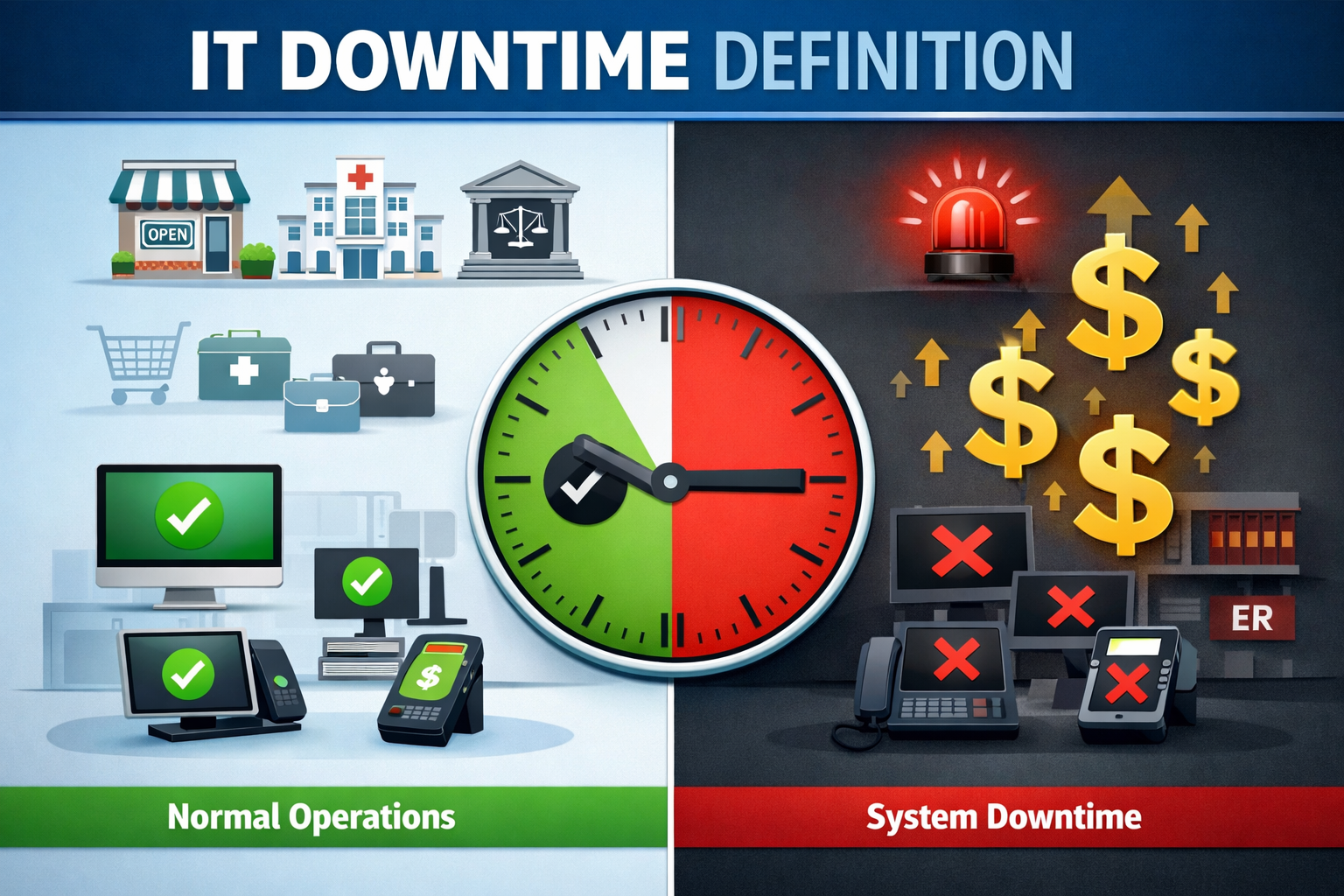
IT downtime occurs when your business-critical technology systems become unavailable, preventing normal operations from continuing. This includes everything from server crashes and internet outages to software failures and cybersecurity incidents.
For small businesses, downtime typically affects:
- Computer systems and networks
- Phone and communication systems
- Point-of-sale and payment processing
- Email and customer databases
- Industry-specific software (practice management, inventory systems, etc.)
The key distinction is between planned downtime (scheduled maintenance) and unplanned downtime (unexpected failures). While planned downtime can be managed during off-hours, unplanned outages strike without warning during your busiest periods.
Unlike large corporations with redundant systems, small businesses often rely on single points of failure. When your main server goes down, everything comes to a halt. This vulnerability results in small business IT downtime being disproportionately more costly relative to company size.
The Real Numbers: Average Cost of IT Outage Per Hour by Industry
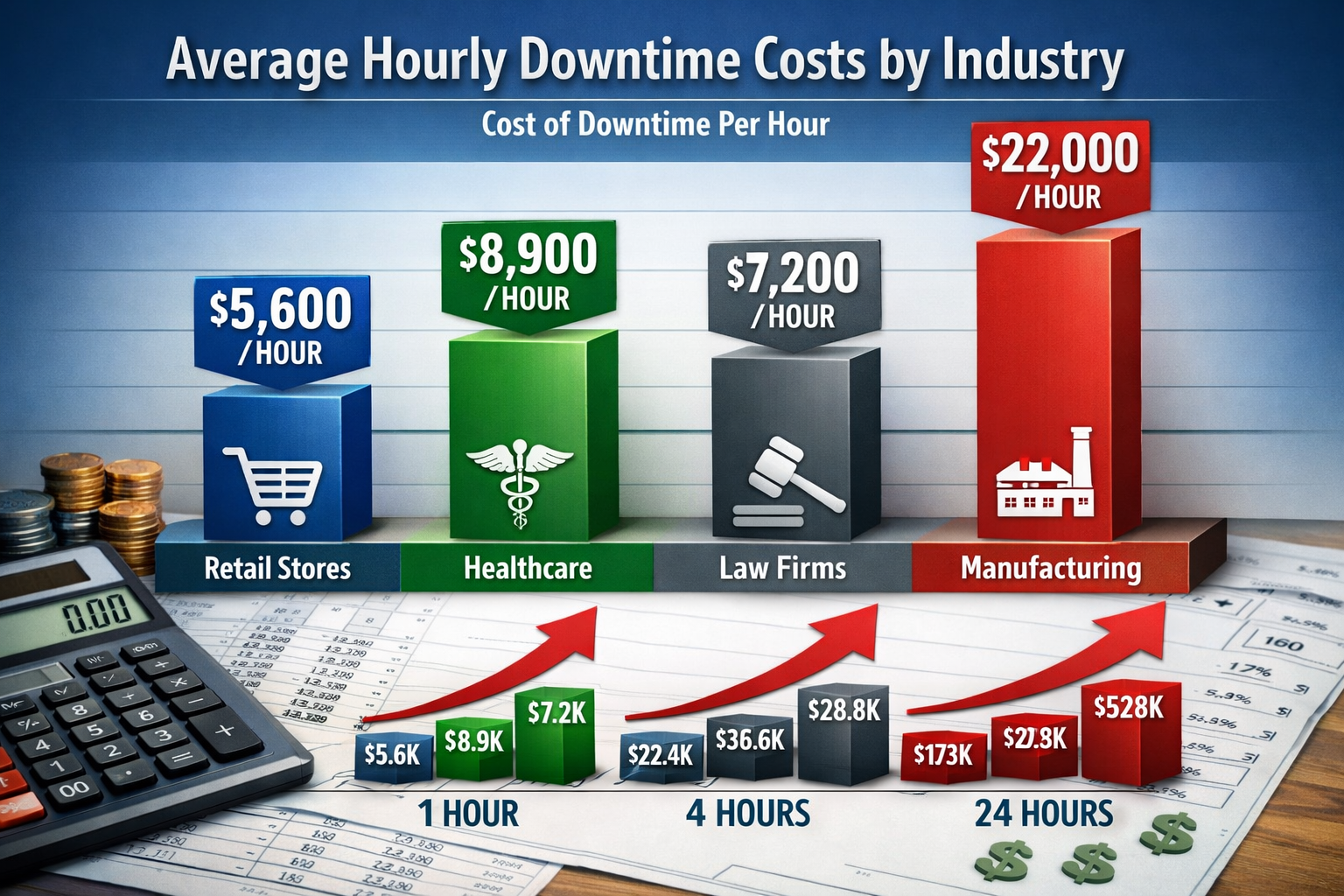
Let me break down the actual financial impact based on industry data from 2026. These numbers reflect not just lost sales, but the complete downtime impact on small business operations.
Retail and E-commerce: $5,600 per hour
- Lost sales during peak shopping periods
- Payment processing interruptions
- Inventory management disruptions
- Customer service delays
Healthcare and Dental Practices: $8,900 per hour
- Cancelled appointments and procedures
- Patient record access issues
- Billing and insurance claim delays
- Regulatory compliance risks
Professional Services (Law, Accounting, Consulting): $7,200 per hour
- Billable hour losses
- Client deadline impacts
- Document and case management disruptions
- Communication breakdowns
Manufacturing and Distribution: $22,000 per hour
- Production line stoppages
- Supply chain coordination failures
- Quality control system outages
- Shipping and logistics delays
Small Restaurants and Hospitality: $3,200 per hour
- POS system failures during meal rushes
- Reservation system outages
- Payment processing issues
- Kitchen display system problems
These figures come from analyzing actual business interruption losses across hundreds of small businesses. The costs escalate quickly because downtime doesn’t just stop revenue – it creates a cascade of operational problems.
The Hidden Costs Most Small Businesses Ignore
Here’s where most business owners get blindsided. The obvious costs are just the tip of the iceberg. The hidden expenses often double or triple your total small business IT downtime cost.
Productivity Losses Beyond the Outage
Your team doesn’t magically return to full productivity the moment systems come back online. Employees need time to:
- Restart interrupted work processes
- Recreate lost data or progress
- Catch up on delayed communications
- Address the backlog of customer issues
Reality check: For every hour of downtime, expect 3-4 hours of reduced productivity as your team gets back to normal operations.
Customer Trust and Reputation Damage
When your systems fail, customers notice. They experience:
- Delayed responses to inquiries
- Inability to complete purchases
- Cancelled appointments or services
- Poor communication during the crisis
Studies show that 40% of customers will switch to competitors after experiencing service disruptions. For small businesses that rely on personal relationships and local reputation, this damage can take months or years to repair.
Emergency Recovery Costs
When systems fail unexpectedly, everything becomes more expensive:
- Emergency IT support: 2-3x normal hourly rates
- Expedited hardware replacement: Rush shipping and premium pricing
- Data recovery services: $1,500-$15,000 depending on complexity
- Temporary workarounds: Manual processes requiring extra staff
Regulatory and Compliance Issues
Many industries face additional penalties for downtime:
- Healthcare: HIPAA violations for patient data unavailability
- Financial services: Regulatory reporting delays
- Legal: Client deadline misses and potential malpractice exposure
- Retail: PCI compliance issues with payment processing
These compliance costs can easily add $10,000-$50,000 to your total business interruption losses.
Overtime and Staffing Costs
Getting back to normal often requires:
- Extended hours to catch up on delayed work
- Additional temporary staff
- Weekend or holiday premium pay
- Outsourcing to meet deadlines
Common Causes of Small Business IT Downtime
Understanding what causes outages helps you focus your downtime prevention strategies where they’ll have the biggest impact.
Ransomware and Cybersecurity Incidents (40% of outages)
Cybersecurity downtime risks have skyrocketed in 2026. Small businesses are prime targets because they often lack robust security measures. A typical ransomware attack can shut down operations for 3-7 days while you decide whether to pay the ransom or restore from backups.
Prevention focus: Regular security updates, employee training, and comprehensive backup systems that can’t be encrypted by attackers.
Hardware Failures (25% of outages)
Servers, hard drives, and networking equipment don’t last forever. The average small business server has a 15% annual failure rate after three years of service.
Prevention focus: Proactive hardware monitoring, regular maintenance, and having spare equipment or rapid replacement agreements.
Human Error (20% of outages)
Your team members accidentally delete files, misconfigure systems, or fall for phishing scams. These “oops” moments can be just as devastating as malicious attacks.
Prevention focus: Regular training, limited access privileges, and automated backup systems that protect against accidental deletions.
Internet Service Provider Outages (15% of outages)
When your ISP goes down, your business goes offline. This is especially problematic for businesses that rely heavily on cloud-based systems.
Prevention focus: Backup internet connections, cellular failover systems, and offline capabilities for critical functions.
Building Your Downtime Prevention Framework
The most effective approach combines multiple layers of protection. Think of it as an insurance policy that actually prevents the accident from happening.
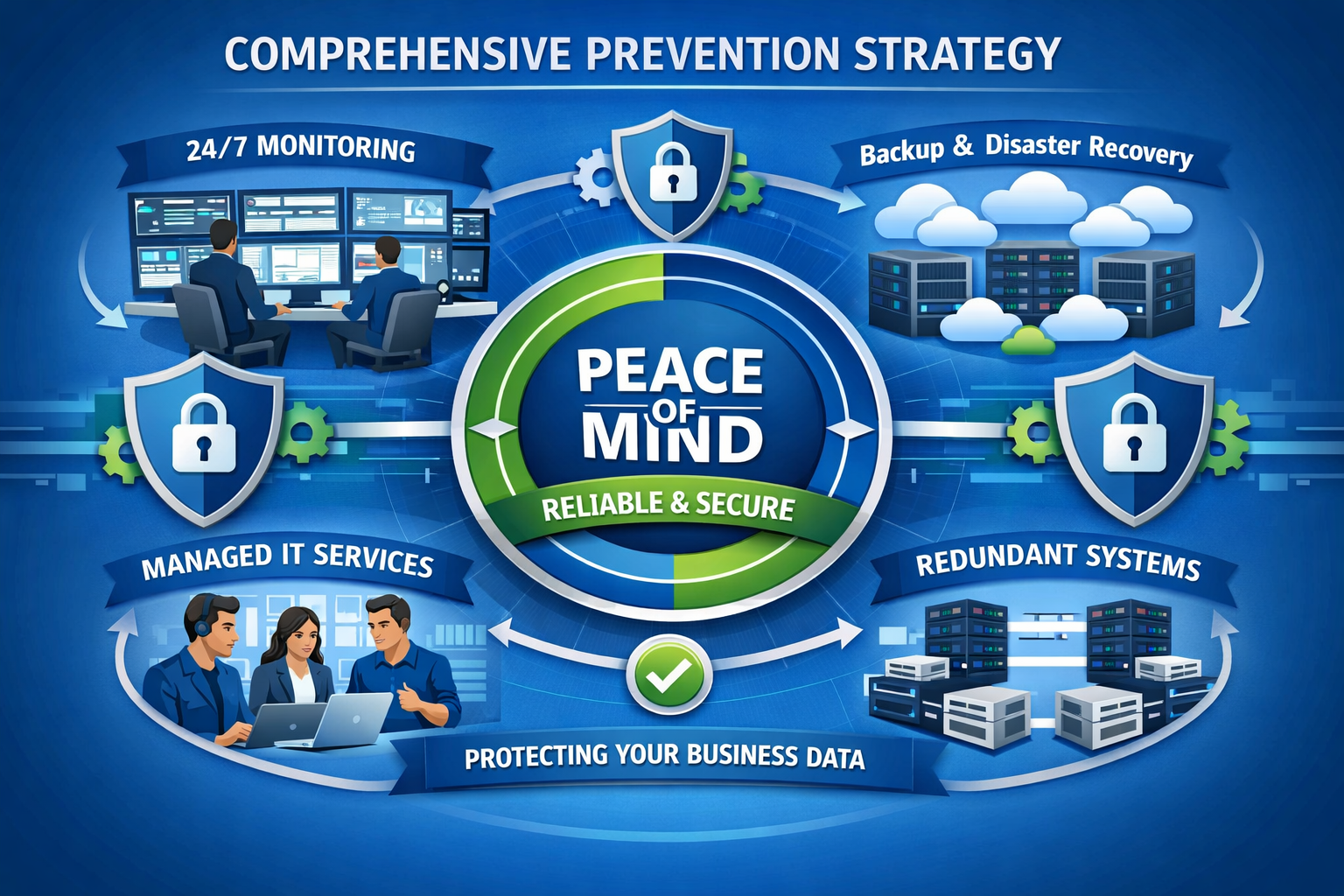
24/7 Monitoring and Proactive Maintenance
Modern monitoring systems can detect problems before they cause outages. Industry expertise shows that proactive monitoring prevents 60-70% of potential failures.
Key monitoring elements:
- Server performance and capacity tracking
- Network connectivity and speed monitoring
- Security threat detection
- Backup system verification
- Hardware health diagnostics
Personalized service means having real people watching your systems, not just automated alerts that get ignored at 2 AM.
Comprehensive Backup and Disaster Recovery Solutions
Your backup strategy needs to protect against all types of data loss while ensuring rapid recovery. Modern backup and disaster recovery solutions should include:
- Automated daily backups with multiple retention points
- Cloud-based storage that’s geographically separated from your office
- Rapid recovery capabilities (minutes, not hours)
- Regular testing to ensure backups actually work
- Ransomware protection with immutable backup copies
The goal is same-day support for getting your systems back online, not next-week recovery.
Redundancy and Failover Systems
Single points of failure are your enemy. Smart redundancy includes:
- Backup internet connections (cellular, secondary ISP)
- Redundant servers or cloud failover systems
- Multiple communication channels (VoIP, cell phones, messaging)
- Distributed data storage across multiple locations
Cybersecurity Layers
Secure and compliant operations require multiple security measures:
- Advanced firewalls with intrusion detection
- Email security to block phishing and malware
- Endpoint protection on all devices
- Regular security updates and patch management
- Employee training on security best practices
ROI Analysis: Proactive IT vs. Reactive Recovery
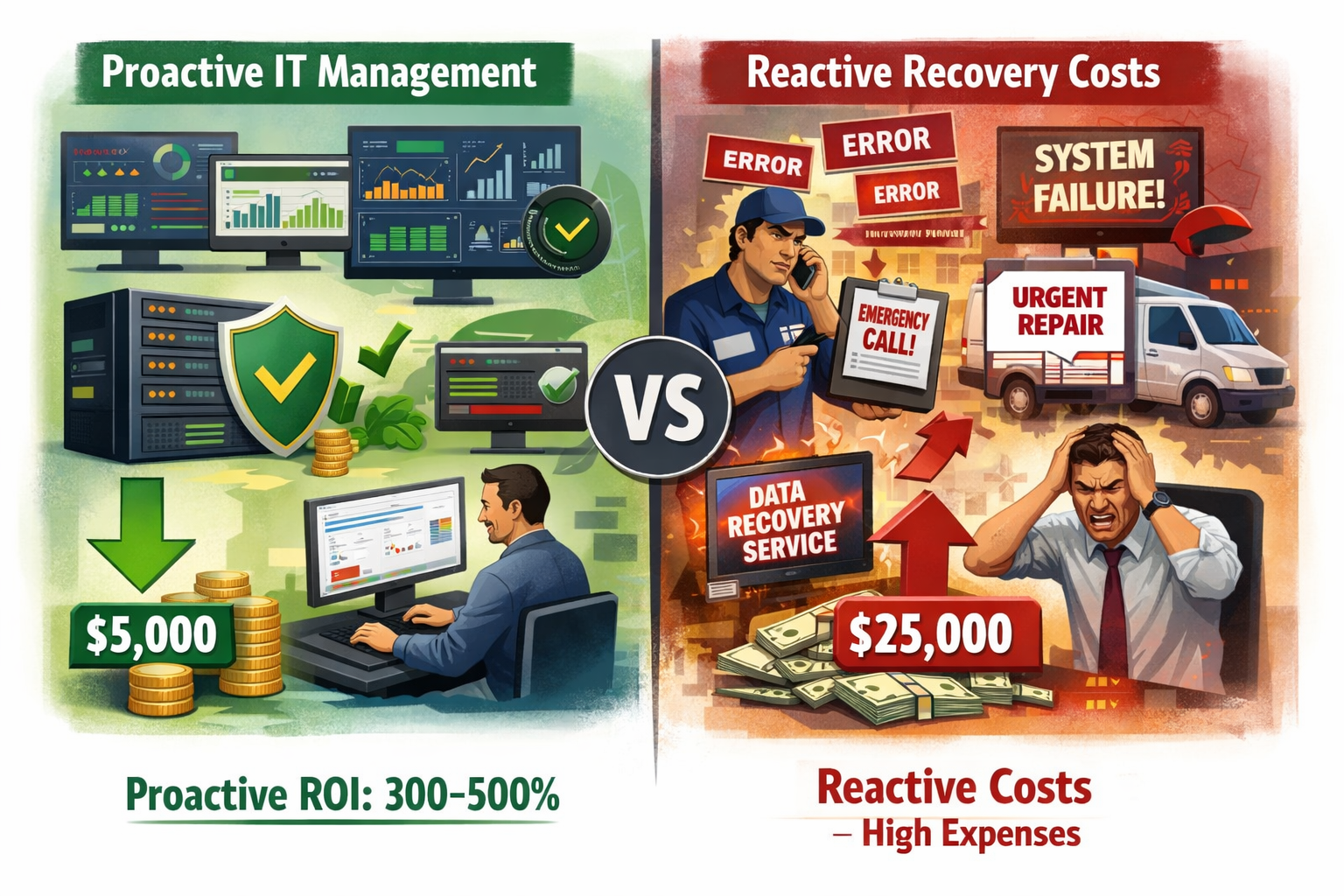
Let me show you the math that makes managed IT services for small businesses a smart investment rather than an expense.
Scenario: 25-Employee Professional Services Firm
Reactive approach (current state):
- 2 major outages per year, averaging 6 hours each
- Downtime cost: $7,200/hour × 12 hours = $86,400
- Emergency recovery costs: $15,000 per incident = $30,000
- Hidden costs (productivity, reputation): $25,000
- Total annual cost: $141,400
Proactive approach (with managed IT):
- Monthly managed services: $3,500 × 12 = $42,000
- Reduced outages: 85% fewer incidents = 1.8 hours annually
- Remaining downtime cost: $7,200 × 1.8 = $12,960
- Total annual cost: $54,960
Annual savings: $86,440
ROI: 204%
This analysis assumes straightforward pricing and realistic downtime reduction based on proactive solutions. The numbers get even better when you factor in improved productivity and peace of mind from knowing your systems are properly protected.
Break-Even Analysis
Most small businesses reach break-even on proactive IT investment after preventing just one major outage. Given that the average small business experiences 2-3 significant outages annually, the ROI typically exceeds 200-300%.
Real-World Example: Local CPA Firm’s Wake-Up Call
Last tax season, a 12-person accounting firm in Metro Atlanta learned this lesson the hard way. Their server crashed during the final week before the April deadline, taking down their tax software and client files.
The damage:
- 18 hours of total downtime over three days
- $129,600 in direct costs (18 × $7,200)
- 15 client deadline extensions requiring penalty payments
- Emergency data recovery: $8,500
- Lost clients: 8 (who switched to competitors)
- Total impact: Over $200,000
The solution:
They partnered with a reliable partner for managed IT services, implementing:
- 24/7 monitoring with automatic failover
- Daily automated backups with a 4-hour recovery guarantee
- Redundant internet connections
- Comprehensive cybersecurity protection
The result:
Zero significant outages in the following 18 months, despite experiencing two attempted ransomware attacks and one ISP failure. The failover systems kept them running without interruption.
“We went from constantly worrying about our technology to focusing entirely on serving clients,” said the firm’s managing partner. “The peace of mind alone was worth the investment, but the cost savings made it a no-brainer.”
Industry-Specific Considerations
Different types of businesses face unique cybersecurity downtime risks and operational challenges.
Healthcare and Dental Practices
- HIPAA compliance requirements for data protection
- Patient safety concerns with system outages
- Appointment scheduling disruptions
- Billing and insurance processing delays
Key focus: Redundant systems for patient records and scheduling, with rapid recovery capabilities.
Retail and E-commerce
- Peak season vulnerability (holidays, sales events)
- Payment processing reliability
- Inventory management accuracy
- Customer service continuity
Key focus: POS system redundancy and real-time inventory backup systems.
Legal Practices
- Client deadline management
- Document security and version control
- Billing and time tracking accuracy
- Court filing system access
Key focus: Document management redundancy and secure remote access capabilities.
Ready to Eliminate IT Headaches?