
The Real Price Tag of “Making Do” with Old Technology
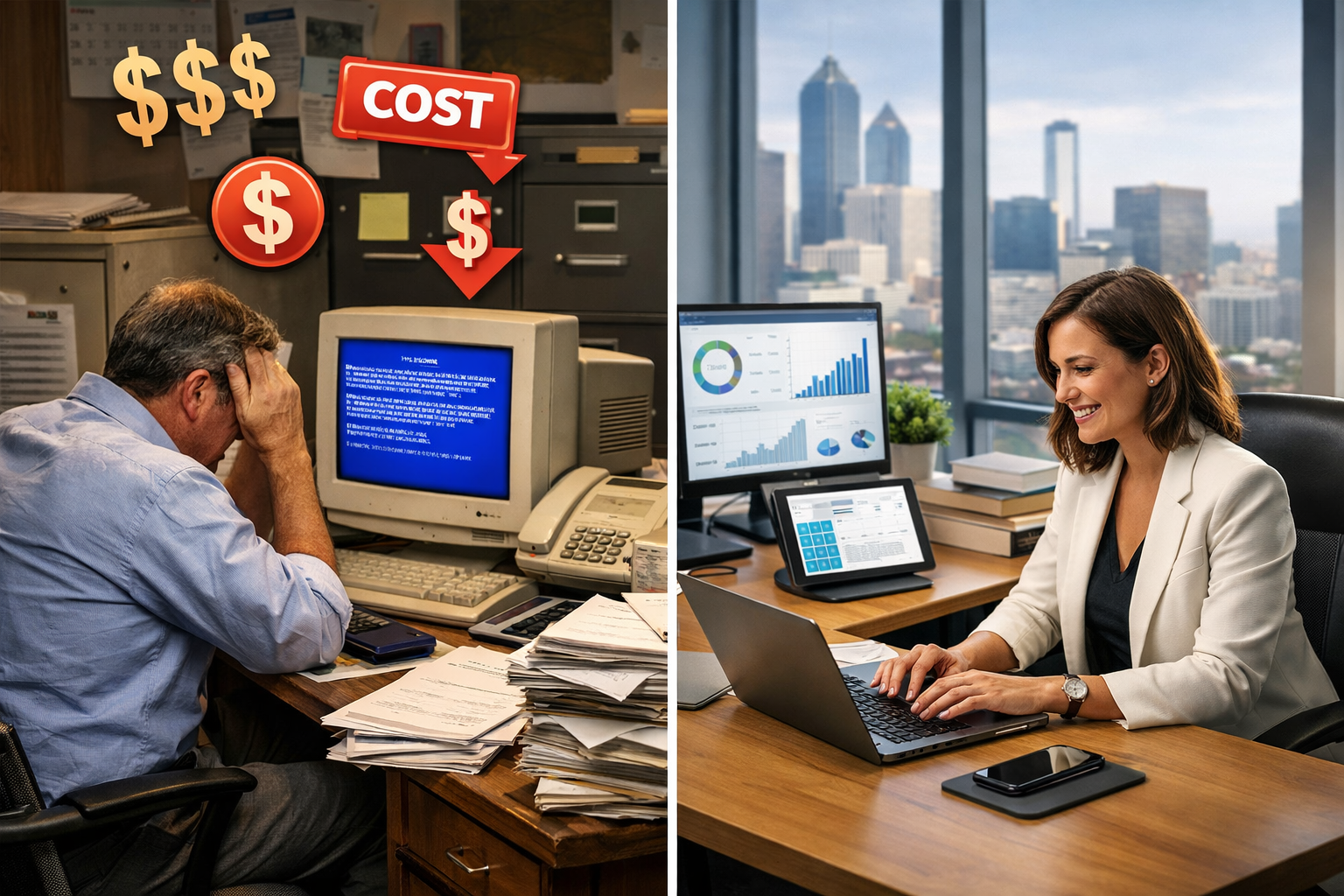
Let me share a story that perfectly illustrates this challenge. Last year, I worked with a successful CPA firm in Buckhead that was proud of its “if it ain’t broke, don’t fix it” approach to technology. They were running accounting software from 2018, using Windows 10 machines that were well past their prime, and relying on a server that made concerning noises every morning.
The firm’s managing partner, Sarah, calculated that upgrading their entire system would cost around $25,000. “That’s a lot of money for something that’s working fine,” she told me during our initial consultation. But when we dug into the actual costs of their current setup, the numbers told a very different story.
The Mathematics of Inefficiency
Here’s what Sarah’s “working fine” technology was actually costing her firm:
- Lost productivity: Staff spent an average of 45 minutes daily dealing with slow systems, crashes, and workarounds, which is nearly 4 hours per week per employee
- Overtime costs: Regular system failures meant weekend work to catch up on delayed projects
- Client frustration: Delayed deliverables due to technical issues resulted in two client departures worth $18,000 annually
- IT support calls: Emergency fixes and patches cost $300-500 per incident, happening 2-3 times monthly
When we calculated the total, Sarah’s “cost-effective” approach was actually costing her firm over $35,000 annually more than the one-time upgrade cost she was trying to avoid.
Beyond the Obvious: Hidden Operational Costs
The hidden costs of outdated technology and unsupported software go deeper than just productivity losses. In today’s business environment, technology isn’t just a tool; it’s the foundation of your competitive advantage. When that foundation is shaky, everything built on top of it becomes unstable.
Consider the ripple effects that most business owners never connect to their technology decisions:
Employee morale and retention suffer when staff constantly battle frustrating, slow systems. In Metro Atlanta’s competitive job market, talented employees won’t tolerate outdated technology for long. The cost of replacing a skilled employee can range from 50% to 200% of their annual salary.
Customer experience deteriorates when outdated systems can’t support modern expectations. Clients expect real-time updates, seamless communication, and quick turnarounds. Legacy systems often can’t deliver these basics, leading to customer dissatisfaction and lost business.
Growth opportunities vanish when your technology can’t scale with demand. That big contract you’ve been chasing might require capabilities your current systems simply can’t handle, forcing you to pass on revenue-generating opportunities.
Security Vulnerabilities: The Ticking Time Bomb in Your Network
If productivity losses are the visible tip of the iceberg, security vulnerabilities represent the massive, hidden danger lurking beneath the surface. Unsupported software doesn’t just stop receiving new features; it stops receiving critical security updates that protect your business from evolving cyber threats.
The Sobering Statistics
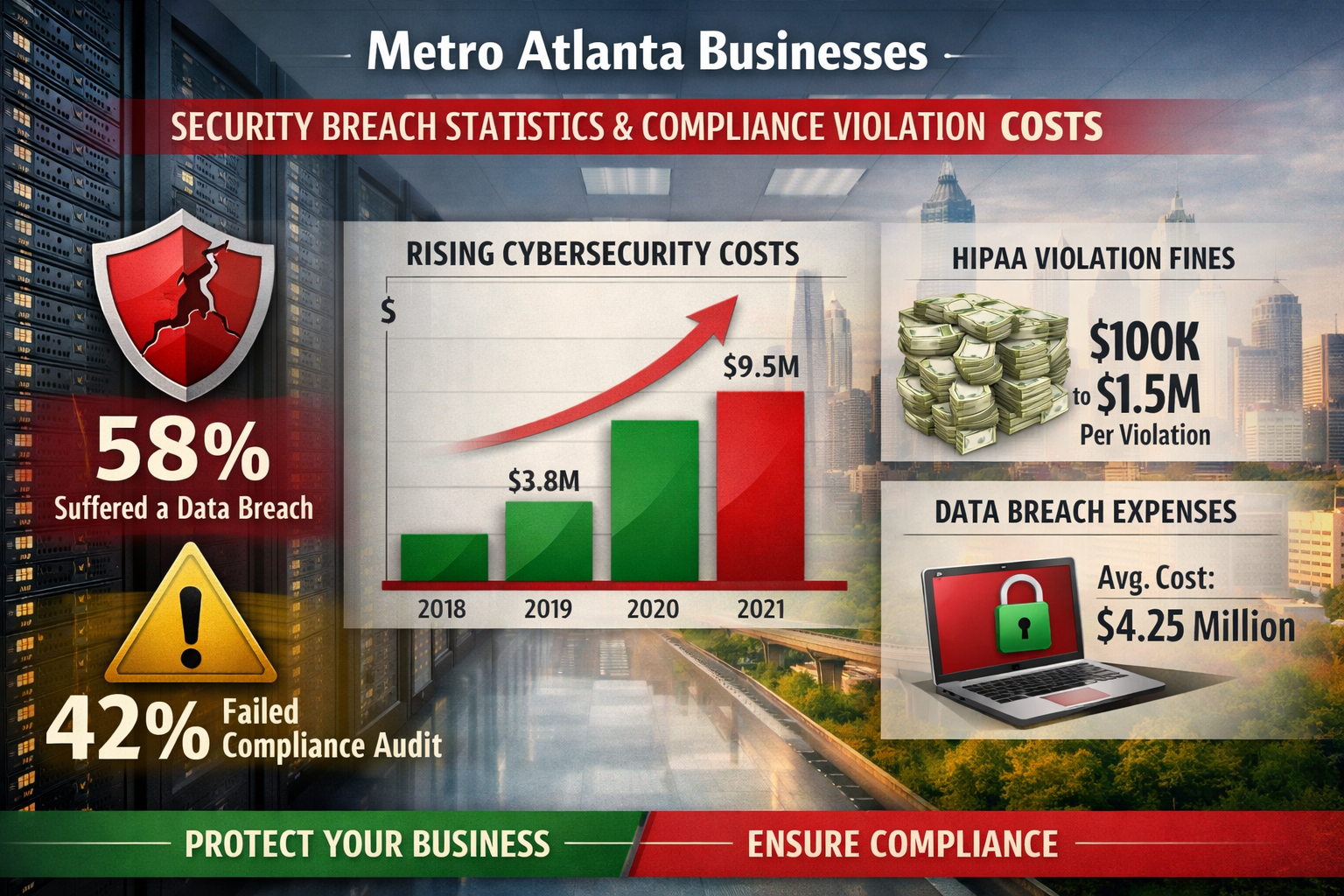
According to recent cybersecurity reports, businesses using outdated software are three times more likely to experience a successful cyber attack. For small to mid-sized businesses in Metro Atlanta, this isn’t just a statistic; it’s a business survival issue. Here’s why:
- 60% of small businesses close within six months of a significant cyber attack
- The average cost of a data breach for small businesses is $2.98 million
- Ransomware attacks on businesses using outdated software have increased by 41% in 2026
- Recovery time from security incidents averages 287 days for businesses with inadequate IT infrastructure
Real-World Consequences in Metro Atlanta
Last spring, a dental practice in Marietta learned this lesson the hard way. They were using practice management software that had been discontinued by the vendor two years earlier. The software worked fine for scheduling appointments and managing patient records, so they saw no reason to upgrade.
Then came the ransomware attack.
Cybercriminals exploited a known vulnerability in their outdated software, encrypting all patient records and demanding $50,000 in ransom. The practice faced a devastating choice: pay the ransom (with no guarantee of data recovery) or rebuild their entire patient database from paper backups.
The total cost? Over $120,000 in lost revenue, recovery expenses, HIPAA violation fines, and reputation damage. The practice nearly closed permanently, all because they wanted to avoid a $15,000 software upgrade.
The Compliance Nightmare
For businesses in regulated industries, such as healthcare, finance, legal services, and others, the hidden costs of outdated technology and unsupported software include serious compliance risks. Regulatory bodies like HIPAA, PCI DSS, and SOX require businesses to maintain current, secure systems for handling sensitive data.
Using outdated software can result in:
- HIPAA violations: Fines ranging from $100 to $50,000 per incident
- PCI compliance failures: Penalties up to $100,000 monthly for non-compliance
- Legal liability: Lawsuits from clients whose data was compromised
- Professional licensing issues: Some regulatory bodies can suspend licenses for inadequate data protection
Productivity Hemorrhaging: How Outdated Systems Drain Your Team’s Potential
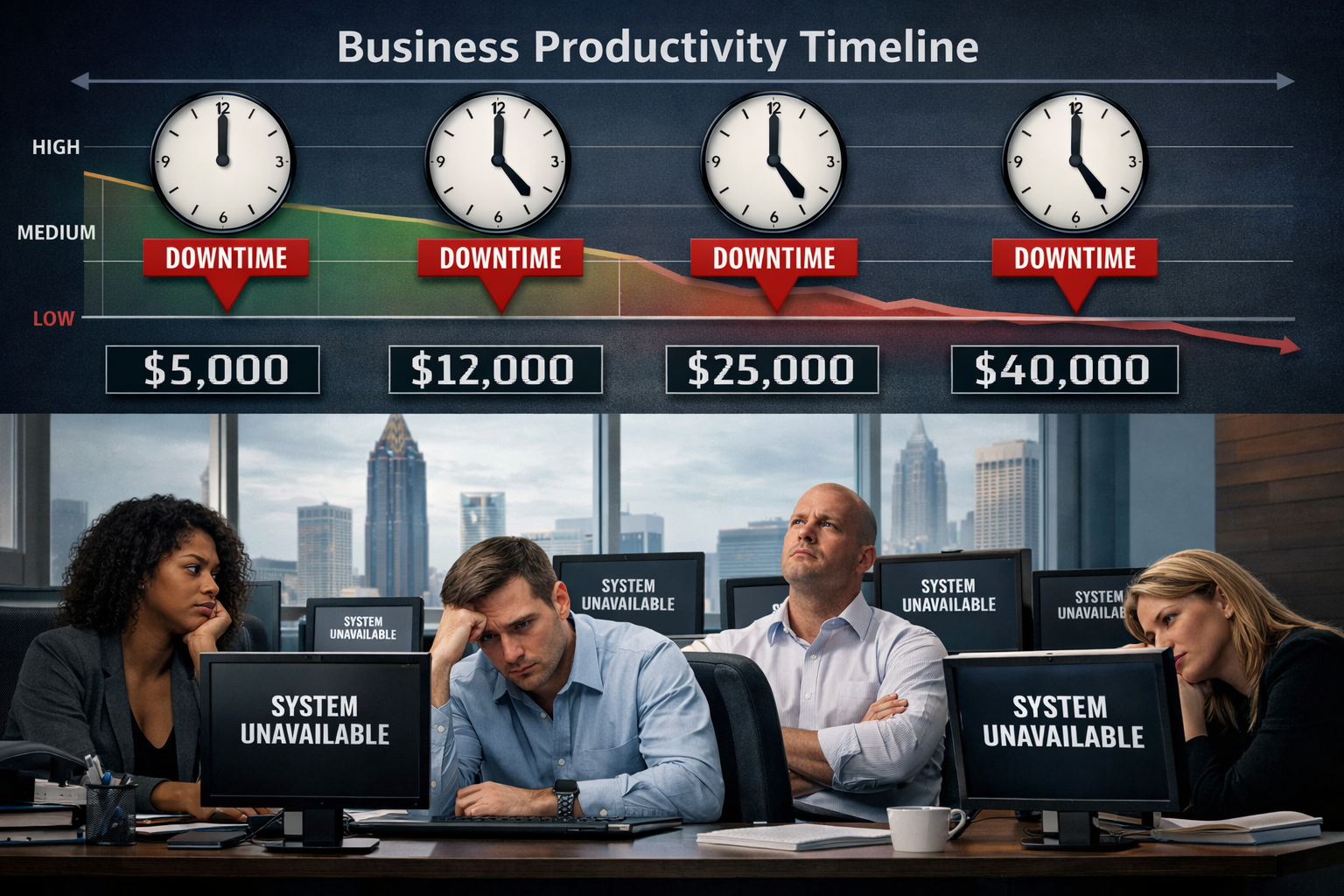
While security vulnerabilities pose existential threats, the daily productivity drain from outdated technology represents a constant, insidious cost that compounds over time. It’s death by a thousand cuts, each small delay, each system crash, each workaround slowly eroding your team’s efficiency and your bottom line.
The Hidden Time Thieves
Most business owners underestimate how much time their teams lose to technology inefficiencies. In my experience working with Metro Atlanta businesses, here are the most common productivity drains:
Slow boot and load times: If your computers take 5-10 minutes to fully boot up and load necessary programs, that’s 25-50 minutes weekly per employee, just for starting work.
Frequent crashes and freezes: Legacy software running on aging hardware crashes more frequently. Each crash costs 10-15 minutes of lost work, plus the frustration and momentum loss.
Compatibility issues: Outdated software often can’t open newer file formats or integrate with modern tools, forcing employees to use inefficient workarounds.
Manual processes: Old systems often lack automation features, requiring staff to perform tasks manually that modern software handles automatically.
Limited remote capabilities: Aging technology often fails to support modern remote work requirements, forcing employees to work less efficiently or commute to the office unnecessarily.
Quantifying the Productivity Impact
Let’s look at a real example from a manufacturing company in Gwinnett County. This 25-employee operation was using computers that were 6+ years old and software that hadn’t been updated in over two years. Here’s what their productivity analysis revealed:
- Daily system delays: 45 minutes per employee
- Weekly system crashes: 3-4 incidents affecting 5-8 employees each
- File compatibility issues: 2 hours weekly spent converting and reformatting documents
- Slow internet/network performance: 20 minutes daily per employee waiting for file transfers and cloud syncing
The total productivity loss? 18.7 hours per week across the organization, equivalent to having one full-time employee doing absolutely nothing productive.
At an average wage of $28 per hour (including benefits), this productivity drain was costing the company over $27,000 annually. The owner had been postponing a $35,000 technology upgrade to “save money,” not realizing he was already paying nearly that amount every year in lost productivity.
The Morale Factor
Beyond the quantifiable productivity losses, outdated technology creates an intangible but very real cost: employee frustration and decreased morale. When your team constantly battles slow, unreliable systems, it affects their job satisfaction, creativity, and willingness to go above and beyond.
In Metro Atlanta’s competitive job market, this matters more than ever. Skilled employees have options, and they’re increasingly unwilling to tolerate outdated technology that makes their jobs unnecessarily difficult. The cost of replacing a good employee, including recruitment, training, and lost productivity during transition, often exceeds $15,000 to $50,000, depending on the role.
Maintenance Costs: The Expensive Cycle That Never Ends
While productivity losses and security risks grab headlines, the escalating maintenance costs of aging technology represent perhaps the most predictable – and preventable – hidden expense. Like an old car that needs increasingly frequent and expensive repairs, outdated technology enters a costly spiral where maintenance expenses grow exponentially over time.
The Maintenance Death Spiral
Here’s how the maintenance cost cycle typically unfolds for businesses clinging to outdated technology:
Year 1-2: Minimal additional costs beyond standard maintenance contracts. Systems work reasonably well with occasional minor issues.
Year 3-4: Increased service calls for hardware failures, software compatibility issues, and performance problems. Costs rise 40-60% above baseline.
Year 5-6: Major component failures become common. Finding replacement parts becomes difficult and expensive. Maintenance costs double or triple.
Year 7+: Systems require constant attention. Emergency repairs become routine. Total maintenance costs often exceed the price of new equipment annually.
Real Numbers from Real Businesses
A dental practice in Roswell provided a perfect case study of this escalating cost cycle. They had been using the same practice management system and hardware setup since 2017, proud of their “investment protection” strategy.
Here’s how their annual IT maintenance costs evolved:
- 2020: $3,200 (baseline year)
- 2021: $4,800 (50% increase due to aging hardware)
- 2022: $7,400 (major server repairs, software patches)
- 2023: $11,200 (multiple emergency calls, hardware replacements)
- 2024: $16,800 (constant issues, premium support rates for legacy systems)
- 2025: $23,500 (nearly monthly emergency repairs)
By 2025, they were spending more on maintaining their old system annually than it would have cost to completely modernize their technology in 2022. The practice owner, Dr. Martinez, finally made the switch when she realized she could get a brand-new, fully supported system with three years of maintenance included for less than she was spending annually on emergency repairs.
The Hidden Costs Within Maintenance Costs
The direct maintenance expenses tell only part of the story. The hidden costs of outdated technology and unsupported software maintenance include:
Premium pricing for legacy support: Vendors charge significantly more to support discontinued products. What might cost $100 to fix on a current system could cost $400+ on legacy equipment.
Longer resolution times: Technicians need more time to diagnose and repair older systems, often requiring specialized knowledge that’s increasingly rare and expensive.
Emergency service premiums: Aging systems fail at inconvenient times, requiring expensive emergency service calls outside normal business hours.
Compatibility troubleshooting: As other systems update, legacy equipment requires constant tweaking to maintain compatibility, creating ongoing service needs.
Data recovery complications: When old systems fail catastrophically, data recovery becomes more complex and expensive due to outdated file formats and backup methods.
The Vendor Support Cliff
One of the highest hidden costs occurs when vendors discontinue support for older products. This “support cliff” can happen suddenly, leaving businesses with expensive choices:
Extended support contracts: Some vendors offer extended support for discontinued products at premium prices – often 200-400% above standard rates.
Third-party support: Independent service providers may offer support, but at higher costs and with no guarantees about parts availability or expertise.
Emergency replacement: When critical systems fail without vendor support, businesses often face rushed, expensive emergency replacements without time for proper planning or competitive bidding.
The Opportunity Cost: What You’re Missing While Standing Still
Perhaps the highest hidden cost of outdated technology and unsupported software isn’t what you’re paying, it’s what you’re missing. While you’re maintaining aging systems and working around their limitations, your competitors are leveraging modern technology to serve customers better, operate more efficiently, and capture market opportunities that your outdated systems simply can’t handle.
Growth Limitations in a Digital Economy
In 2026, business growth increasingly depends on technology capabilities. Companies with modern, integrated systems can:
- Respond faster to customer inquiries through automated systems and real-time data access
- Scale operations efficiently without proportional increases in administrative overhead
- Offer superior customer experiences through modern interfaces and seamless service delivery
- Make data-driven decisions using real-time analytics and reporting tools
- Adapt quickly to market changes with flexible, cloud-based systems
Meanwhile, businesses stuck with outdated technology find themselves unable to compete effectively. They lose opportunities not because their core services are inferior, but because their technology can’t deliver the experience modern customers expect.
Case Study: The $200,000 Contract That Got Away
An automotive dealership in Alpharetta learned this lesson painfully when it lost a major fleet management contract worth $200,000 annually. The potential client required real-time inventory tracking, automated reporting, and integration with their corporate systems capabilities, which the dealership’s 2019-era management system simply couldn’t provide.
The dealership owner, Mike, had been postponing a $45,000 system upgrade for two years to “preserve cash flow.” When he lost the contract, he realized his “cost savings” had actually cost him over four times the upgrade price in lost revenue – and that was just one missed opportunity.
The Innovation Gap
Outdated technology doesn’t just limit your current capabilities – it prevents you from adopting innovations that could transform your business. Consider these modern capabilities that require current technology platforms:
Artificial Intelligence integration: Modern AI tools for customer service, data analysis, and process automation require current operating systems and compatible software platforms.
Cloud-based collaboration: Remote work capabilities, real-time collaboration, and mobile access depend on modern, cloud-compatible systems.
Advanced analytics: Business intelligence tools that provide competitive insights require current databases and compatible software environments.
Automation opportunities: Process automation that can dramatically reduce labor costs typically requires modern software platforms with API capabilities.
Enhanced security features: Advanced threat protection, multi-factor authentication, and compliance tools are often incompatible with legacy systems.
Competitive Disadvantage Compounds Over Time
The opportunity costs of outdated technology compound as competitors pull further ahead. A law firm using 2020-era practice management software might initially lag only slightly behind competitors with modern systems. But as those competitors leverage their technology advantages to serve more clients efficiently, offer better service, and reduce costs, the gap widens exponentially.
Within two years, the firm with outdated technology might find itself:
- Charging higher prices to cover inefficient operations while competitors offer better value
- Taking longer to complete projects due to manual processes, competitors have automated
- Losing clients who expect modern conveniences like online portals and real-time updates
- Struggling to attract talent who prefer working with current technology
Breaking Free: The Strategic Approach to Technology Modernization

Understanding the hidden costs of outdated technology and unsupported software is only the first step. The key to breaking free from this expensive cycle lies in approaching technology modernization strategically, rather than reactively. Too many Metro Atlanta businesses wait until a crisis forces their hand, leading to rushed decisions and suboptimal outcomes.
The Modernization Mindset Shift
The most successful technology transformations happen when business owners shift from viewing IT as an expense to understanding it as a strategic investment. This mindset change is crucial because it affects every decision about technology spending, vendor selection, and implementation timing.
Instead of asking “How can we spend the least on technology?” successful business owners ask “How can we leverage technology to achieve our business goals most effectively?” This subtle shift in perspective leads to dramatically different – and more profitable – outcomes.
Phased Modernization: The Smart Approach
Complete technology overhauls can be overwhelming and disruptive. A phased approach allows businesses to modernize systematically while maintaining operations and managing cash flow effectively. Here’s how smart Metro Atlanta businesses approach modernization:
Phase 1: Critical Security and Stability
- Address immediate security vulnerabilities
- Replace systems that pose compliance risks
- Stabilize unreliable infrastructure that causes frequent downtime
- Implement basic backup and disaster recovery
Phase 2: Productivity and Efficiency
- Upgrade software that significantly impacts daily productivity
- Implement automation for routine tasks
- Modernize communication and collaboration tools
- Integrate systems to eliminate duplicate data entry
Phase 3: Growth and Innovation
- Add advanced analytics and reporting capabilities
- Implement customer-facing technology improvements
- Integrate AI and automation for competitive advantage
- Scale infrastructure to support business growth
The ROI of Proactive Planning
Businesses that plan technology modernization proactively typically see return on investment within 12-18 months. Compare this to reactive approaches, where emergency replacements often cost 50-100% more and provide less optimal solutions.
A manufacturing company in Marietta exemplifies this approach. Rather than waiting for their aging ERP system to fail, they planned a modernization project 18 months in advance. This allowed them to:
- Negotiate better pricing by shopping multiple vendors without time pressure
- Plan implementation during slower business periods to minimize disruption
- Train staff gradually rather than forcing rapid adoption under crisis conditions
- Integrate the new system with other planned improvements for maximum benefit
- Achieve 23% productivity improvement within six months of implementation
The total project cost was $85,000, but the productivity gains alone saved $140,000 annually, a 65% first-year ROI that continues to compound.
Choosing the Right Technology Partner
The success of technology modernization often depends more on your implementation partner than on the specific products chosen. The best technology partners for Metro Atlanta businesses combine technical expertise with a deep understanding of local business challenges.
Look for partners who offer:
Industry expertise relevant to your specific business type and challenges. A healthcare IT provider understands HIPAA compliance in ways that a general IT company might not.
Proactive support that prevents problems rather than just fixing them after they occur. 24/7 monitoring and preventive maintenance eliminate most emergencies.
Straightforward pricing that allows you to budget accurately without surprise costs. The best providers offer fixed monthly fees that include all routine support and maintenance.
Local presence that enables same-day support when needed. Metro Atlanta businesses benefit from providers who understand local market conditions and can respond quickly to urgent needs.
Scalable solutions that grow with your business rather than requiring complete replacement as you expand.
Making the Business Case: Justifying Technology Investment
One of the biggest obstacles to modernizing outdated technology isn’t technical; it’s financial justification. Many business owners understand that their current technology isn’t ideal, but struggle to justify the upfront investment required for modernization. The key lies in presenting technology upgrades not as costs, but as profit-generating investments.
Building Your Investment Case
The most compelling business cases for technology modernization focus on measurable business outcomes rather than technical specifications. Here’s how to build a persuasive case:
Calculate Current Hidden Costs
Use the methodology we’ve discussed to quantify what your current technology is actually costing you:
- Productivity losses from downtime and inefficiency
- Security risks and compliance exposure
- Escalating maintenance and support costs
- Missed opportunities due to capability limitations
Project Future Savings
Modern technology typically reduces operational costs through:
- Automation that eliminates manual tasks
- Integration that reduces duplicate data entry and errors
- Reliability that minimizes downtime and emergency repairs
- Efficiency that allows staff to accomplish more in less time
Identify Revenue Opportunities
Updated technology often enables new revenue streams:
- Improved customer service that increases retention and referrals
- Faster project completion that allows higher client throughput
- New service offerings that weren’t possible with old systems
- Competitive advantages that support premium pricing
A Real-World Business Case
Let me share how one Metro Atlanta CPA firm built its business case for technology modernization. The firm had 12 employees and was using accounting software and hardware that was 5+ years old.
Current State Costs (Annual):
- Lost productivity: $28,000
- IT maintenance and emergency repairs: $18,000
- Security and compliance risks: $8,000 (estimated exposure)
- Missed opportunities: $15,000 (clients lost due to service delays)
- Total Hidden Costs: $69,000 annually
Proposed Investment:
- New hardware and software: $45,000
- Implementation and training: $8,000
- Total Investment: $53,000
Projected Benefits (Annual):
- Productivity improvements: $35,000 savings
- Reduced maintenance costs: $15,000 savings
- Enhanced security and compliance: $8,000 risk reduction
- New client capacity: $25,000 additional revenue
- Total Annual Benefits: $83,000
Net Result: $30,000 annual profit improvement with a payback period of 7.6 months.
The firm’s managing partner presented this analysis to her board, and the modernization project was approved unanimously. Eighteen months later, the actual results exceeded projections, with $95,000 in annual benefits realized.
Financing Options for Technology Modernization
The upfront cost of technology modernization doesn’t have to strain cash flow. Several financing options make modernization accessible:
Technology-as-a-Service (TaaS): Many providers offer complete technology solutions for fixed monthly payments that include hardware, software, support, and regular upgrades.
Equipment financing: Traditional equipment loans spread costs over 2-4 years with competitive interest rates.
Lease options: Technology leases provide tax advantages and ensure you always have current equipment.
Managed service agreements: Comprehensive IT management services often include equipment and software as part of monthly fees.
The key is choosing financing that aligns with your cash flow while ensuring you capture the benefits of modernization immediately rather than waiting until you can afford to pay cash.
Your Roadmap to Technology Freedom
Now that you understand the hidden costs of outdated technology and unsupported software, it’s time to take action. The longer you wait, the more these hidden costs compound, and the further behind your competition you fall. But with the right approach, you can transform technology from a source of frustration and expense into a competitive advantage that drives growth and profitability.
Step 1: Conduct a Comprehensive Technology Audit
Start by getting a clear picture of your current technology landscape. This audit should evaluate:
- Hardware age and condition: Identify equipment that’s approaching end-of-life
- Software currency and support status: Catalog applications that are outdated or unsupported
- Security vulnerabilities: Assess exposure to cyber threats and compliance risks
- Performance bottlenecks: Document areas where technology limits productivity
- Integration gaps: Identify systems that don’t communicate effectively
Most reputable IT providers offer complimentary technology assessments for qualified businesses. This investment of time can reveal exactly where your hidden costs are coming from and provide a roadmap for addressing them.
Step 2: Prioritize Based on Risk and Impact
Not all technology issues require immediate attention. Prioritize improvements based on:
High Risk, High Impact: Security vulnerabilities and compliance issues that could threaten business survival
High Impact, Lower Risk: Productivity bottlenecks that significantly affect daily operations
Lower Impact, High Risk: Potential problems that could become serious if not addressed
Lower Impact, Lower Risk: Nice-to-have improvements that can wait
This prioritization ensures you address the most costly hidden expenses first while managing cash flow effectively.
Step 3: Develop a Modernization Timeline
Create a realistic timeline that balances urgency with operational needs. Consider:
- Budget cycles and cash flow patterns
- Seasonal business fluctuations that might affect implementation timing
- Staff availability for training and transition support
- Vendor capacity and implementation schedules
- Interdependencies between different technology systems
A well-planned timeline prevents rushed decisions while ensuring critical issues are addressed promptly.
Step 4: Select the Right Technology Partner
The success of your modernization effort depends heavily on choosing the right implementation partner. Look for providers who:
- Understand your industry and its specific technology challenges
- Offer comprehensive solutions rather than just selling products
- Provide ongoing support with same-day response capabilities
- Have local presence in Metro Atlanta for responsive service
- Demonstrate proven results with businesses similar to yours
Don’t just evaluate the technology – evaluate the partnership. You’re not just buying products; you’re investing in a relationship that will support your business for years to come.
Step 5: Implement with Minimal Disruption
Proper implementation planning minimizes business disruption while ensuring successful adoption:
- Parallel operation during transition periods to maintain business continuity
- Comprehensive staff training to ensure effective utilization of new capabilities
- Data migration planning to preserve historical information and maintain compliance
- Testing protocols to identify and resolve issues before they affect operations
- Rollback procedures in case unexpected problems arise
The goal is a seamless transition that improves operations from day one rather than creating a temporary disruption.
Conclusion: Transform Technology from Cost Center to Profit Driver
The hidden costs of outdated technology and unsupported software represent one of the most overlooked profit drains in modern business. While these costs often remain invisible on financial statements, they quietly erode productivity, expose businesses to serious risks, and prevent organizations from capturing growth opportunities.
For Metro Atlanta business owners, the choice is clear: continue paying these hidden costs while falling further behind competitors, or invest strategically in modern technology that drives profitability and growth. The businesses that thrive in 2026 and beyond will be those that view technology not as a necessary evil, but as a strategic advantage.
The path forward doesn’t require massive disruption or overwhelming investment. With the right partner providing industry expertise, proactive solutions, and reliable support, technology modernization becomes a manageable process that delivers immediate benefits and long-term competitive advantages.
Your business deserves technology that works for you, not against you. Technology that provides peace of mind instead of constant worry. Technology that enables growth rather than limiting it. The question isn’t whether you can afford to modernize, it’s whether you can afford not to.
Ready to eliminate your hidden IT costs and transform technology into a competitive advantage? AlphaCIS specializes in helping Metro Atlanta businesses break free from the expensive cycle of outdated technology. Our team provides comprehensive technology assessments, strategic modernization planning, and ongoing support that ensures your technology investment delivers maximum returns.
We understand the unique challenges facing businesses in our community, and we’re committed to providing the personalized service and local support that make technology transformation successful. With our same-day support, 24/7 monitoring, and straightforward pricing, you can focus on growing your business while we ensure your technology works flawlessly.
Don’t let another day pass by paying hidden costs for outdated technology. Contact AlphaCIS today to schedule your complimentary technology assessment and discover how much your current systems are really costing you. Your future self – and your bottom line – will thank you.