

What These Compliance Frameworks Really Mean for Your Manufacturing Business
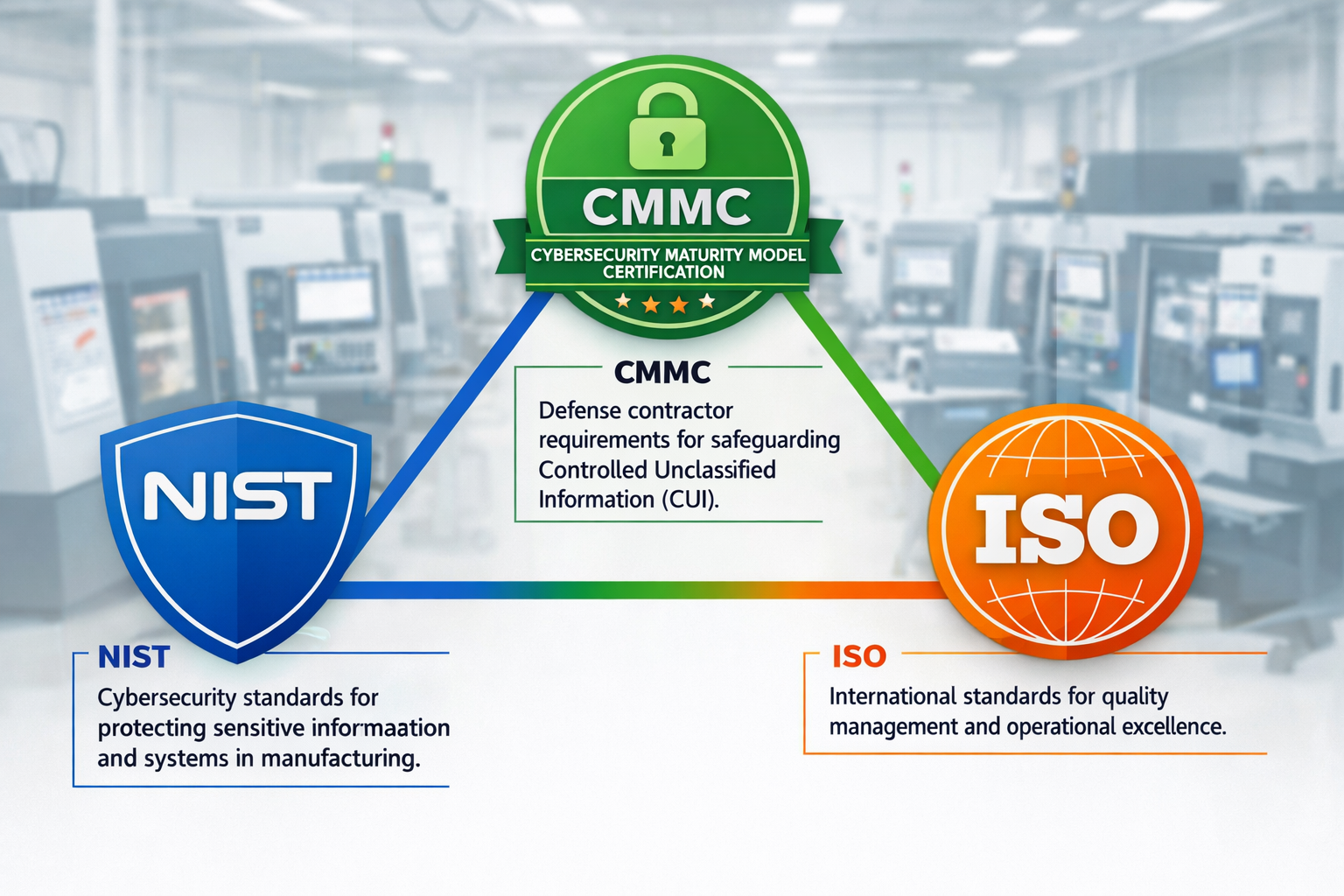
When most manufacturing business owners hear acronyms like NIST, CMMC, and ISO, their eyes glaze over. I get it, you’re focused on production schedules, quality control, and keeping customers happy. But here’s the reality: these frameworks are reshaping who gets to play in the manufacturing game.
NIST (National Institute of Standards and Technology) provides the cybersecurity foundation that most other frameworks build upon. Think of it as the baseline security playbook that helps protect your manufacturing systems from cyber threats.
CMMC (Cybersecurity Maturity Model Certification) is the Department of Defense’s way of ensuring that contractors and suppliers can actually protect sensitive defense information. If you work with the DoD or want to, CMMC isn’t a suggestion; it’s a requirement.
ISO 27001 is the international gold standard for information security management. Many large corporations now require their manufacturing partners to have ISO certification before they’ll even consider working with you.
The bottom line? These aren’t just IT buzzwords. They’re gatekeepers to some of the most profitable contracts in manufacturing. Companies that embrace compliance are winning bigger deals, while those that ignore it are getting locked out of entire market segments.
Why Manufacturing IT Compliance Has Become Non-Negotiable
The manufacturing landscape has changed dramatically over the past few years. What used to be a relationship-based industry where a handshake could seal a deal has become increasingly regulated and security-focused. Here’s why compliance has moved from “nice to have” to “essential.”
Government Contracts Require Proof, Not Promises
The federal government spends over $600 billion annually on contracts, and a significant portion goes to manufacturing. But here’s the catch: you can’t just promise you’re secure anymore. You need to prove it with certifications.
I recently worked with a precision parts manufacturer who had been supplying the military for years through a prime contractor. When new CMMC requirements kicked in, their longtime partner had to drop them because they couldn’t demonstrate compliance. Six months of lost revenue and scrambling to get certified taught them a valuable lesson about the cost of waiting.
Supply Chain Security Has Become Everyone’s Problem
Major corporations have learned that their security is only as strong as their weakest supplier. That’s why companies like Boeing, Lockheed Martin, and even non-defense manufacturers are requiring their suppliers to meet specific cybersecurity standards.
When a cyberattack hits your manufacturing systems, it doesn’t just affect you. It can shut down your customers’ production lines, compromise their data, and damage relationships built over decades. Smart manufacturers are getting ahead of these requirements instead of waiting for customers to demand compliance.
The Real Cost of Cyber Threats in Manufacturing
Manufacturing has become the most targeted industry for cyberattacks, and the numbers are sobering. The average cost of a manufacturing cyber incident now exceeds $5 million when you factor in downtime, recovery costs, and lost business.
But beyond the immediate financial impact, consider what happens to your reputation when word gets out that your systems were compromised. In an industry where trust and reliability are everything, a security breach can be a business-ending event.
Breaking Down NIST, CMMC, and ISO for Manufacturing Leaders
Let me translate these frameworks into plain English and explain what they actually mean for your day-to-day operations.
NIST: Your Cybersecurity Foundation
The NIST Cybersecurity Framework gives you a structured approach to protecting your manufacturing systems. It focuses on five core functions:
Identify what needs protection in your facility. This includes your production systems, customer data, intellectual property, and any sensitive information you handle.
Protect those assets with appropriate safeguards. Think firewalls, access controls, employee training, and secure backup systems.
Detect when something goes wrong. You need monitoring systems that can spot unusual activity before it becomes a major problem.
Respond quickly when incidents occur. Having a plan means the difference between a minor disruption and a catastrophic shutdown.
Recover your operations as quickly as possible. This is where having reliable backup systems and a solid IT partner becomes crucial.
For most manufacturers, NIST provides the roadmap for building a security program that makes sense for your business without breaking the bank.
CMMC: The Defense Industry Game-Changer
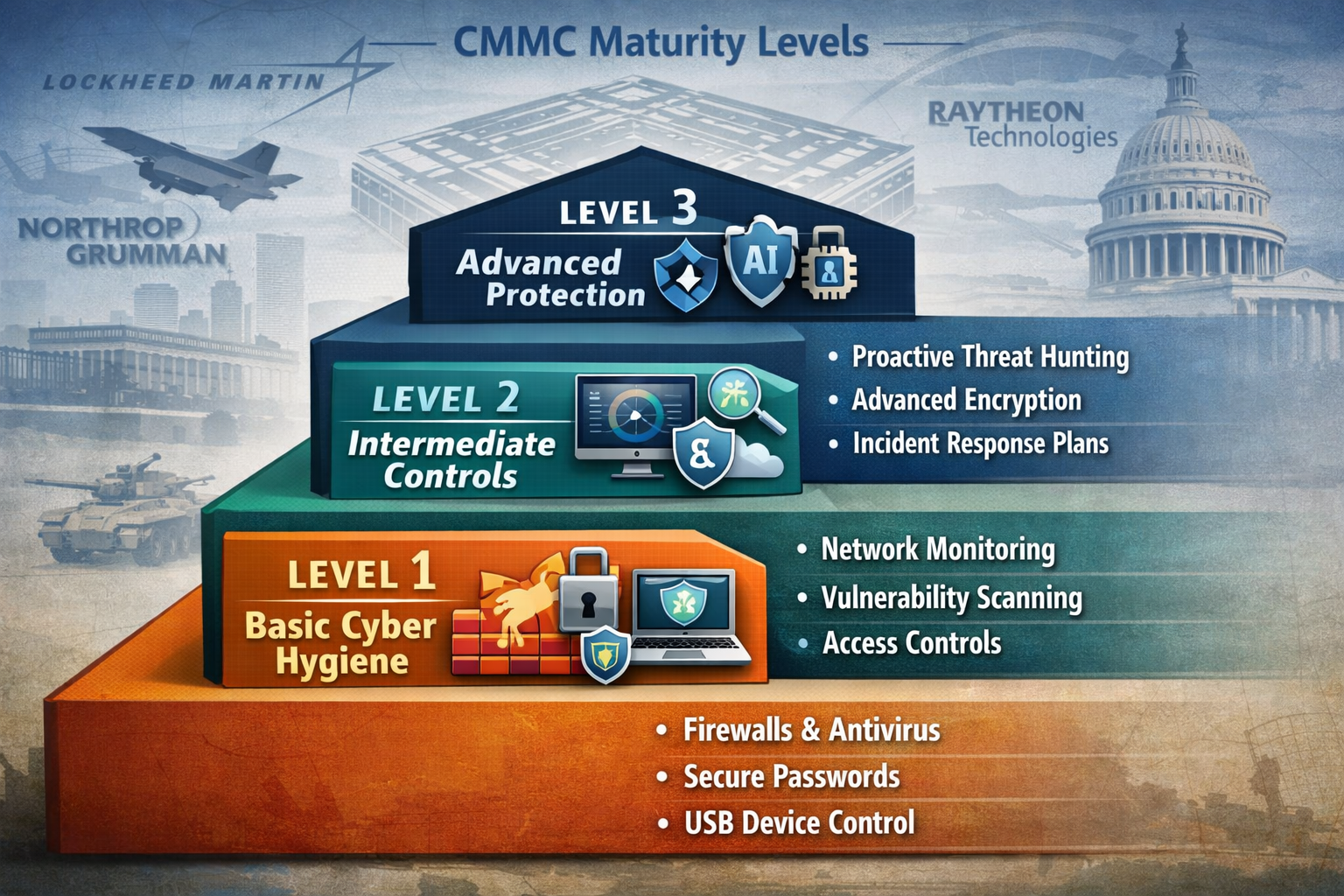
CMMC has three maturity levels, and understanding which one applies to your business is critical:
Level 1 (Foundational) covers basic cybersecurity practices. If you handle Federal Contract Information (FCI), you need at least this level. We’re talking about basic protections like antivirus software, regular updates, and access controls.
Level 2 (Advanced) is where most defense contractors need to be. This level requires 110 specific security controls and is mandatory for handling Controlled Unclassified Information (CUI). This includes detailed logging, incident response procedures, and regular security assessments.
Level 3 (Expert) involves protecting against advanced persistent threats and is required for the most sensitive defense work. Most small to mid-sized manufacturers won’t need this level unless they’re working on highly classified projects.
The key thing to understand about CMMC is that it’s not self-certified. You need an independent assessor to verify your compliance, and the certification is only valid for three years.
ISO 27001: The Global Standard
ISO 27001 takes a comprehensive approach to information security management. Unlike NIST and CMMC, which focus primarily on cybersecurity controls, ISO 27001 requires you to implement a complete Information Security Management System (ISMS).
This means documenting your security policies, conducting regular risk assessments, training your staff, and continuously improving your security posture. It’s more involved than the other frameworks, but it also provides the most comprehensive protection and opens doors to international business opportunities.
Many manufacturers find that achieving ISO 27001 certification gives them a competitive edge when bidding on contracts with large corporations or international customers who prioritize security.
The Hidden Costs of Ignoring Manufacturing IT Compliance
While the upfront investment in compliance might seem daunting, the cost of ignoring these requirements is far higher. Let me share some real examples of what non-compliance actually costs manufacturing businesses.
Lost Contract Opportunities
I’ve seen manufacturers lose out on contracts worth millions because they couldn’t demonstrate basic cybersecurity controls. One automotive parts supplier in our area missed out on a $15 million contract with a major automaker because it couldn’t provide evidence of ISO 27001 compliance.
The painful part? Their actual security was probably adequate for the work, but they couldn’t prove it with the documentation and certifications the customer required. In today’s market, good enough isn’t good enough if you can’t demonstrate it formally.
Regulatory Fines and Penalties
Non-compliance with government requirements can result in significant financial penalties. CMMC violations can lead to contract termination, suspension from future government work, and, in severe cases, criminal charges for mishandling classified information.
Even if you’re not directly contracted with the government, many prime contractors are now flowing down compliance requirements to their entire supply chain. Failing to meet these requirements doesn’t just cost you one contract; it can get you blacklisted from entire market segments.
The True Cost of Data Breaches
When cybercriminals target manufacturing companies, they’re not just after financial data. They want intellectual property, customer information, production schedules, and anything else they can monetize or use to disrupt operations.
A single ransomware attack can shut down production for days or weeks. I’ve worked with manufacturers who lost more in three days of downtime than they would have spent on five years of comprehensive cybersecurity measures.
Beyond the immediate costs, consider the long-term damage to customer relationships. If your security breach affects a customer’s production schedule or compromises their data, you may never win their business back.
How Smart Manufacturers Are Turning Compliance Into Competitive Advantage
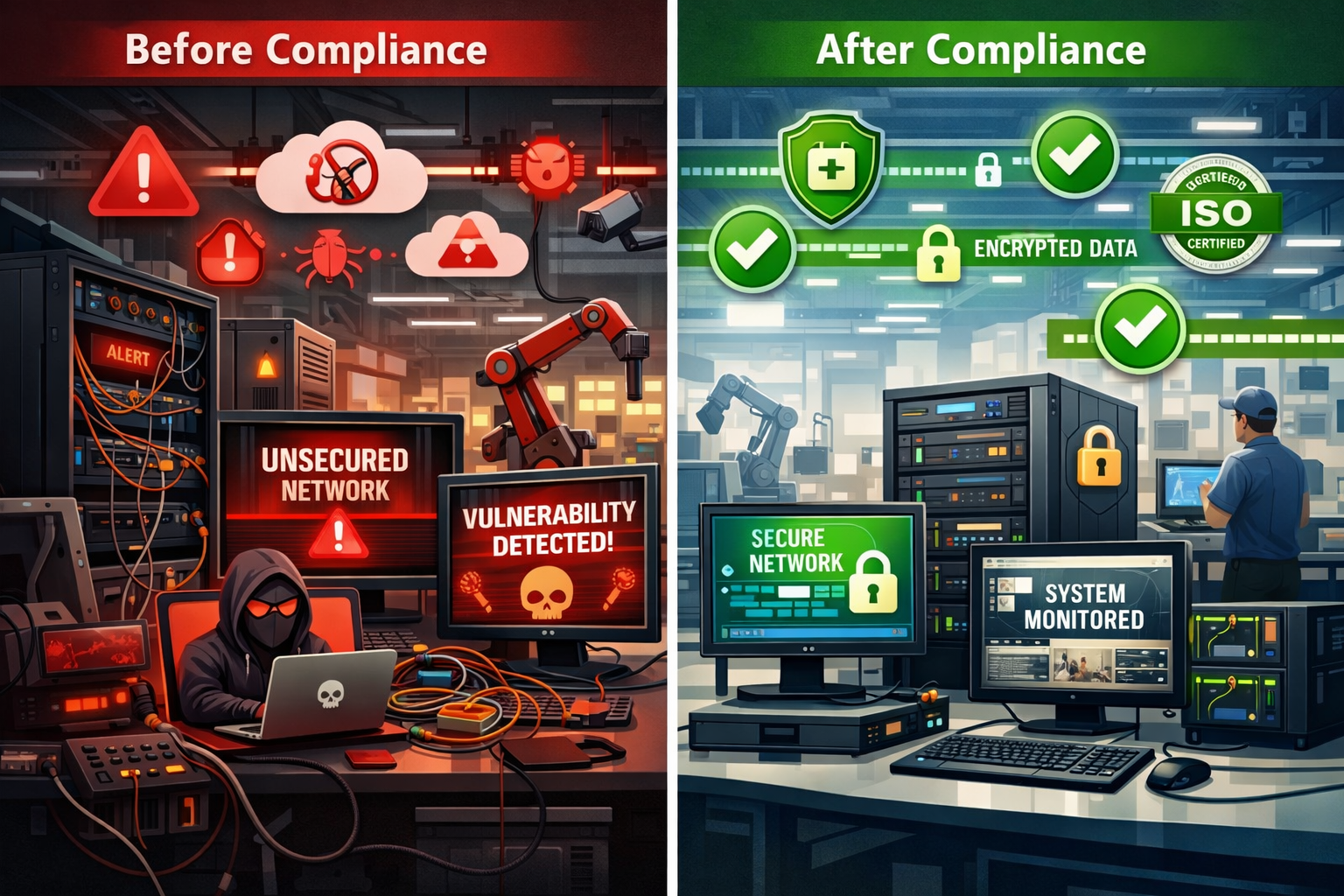
The manufacturers who are thriving in 2026 aren’t just meeting compliance requirements – they’re using them strategically to differentiate themselves and win more business.
Marketing Your Security Posture
Once you achieve compliance certifications, they become powerful marketing tools. CMMC certification, ISO 27001, and NIST framework implementation are proof points that you take security seriously and can handle sensitive projects.
One of our manufacturing clients started including their compliance certifications in all their proposals and marketing materials. Within six months, they were competing for contracts they never would have been considered for previously. Their compliance investment paid for itself with a single new customer.
Streamlining Operations Through Better IT
The process of achieving compliance often reveals inefficiencies in your IT operations. Manufacturers frequently discover they can automate processes, improve data management, and enhance communication systems while meeting security requirements.
Better IT systems don’t just improve security; they improve productivity, reduce errors, and provide better visibility into your operations. The manufacturers who approach compliance as an opportunity to modernize their entire IT infrastructure see the biggest returns on their investment.
Building Customer Confidence
In an era where supply chain security is front-page news, demonstrating robust cybersecurity practices builds tremendous customer confidence. Large corporations are increasingly willing to pay premium prices for suppliers who can guarantee security and reliability.
Your compliance certifications signal that you’re a professional operation that takes business seriously. This can be the deciding factor when customers choose between you and competitors who can’t demonstrate the same level of security maturity.
Your Practical Roadmap to Manufacturing IT Compliance
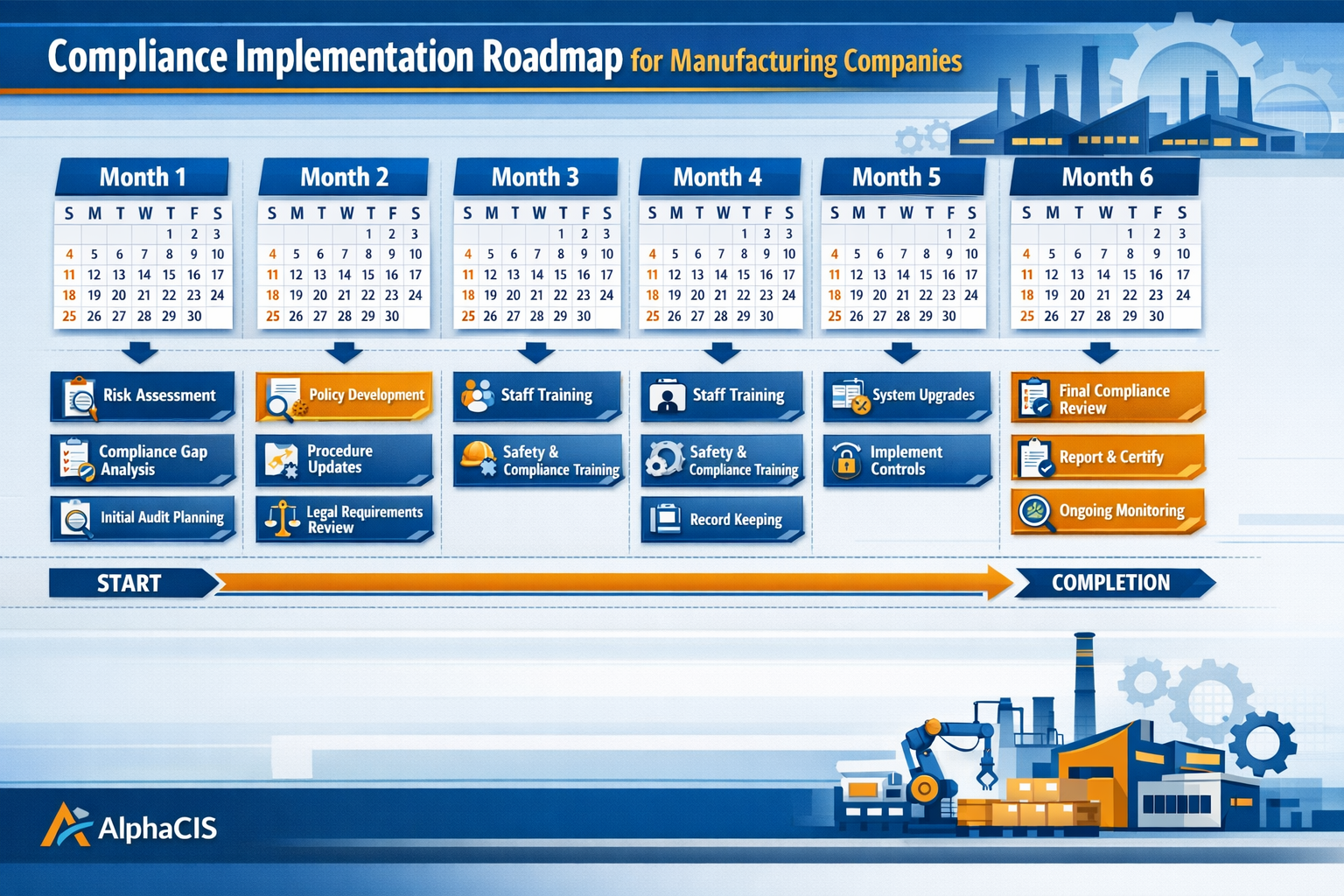
Achieving compliance doesn’t have to be overwhelming if you approach it systematically. Here’s the step-by-step process we recommend for manufacturers who want to get compliant without disrupting their operations.
Phase 1: Assessment and Planning (Month 1-2)
Start with a comprehensive assessment of your current IT security posture. This involves documenting your existing systems, identifying gaps, and understanding which compliance frameworks apply to your business.
Don’t try to do this alone. Working with an experienced IT partner who understands manufacturing environments and compliance requirements will save you time and ensure you don’t miss critical elements.
The assessment should cover your network infrastructure, data handling procedures, employee access controls, and incident response capabilities. You’ll also need to identify what types of sensitive information you handle and which compliance levels you need to achieve.
Phase 2: Foundation Building (Month 2-4)
Focus on implementing the basic security controls that form the foundation of any compliance framework. This includes:
- Network security improvements like firewalls, intrusion detection, and network segmentation
- Access control systems that ensure only authorized personnel can access sensitive information
- Data backup and recovery procedures that can restore operations quickly after an incident
- Employee training programs that help your team recognize and respond to security threats
- Documentation systems that track your security policies and procedures
Many manufacturers are surprised to learn they already have some of these elements in place. The key is formalizing and documenting your existing practices while filling in the gaps.
Phase 3: Advanced Controls and Documentation (Month 4-6)
Once your foundation is solid, focus on the more advanced requirements specific to your target compliance framework. This might include:
- Continuous monitoring systems that provide 24/7 oversight of your IT environment
- Incident response procedures that define exactly how you’ll handle security events
- Regular vulnerability assessments that identify and address potential weaknesses
- Detailed policy documentation that meets the specific requirements of your target framework
- Staff training and certification to ensure your team can maintain compliance long-term
This phase is where having industry expertise becomes crucial. The requirements can be complex, and the consequences of getting them wrong are significant.
Phase 4: Certification and Continuous Improvement (Month 6+)
The final phase involves formal assessment and certification, followed by ongoing maintenance of your compliance posture.
For CMMC, this means working with a certified third-party assessor who will evaluate your implementation and award your certification. ISO 27001 requires a similar independent audit process.
Remember that compliance isn’t a one-time achievement. You’ll need ongoing monitoring, regular assessments, and continuous improvement to maintain your certifications and stay ahead of evolving threats.
Common Compliance Mistakes That Cost Manufacturing Companies Big
After helping dozens of manufacturers navigate compliance requirements, I’ve seen the same costly mistakes repeated over and over. Learning from these common pitfalls can save you time, money, and frustration.
Waiting Until the Last Minute
The biggest mistake I see is manufacturers waiting until a customer demands compliance before starting the process. CMMC certification can take 6-12 months from start to finish, and ISO 27001 often takes even longer.
I recently worked with a manufacturer that had 90 days to achieve CMMC Level 2 compliance or risk losing their largest contract. While we managed to get them compliant in time, the rushed process cost them nearly double what it would have with proper planning, and the stress nearly derailed their other business operations.
Trying to Go It Alone
Compliance frameworks are complex, and the consequences of getting them wrong are severe. Yet, many manufacturing leaders attempt to handle compliance internally to save money, only to discover that they’ve wasted months implementing the wrong controls or missing critical requirements.
The most successful manufacturers treat compliance as a partnership between their business expertise and specialized IT knowledge. You know your manufacturing processes better than anyone, but compliance requires technical expertise that most manufacturers don’t have in-house.
Focusing Only on Technology
While technology controls are important, compliance frameworks also require policies, procedures, training, and ongoing management. I’ve seen manufacturers invest heavily in security tools while completely ignoring the documentation and process requirements.
True compliance requires a balance of technology, processes, and people. The manufacturers who understand this from the beginning have smoother implementations and better long-term results.
Underestimating Ongoing Requirements
Achieving initial compliance is just the beginning. Most frameworks require continuous monitoring, regular assessments, ongoing training, and periodic recertification.
Budget for compliance as an ongoing operational expense, not a one-time project cost. The manufacturers who plan for long-term compliance management avoid surprises and maintain their certifications without disruption.
Why AlphaCIS Is Your Ideal Partner for Manufacturing IT Compliance
At AlphaCIS, we understand that manufacturing compliance isn’t just about IT; it’s about protecting your business and opening new opportunities. Our approach combines deep technical expertise with a clear understanding of manufacturing operations and business priorities.
Industry-Specific Experience
We’ve helped manufacturers across the Atlanta metro area achieve NIST, CMMC, and ISO compliance without disrupting their production schedules or overwhelming their teams. Our experience spans automotive suppliers, aerospace contractors, precision manufacturers, and specialty fabricators.
This industry expertise means we understand the unique challenges manufacturers face, from protecting production systems to managing compliance across multiple facilities. We know which security controls work in manufacturing environments and how to implement them without interfering with your operations.
Straightforward Pricing and Clear Timelines
Compliance projects can quickly spiral out of control without proper planning and clear expectations. We provide detailed project plans with fixed pricing so you know exactly what to expect and when.
Our goal is to eliminate IT headaches, not create new ones. That means clear communication, realistic timelines, and no surprises along the way.
Ongoing Support and Peace of Mind
Achieving compliance is just the beginning of our relationship. We provide 24/7 monitoring, same-day support, and proactive solutions to ensure your compliance posture remains strong long after certification.
Our personalized service means you’ll work with the same team throughout your compliance journey and beyond. We become your reliable partner for all IT needs, not just compliance projects.
Taking Action: Your Next Steps Toward Manufacturing IT Compliance
Understanding NIST, CMMC, ISO… What Compliance Really Means for Manufacturing IT (And Why You Can’t Ignore It) is the first step toward protecting your business and unlocking new opportunities. But knowledge without action won’t keep you competitive in today’s manufacturing landscape.
The manufacturers who are thriving in 2026 didn’t wait for compliance to become urgent. They treated it as a strategic investment that strengthens their security, improves their operations, and differentiates them from competitors.
Whether you’re facing immediate compliance requirements or planning for future growth, the key is starting with a clear assessment of where you stand today and what you need to achieve. With the right IT partner and a systematic approach, compliance becomes a competitive advantage rather than a burden.
Don’t let complex compliance requirements hold your manufacturing business back from the opportunities you’ve worked so hard to create. The investment you make in proper IT compliance today will pay dividends in contract opportunities, customer confidence, and operational security for years to come.