

The Hidden Costs That Keep Manufacturing Leaders Awake at Night

I’ve worked with dozens of manufacturing companies over the years, and there’s one conversation that happens more often than I’d like to admit. It usually starts with a phone call around 8 AM: “Our entire system is down, and we have a major order due today.”
The immediate panic is understandable. When your production line stops, everything stops. Workers stand idle. Machines sit silent. Deadlines slip. Customer relationships are strained. But here’s what many don’t realize: the visible costs are just the tip of the iceberg.
The Real Numbers Behind Manufacturing Downtime
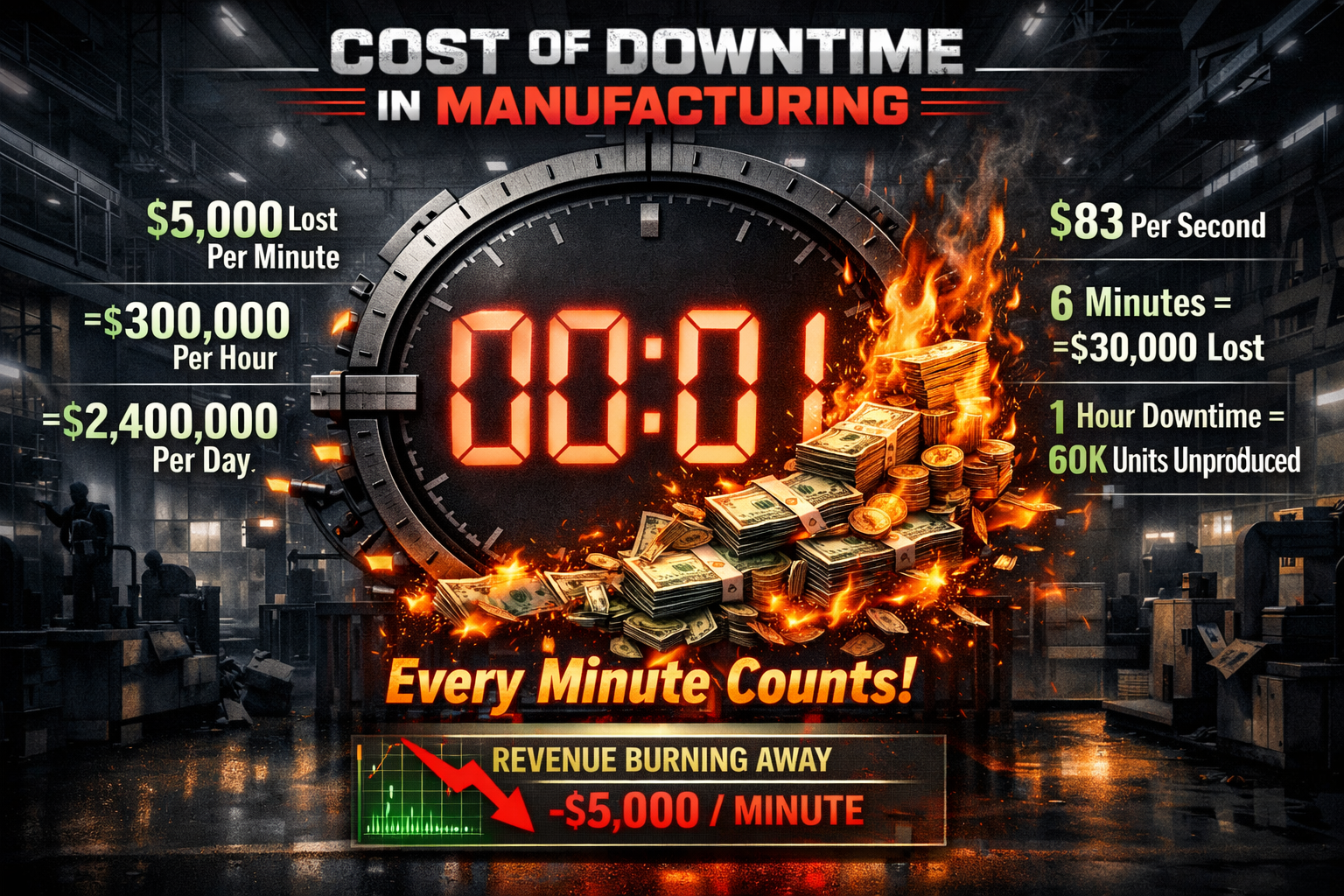
Let’s talk real numbers for a moment. According to recent industry data, the average manufacturing facility loses $50,000 per hour during unplanned downtime. For smaller operations (20-50 employees), that number might be closer to $10,000-$15,000 per hour. For larger facilities, it can skyrocket to $100,000 or more.
But here’s the breakdown that really opens eyes:
Direct Costs:
- Lost production revenue
- Idle labor costs (you’re still paying workers who can’t work)
- Overtime to catch up on missed production
- Rush shipping to meet delayed deadlines
Hidden Costs:
- Customer dissatisfaction and potential lost business
- Regulatory compliance issues if you miss the required reporting
- Inventory spoilage (especially in food manufacturing)
- Equipment damage from improper shutdowns
One of our clients, a mid-sized automotive parts manufacturer, experienced a network failure that lasted just 4 hours. The direct cost? $32,000 in lost production. The hidden cost? They nearly lost their largest customer due to a missed delivery deadline.
Why IT Issues Hit Manufacturing Harder Than Other Industries
Manufacturing is unique. Unlike a law firm that might lose some billable hours or a retail store that can extend operating hours, manufacturing operates on tight schedules with little room for error.
Your production planning software needs to communicate with inventory management systems. Quality control data must flow seamlessly to reporting tools. Equipment monitoring requires constant network connectivity. When any piece of this IT puzzle fails, the entire operation can grind to a halt.
The domino effect is swift and expensive:
- Production systems go offline
- Workers can’t access work orders or quality specifications
- Automated equipment stops or produces defective parts
- Quality control can’t verify that products meet standards
- Shipping delays cascade to multiple customers
When Minutes Mean Money: Understanding the True Impact on Your Bottom Line

Let me share a story that perfectly illustrates how quickly costs can spiral. Last year, we received an emergency call from a food processing plant. Their main server had crashed at 6 AM, right as the morning shift was starting their largest production run of the week.
The timeline looked like this:– 6:00 AM: Server crash detected
- 6:15 AM: Production line stops (workers can’t access recipes or quality specs)
- 7:30 AM: Management realizes the full scope of the problem
- 8:00 AM: Emergency IT call placed
- 11:30 AM: Systems restored and production resumes
That 5.5-hour outage cost them $67,000 in direct losses. But the real kicker? They had to throw away $15,000 worth of partially processed food that couldn’t be completed properly without the quality control systems.
The Compounding Effect of Downtime
Here’s what makes manufacturing downtime particularly brutal: the costs compound quickly. It’s not just about the immediate lost production. Consider these ripple effects:
Hour 1-2: Direct production losses, idle labor costs
Hour 3-4: Customer notifications required, overtime planning begins
Hour 5-8: Potential raw material spoilage, expedited shipping arrangements
Day 2+: Customer relationship damage, potential contract penalties
One client told me, “We can handle a 30-minute outage. We can even manage an hour. But once we hit two hours, we’re looking at weeks of recovery time with our customers.”
Industry-Specific Vulnerabilities
Different types of manufacturing face unique IT-related risks:
Food Processing:
- Temperature monitoring systems must stay online
- Traceability requirements demand constant data logging
- HACCP compliance depends on real-time documentation
Automotive Parts:
- Just-in-time delivery schedules allow zero buffer time
- Quality certifications require continuous data capture
- Customer portals need 24/7 availability for order updates
Electronics Manufacturing:
- Clean room environmental controls rely on network connectivity
- Component tracking requires seamless barcode scanning
- Testing equipment generates massive data files that need immediate processing
Each industry has its pressure points, but they all share one common thread – when IT fails, production stops.
How Proactive IT Support Prevents Costly Manufacturing Downtime
After seeing too many manufacturers suffer through preventable outages, I’ve learned that the best approach isn’t fixing problems faster; it’s preventing them altogether.
Proactive IT support transforms your technology from a liability into a competitive advantage.
24/7 Monitoring: Your Digital Early Warning System
Think of proactive monitoring like having a security guard who never sleeps, never takes breaks, and can spot trouble before it happens. Our monitoring systems watch hundreds of performance indicators across your network:
- Server performance and capacity
- Network traffic and bottlenecks
- Hard drive health and storage space
- Application response times
- Security threats and unusual activity
Last month, our monitoring detected that a client’s main production server was showing early signs of hard drive failure. We scheduled a replacement during their planned maintenance window. Total downtime: Zero. Without monitoring, that drive would have failed during peak production, costing them an estimated $45,000.
Network Redundancy: Building Your Safety Net
Here’s a question I ask every manufacturing client: “What happens if your internet goes down right now?” The answer is usually uncomfortable silence.
Smart manufacturers build redundancy into their networks:
Primary Internet Connection: High-speed fiber for normal operations
Secondary Connection: Cable or DSL backup that automatically activates
Cellular Backup: 4G/5G connection for critical systems during total outages
Local Backup Systems: On-site servers that can operate independently
One of our automotive clients learned this lesson the hard way. A construction crew accidentally cut their fiber line on a busy Friday. Thanks to automatic failover to their backup connection, production continued without interruption. Their competitor down the street? They lost an entire day of production.
Preventive Maintenance: Fixing Problems Before They Happen
We schedule regular maintenance during your planned downtime – not during your busiest production hours.
This proactive approach includes:
- Software updates and security patches
- Hardware health checks and cleaning
- Performance optimization and tuning
- Backup testing and verification
- Security assessments and improvements
The goal is simple: Handle maintenance on your schedule, not when systems force you to.
Industry Expertise Makes the Difference
Generic IT support doesn’t understand manufacturing. They don’t know that you can’t just “restart the server” in the middle of a production run. They don’t understand that your quality control system needs to maintain data integrity for regulatory compliance.
Our manufacturing-focused approach means we understand:
- Production schedules and critical timing
- Regulatory requirements and compliance needs
- Integration challenges between different systems
- The true cost of downtime in your specific industry
When you call with an emergency, we don’t just hear “the computer is broken.” We understand “production line 2 can’t access the quality specifications for the Johnson order that ships tomorrow.”
Real-World Success Stories: How IT Support Saves Manufacturing Money

Let me tell you about three clients who transformed their operations by taking a proactive approach to IT support. These aren’t theoretical examples – these are real companies that went from constant IT headaches to smooth, reliable operations.
Case Study 1: The Automotive Parts Manufacturer
The Challenge: A 75-employee automotive parts manufacturer was experiencing 2-3 system outages per month, each lasting 2-4 hours. Their just-in-time delivery commitments meant even short outages created major customer service issues.
The Solution: We implemented comprehensive monitoring, network redundancy, and scheduled preventive maintenance during their Sunday shutdown periods.
The Results:– Unplanned downtime reduced by 89% (from 8-12 hours per month to less than 1 hour)
- Customer complaints dropped to zero related to delivery delays
- Saved approximately $180,000 annually in downtime costs
- Improved employee morale as workers no longer faced constant system frustrations
The plant manager told us, “For the first time in years, I don’t dread Monday mornings wondering what broke over the weekend.”
Case Study 2: The Food Processing Plant
The Challenge: A food processing facility was experiencing frequent failures in its temperature monitoring system, which threatened product safety and regulatory compliance. Manual workarounds were costing 3-4 hours of labor daily.
The Solution: We designed a redundant monitoring system with backup sensors and automatic alerts, plus integrated their quality management software for seamless reporting.
The Results:– 100% uptime on critical temperature monitoring for 18 months running
- Eliminated manual data entry, saving 20+ hours per week
- Passed their FDA inspection with zero IT-related findings
- Reduced insurance costs due to improved safety systems
The quality manager said, “We went from constantly worrying about compliance to having complete confidence in our systems.”
Case Study 3: The Electronics Manufacturer
The Challenge: A circuit board manufacturer was losing $25,000 per hour when their pick-and-place machines couldn’t communicate with the inventory management system. This happened 1-2 times per month.
The Solution: We rebuilt their network infrastructure with dedicated VLANs for production equipment, implemented real-time monitoring, and created automated backup procedures.
The Results:– Zero production-stopping network failures in the past 14 months
- Improved production efficiency by 12% due to better system integration
- Eliminated weekend emergency calls that were costing $2,000+ each
- Enabled remote monitoring capabilities for better production planning
The operations director noted, “Our production planning is now based on customer demand, not IT reliability concerns.”
The Common Thread:
Peace of Mind.
What strikes me about these success stories isn’t just the cost savings – though those are significant. It’s the peace of mind these manufacturers gained. They shifted from reactive crisis management to proactive business growth.
Before: “Will our systems work today?”
After: “How can we optimize our systems to work even better?”
That’s the transformation that happens when you partner with IT professionals who understand manufacturing.
Building Your Manufacturing IT Defense Strategy
Now that you understand the costs and see the possibilities, let’s talk about building a defense strategy that protects your operation.
Think of this as insurance for your production schedule. You hope you’ll never need it, but you’ll be grateful it’s there when you do.
The Four Pillars of Manufacturing IT Resilience
Pillar 1: Comprehensive Monitoring. Your systems should be watched 24/7, even when your facility is closed. Monitoring catches problems early, often before they impact production.
Key components:
- Server performance tracking
- Network traffic analysis
- Application response monitoring
- Security threat detection
- Environmental monitoring (temperature, humidity, power)
Pillar 2: Redundant Systems. Single points of failure are production killers. Smart manufacturers build backup systems for everything critical.
Essential redundancies:
- Multiple internet connections
- Backup power systems
- Redundant servers for critical applications
- Secondary network paths
- Offsite data backups
Pillar 3: Proactive Maintenance. Regular maintenance prevents emergency repairs. Schedule updates and improvements during planned downtime, not during production crises.
Maintenance schedule should include:
- Monthly security updates
- Quarterly performance optimization
- Semi-annual hardware health checks
- Annual system upgrades and replacements
Pillar 4: Expert Support When problems do occur, you need support from people who understand manufacturing. Generic help desk support doesn’t cut it when production is on the line.
Look for support that offers:
- Same-day response for critical issues
- Manufacturing industry experience
- Understanding of production schedules
- Proactive problem-solving approach
Calculating Your IT Investment ROI
Here’s a simple way to think about IT investment: What does one hour of downtime cost your operation?
Let’s say your answer is $15,000 per hour. If proactive IT support prevents just one 4-hour outage per year, that’s $60,000 in saved costs. Most comprehensive IT support programs cost a fraction of that amount.
ROI calculation example:
- Annual IT support cost: $18,000
- Prevented downtime: 6 hours
- Downtime cost per hour: $15,000
- Total savings: $90,000
- ROI: 400%### Questions to Ask Potential IT Partners
Not all IT support is created equal. When evaluating potential partners, ask these manufacturing-specific questions:
“How quickly can you respond to production-stopping emergencies?” Look for same-day response guarantees, not “we’ll get to it this week.”
“Do you have experience with manufacturing environments?” Generic IT knowledge isn’t enough. You need someone who understands production schedules and regulatory requirements.
“What monitoring tools do you use, and how do they prevent problems?” Reactive support fixes problems after they happen. Proactive support prevents them.
“How do you handle after-hours emergencies?” Manufacturing doesn’t stop at 5 PM. Your IT support shouldn’t either.
“Can you provide references from other manufacturing clients?” Talk to other manufacturers about their experience. Real-world feedback is invaluable.
Your Next Steps: From Reactive to Proactive Manufacturing IT
We’ve covered a lot of ground together. You now understand the true cost of downtime, you’ve seen how other manufacturers have solved these challenges, and you know what to look for in an IT partner.
The question isn’t whether you can afford to invest in proactive IT support – it’s whether you can afford not to.
The Choice Every Manufacturing Leader Faces Right now, you’re at a crossroads. You can continue managing IT reactively, hoping nothing major breaks during your busiest production periods. Or you can take control, implementing the kind of proactive IT strategy that gives you peace of mind and protects your bottom line.
The reactive approach means:
- Crossing your fingers every Monday morning
- Explaining delays to frustrated customers
- Paying emergency rates for crisis repairs
- Losing sleep over what might break next
The proactive approach means:
- Confident production planning
- Reliable delivery schedules
- Predictable IT costs
- Focus on growing your business, not fixing technology
Taking Action: Your 30-Day
IT Health Check
Here’s what I recommend as your first step: Conduct a 30-day IT health assessment. You don’t need to overhaul everything immediately, but you need to understand your current vulnerabilities.
Week 1: Document Your Current State
- List all critical systems and their backup status
- Identify single points of failure
- Calculate your actual downtime costs using our calculator above
- Review your current IT support response times
Week 2: Assess Your Risks
- When was your last major system failure?
- How long would it take to recover from a server crash?
- Do you have adequate internet redundancy?
- Are your backups tested and verified?
Week 3: Research Solutions
- Get quotes from manufacturing-focused IT providers
- Ask for references from similar companies
- Understand the difference between reactive and proactive support
- Calculate potential ROI based on your downtime costs
Week 4: Make Your Decision
- Compare the cost of proactive support vs. your current downtime losses
- Consider the peace of mind factor for you and your team
- Choose a partner who understands manufacturing schedules and pressures
Red Flags That Demand Immediate Action
Some situations can’t wait for a 30-day assessment. If any of these apply to your operation, you need to address IT vulnerabilities immediately:
You’ve had more than one production-stopping IT failure in the past 6 months
Your current IT support takes more than 4 hours to respond to emergencies
You don’t have redundant internet connections
Your last backup test was more than 3 months ago
You’re running critical software on hardware more than 5 years old
The Investment That Pays for Itself
Remember our earlier ROI calculation? Most manufacturing companies find that comprehensive IT support pays for itself by preventing just 1-2 major outages per year.
Everything beyond that is pure profit protection.
Think about it this way: Would you operate your facility without insurance? Of course not. Proactive IT support is insurance for your production schedule. It protects against the unexpected and gives you the confidence to focus on what you do best, manufacturing quality products on time.
Conclusion: When Minutes Mean Money, Every Second Counts
When minutes mean money: the real cost of downtime in manufacturing (and how IT support prevents it) isn’t just about technology – it’s about protecting your livelihood, your employees’ jobs, and your customers’ trust. The manufacturers who thrive in 2026 and beyond will be those who recognize that reliable IT isn’t a luxury – it’s a necessity.
The choice is yours. You can continue playing IT roulette, hoping nothing breaks during your next big production run. Or you can partner with experienced professionals who understand that in manufacturing, uptime isn’t just a metric – it’s everything.
Your production schedule is too important to leave to chance. Your customers are too valuable to disappoint with delayed deliveries. Your peace of mind is too precious to sacrifice to IT uncertainty.
The manufacturers who succeed don’t just make great products – they make them reliably, on schedule, every time. That reliability starts with rock-solid IT infrastructure and the proactive solutions that keep everything running smoothly.
Take the first step today. Calculate your downtime costs, assess your risks, and discover how the right IT partner can transform your operation from reactive crisis management to proactive business growth.
Because when minutes mean money, you can’t afford to waste either.